Commercial Disclosure: The HiMAXBATT Editorial Team brings together expertise in lithium battery manufacturing, battery engineering, power systems, and global application support to provide practical, technically informed content for businesses and industry professionals. Our content covers lithium-ion and LiFePO4 batteries, custom battery packs, BMS technology, charging solutions, battery selection, energy storage, industrial applications, product updates, and HiMAXBATT news. All content reflects HiMAXBATT’s official editorial perspective and our commitment to delivering safe, reliable, and application-focused lithium battery solutions to customers worldwide.
Key Takeaways
- When selecting a backup battery for emergency medical equipment, confirm the voltage, capacity, output power, connector, and communication protocol rather than looking at battery capacity alone.
- To estimate runtime, first convert battery capacity to watt-hours (Wh), then account for the device’s actual power consumption, conversion losses, ambient temperature, and battery aging.
- Patient monitors, portable ventilators, infusion devices, and AEDs have different power requirements, so battery selection should be based on the specific device model and use case.
- The battery management system (BMS), cell consistency, interconnect design, and system-level compatibility testing can all affect power reliability.
- Battery safety testing, transportation testing, and complete medical device validation serve different purposes and should not be treated as interchangeable.
- Once a backup battery is placed into service, a maintenance program should cover charging, routine inspections, capacity verification, and replacement records.
Introduction
Emergency medical equipment may need to rely on backup batteries to remain operational during patient transport, prehospital care, or power outages. For procurement teams and device development engineers, choosing a backup battery involves more than determining how many milliamp-hours are needed. The battery must also be able to deliver continuous, stable, and validated power under the specified operating conditions.
From a battery manufacturing perspective, a sound selection process should cover requirements definition, cell selection, battery pack design, protection strategies, and system-level testing. The following sections explain how to choose a backup battery for medical equipment, with a focus on capacity, runtime, and safety.
- Define the Device Requirements Before Selecting a Backup Battery
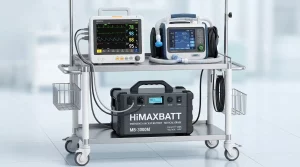
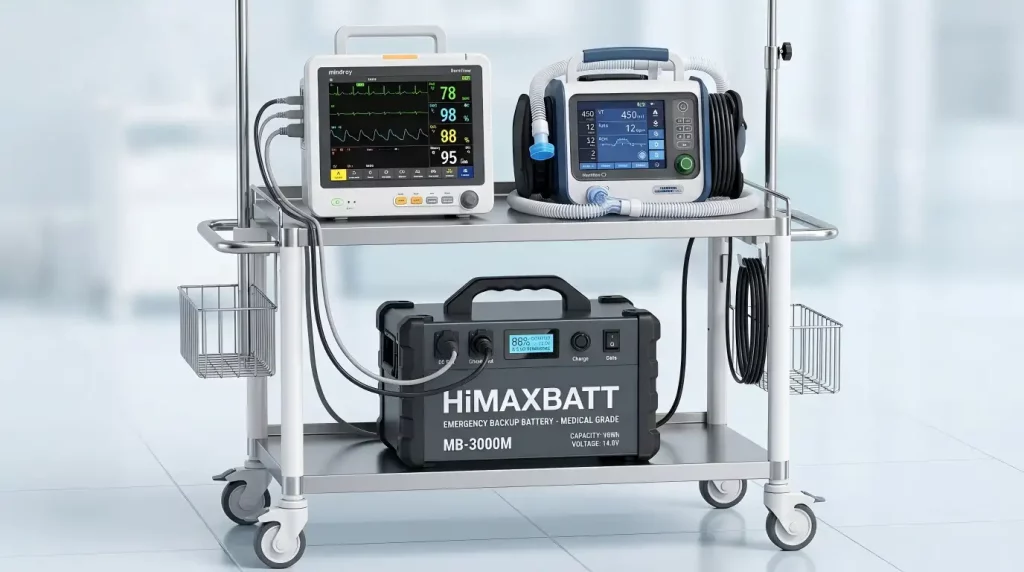
Different types of emergency medical equipment have different load profiles. Power consumption can also change when different functions are enabled on the same device. Before selecting a battery, confirm the device model, operating mode, required mission duration, and backup power configuration.
| Device Type | Power Characteristics | Key Backup Battery Considerations |
| Transport patient monitor | Displays, monitoring modules, and communication functions can affect power consumption | Runtime under representative operating modes, battery level indication, and low-battery alarms |
| Portable ventilator | Power consumption varies with device design, operating settings, and accessories | Continuous power capability, dynamic load response, and power source switching |
| Infusion and syringe pumps | May require extended periods of continuous operation | Usable capacity after aging, alarm response, and maintenance intervals |
| Defibrillator | Monitoring, standby, and capacitor charging have different load requirements | Peak power capability, charging time, and number of discharges under specified conditions |
| AED | May involve long-term standby, periodic self-tests, and emergency use | Battery type, installed standby life, and replacement requirements |
One important distinction is that primary lithium batteries and rechargeable lithium-ion batteries are not the same. Some AEDs use non-rechargeable batteries, so standard rechargeable-battery maintenance practices do not apply. Batteries should also not be substituted simply because they have a similar shape and voltage. Reference: FDA information on AED replacement batteries
For equipment already in service, follow the device manufacturer’s specified battery model and replacement procedure. For new device development projects, the medical device manufacturer and battery supplier should define the technical requirements together before proceeding with a custom battery design.
- How Do You Calculate Backup Battery Capacity for Medical Equipment?
Compare Batteries with Different Voltages Using Wh
Milliamp-hours (mAh) and amp-hours (Ah) measure charge capacity, while watt-hours (Wh) measure energy. When estimating how long a battery can power a device, Wh provides a more useful basis for comparison.
Nominal Energy (Wh) ≈ Nominal Voltage (V) × Rated Capacity (Ah)
Where 1,000 mAh = 1 Ah.
| Nominal Battery Voltage | Rated Capacity | Nominal Energy |
| 7.4 V | 5000 mAh, or 5 Ah | 37 Wh |
| 14.8 V | 5000 mAh, or 5 Ah | 74 Wh |
Both batteries are rated at 5000 mAh, but their nominal energy is different. Keep in mind that a higher energy rating does not mean one battery can replace another. The voltage range, charging parameters, connector, and other requirements must still be compatible.
Estimate Capacity Based on Power Consumption and Required Runtime
For devices with relatively stable power consumption, the following formula can be used for an initial estimate:
Required Nominal Energy ≈ Average Power Consumption × Target Runtime ÷ (Power Delivery Efficiency × Usable Energy Factor)
The parameters can be defined as follows:
| Parameter | Meaning | Recommended Data Source |
| Average power consumption | Average input power under the intended operating mode | Device technical documentation or actual measurements |
| Target runtime | Required operating time plus an evaluated time margin | Transport procedures, use case, and risk assessment |
| Power delivery efficiency | Efficiency of the power path between the battery and device | Power conversion and wiring tests |
| Usable energy factor | Usable proportion after accounting for temperature, aging, cutoff conditions, and reserve capacity | Battery and system-level validation data |
Suppose a device has an average power consumption of 20 W and needs to operate for 3 hours. If power delivery efficiency is estimated at 90% and the usable energy factor at 80%:
Required Nominal Energy ≈ 20 × 3 ÷ (0.90 × 0.80) ≈ 83.3 Wh
If the design uses a battery pack with a nominal voltage of 14.8 V, the required capacity would be approximately:
83.3 ÷ 14.8 ≈ 5.63 Ah
This example is intended to illustrate the calculation method. The 90% and 80% values are not fixed assumptions that apply to every medical device. Actual projects should use parameters supported by test results. The measurement point for power consumption should also be clearly defined to avoid counting conversion losses twice.
For devices with significantly varying loads, calculate the energy demand for each operating phase separately and then combine the results for the overall assessment.
- Why Is Actual Battery Runtime Often Shorter Than the Theoretical Runtime?
A battery’s rated capacity is measured under specified conditions, while temperature, load, and battery condition in emergency medical applications may differ. The following factors are among the main reasons actual medical equipment battery runtime can be shorter than expected.

Ambient Temperature
Low temperatures can increase battery internal resistance and cause voltage to drop under load, potentially causing the device to reach its shutdown threshold sooner. High temperatures can accelerate battery aging and increase thermal management demands.
The permitted charging and discharging temperature ranges may also be different. Both should be reviewed separately rather than relying on a single general “operating temperature” specification.
Battery Aging
As a battery undergoes storage and charge-discharge cycles, its capacity may decrease and its internal resistance may increase. Even when the battery indicator shows a full charge, an aged battery may provide less operating time than a new one.
Backup battery runtime evaluations should therefore not be limited to new batteries. Performance should also be validated as the battery approaches its specified replacement criteria.
Operating Modes and Accessories
Display settings, monitoring modules, wireless communications, and external accessories can all affect device power consumption. Runtime data should specify the test configuration so that users can determine whether the results reflect the intended operating conditions.
Device Cutoff Voltage
A device may shut down while some energy remains in the battery in order to maintain required operating performance. As a result, the capacity measured during cell testing may not be fully usable by the complete device.
Runtime used for mission planning should be based on system-level test results under specified conditions.
- What Else Should You Check Besides Battery Capacity?
Voltage Range and Charging Method
Nominal voltage is only one reference point. A complete evaluation should also cover the fully charged voltage, discharge cutoff voltage, and charging control method.
Different cell chemistries or series configurations may require different operating parameters. Changing the battery chemistry without validation can affect charging compatibility, state-of-charge estimation, and protection behavior.
Continuous and Peak Current
A battery must not only store enough energy but also deliver sufficient power when the device requires it.
Device startup, actuator operation, or defibrillator capacitor charging may create short periods of higher load. If the cells, interconnects, protection components, or connectors cannot handle the required current, voltage drop, excessive temperature rise, or protection-triggered shutdown may occur even when the battery has sufficient capacity.
Connectors and Communication Protocols
Medical equipment battery connectors may include pins for temperature sensing, identification, and communication. A physically identical connector does not necessarily mean that the pinout or communication protocol is compatible.
For smart batteries, the state-of-charge display, alarm thresholds, and device response should also be validated together to prevent inconsistencies between battery data and device-level decisions.
Battery Replacement and Power Source Switching
Whether a device supports battery replacement while operating should be confirmed in the device documentation and through design validation. A removable battery does not automatically mean that the device supports hot swapping.
For equipment that must operate continuously, external power switching, dual-battery management, or other validated power configurations may need to be evaluated. The design should also confirm whether device functionality is affected during the transition between power sources.
- How Should Lithium Battery Safety Be Evaluated for Medical Equipment?
Review the BMS Protection Design
A battery management system typically monitors voltage, current, and temperature and may provide overcharge, over-discharge, overcurrent, and other protection functions, depending on the product design.

Protection parameters need to be coordinated with the device load. If thresholds are set incorrectly, a normal startup load may trigger a shutdown. Conversely, simply relaxing protection thresholds to prevent shutdowns can increase battery-related risks. Protection behavior and device response should therefore be evaluated at the system level.
Consider Manufacturing Consistency and Traceability
Battery pack performance can also be affected by cell consistency, welding quality, insulation design, connection reliability, and assembly processes.
During procurement, buyers can request specifications, lot identification, outgoing inspection records, and change-control information that correspond to the delivered product. If the cell model, protection board, or other critical materials change, the need for additional validation should be evaluated.
Understand the Purpose of Different Test Documents
| Standard or Documentation | Primary Purpose | Limitations |
| IEC 62133-2 documentation | Evaluates the safety of applicable portable sealed secondary lithium cells and batteries | Does not replace complete medical device validation |
| IEC 60601-1 and applicable collateral/particular standard documentation | Evaluates the basic safety and essential performance of medical electrical equipment | Applicable requirements depend on device type, standard edition, and target market |
| UN 38.3 testing and test summary | Supports compliance checks related to lithium battery transportation | Does not demonstrate suitability for a specific medical device |
| System-level compatibility test report | Verifies runtime, load response, alarms, and power source switching | Test configuration should correspond to the intended application |
For additional information, refer to the IEC 62133-2 standard overview, the IEC 60601-1 standard overview, and PHMSA guidance on lithium battery test summaries. Applicable requirements for a specific project should be determined based on the device classification and target market.
- How Should Backup Batteries Be Maintained and Replaced?
Backup battery management should cover receiving, charging, routine inspections, capacity verification, and retirement from service.

| Management Item | Recommended Records or Checks |
| Battery records | Model, lot number, date placed into service, and compatible equipment |
| Visual inspection | Swelling, physical damage, connector corrosion, or looseness |
| Charging check | Normal charging behavior, abnormal temperature rise, or alarms |
| Capacity verification | Runtime or capacity checks according to device maintenance requirements |
| Usage records | Unexpected shutdowns, reduced runtime, and repair history |
| Replacement management | Replacement based on manufacturer requirements, test results, and device alarms |
When charging, use the accessories specified by the device manufacturer and follow the applicable environmental and temperature requirements. FDA guidance on medical device charging also emphasizes following manufacturer instructions and inspecting the device and charging accessories for damage. Reference: FDA tips for charging medical devices safely
Long-term storage and ready-for-use standby are different operating scenarios, so a single storage state of charge or recharge interval should not automatically be applied to both. The number of backup batteries required should also be determined based on mission duration, charging turnaround time, and the battery replacement method.
- Frequently Asked Questions
Is a Higher-Capacity Battery Always Better for Emergency Medical Equipment?
Not necessarily. Increasing battery capacity may also change the battery’s dimensions, weight, charging time, and thermal management requirements. Device compatibility may need to be reassessed. The appropriate solution is one that has been properly matched and validated to meet the required mission duration.
How Many Hours Can a Patient Monitor Run on a Backup Battery?
It depends on the specific model, operating settings, battery condition, and environmental conditions. An initial estimate can be made by dividing usable battery energy by average power consumption, but system-level testing should be used for confirmation. When referring to published runtime data, the associated test conditions should also be reviewed.
Can a Portable Ventilator Be Powered by a Regular Power Bank?
Only if the device manufacturer explicitly supports that power source and the voltage, power output, connector, and relevant validation requirements are satisfied. The fact that a connector physically fits is not sufficient to establish compatibility.
Can an AED Battery Be Recharged?
It depends on the battery type specified for the AED. Non-rechargeable primary batteries must not be recharged. Rechargeable models must also be charged using the specified method. Replacement intervals and post-use requirements should follow the instructions for the specific device.
Can a Battery That Has Passed UN 38.3 Testing Be Used Directly in Medical Equipment?
UN 38.3 compliance alone does not establish suitability for medical equipment. UN 38.3 addresses transportation-related testing. Medical applications also require evaluation of electrical compatibility, output capability, protection strategy, and system-level safety and performance.
How Often Should a Backup Battery Be Replaced?
There is no single replacement interval that applies to every device. Replacement decisions should consider the manufacturer’s requirements, calendar aging, cycle history, capacity test results, and device alarms. Limited use does not necessarily mean that the battery’s condition has remained unchanged.
What Information Is Needed for a Custom Medical Device Battery?
Recommended information includes the operating voltage range, average and peak power consumption, target runtime, available installation space, connector pinout, communication protocol, charging conditions, environmental range, and intended sales markets. These details allow the battery supplier to evaluate the design and develop an appropriate validation plan.
About HiMAXBATT Batteries
HiMAXBATT is a battery brand of Shenzhen Himax Electronics Co., Ltd., providing custom lithium-ion, LiFePO4, lithium-polymer, and NiMH battery products for applications including medical equipment. Learn more about HiMAXBATT
If you are developing emergency medical equipment or evaluating a backup battery solution, you can submit your project requirements to HiMAXBATT. Clearly defining device power consumption, target runtime, installation space, and connector requirements provides a sound basis for battery selection and subsequent validation. Specific product parameters, test documentation, and device suitability should be based on mutually confirmed technical specifications and validation results.