Commercial Disclosure: The HiMAXBATT Editorial Team brings together expertise in lithium battery manufacturing, battery engineering, power systems, and global application support to provide practical, technically informed content for businesses and industry professionals. Our content covers lithium-ion and LiFePO4 batteries, custom battery packs, BMS technology, charging solutions, battery selection, industrial applications, product updates, and HiMAXBATT news. All content reflects HiMAXBATT’s official editorial perspective and our commitment to delivering safe, reliable, and application-focused lithium battery solutions to customers worldwide.
Key Takeaways
- Selecting a 48V lithium battery requires meeting voltage, current, and energy requirements at the same time: voltage determines equipment compatibility, current determines load-handling capability, and usable energy determines runtime.
- Average load is used to estimate energy consumption, sustained high loads are used to evaluate temperature rise, and startup or operating peaks are used to verify the short-term current capability of the cells, BMS, and electrical connections.
- “48V” is only a starting point for system selection and does not mean different batteries are directly interchangeable. Actual nominal voltage, fully charged voltage, and operating voltage range still need to be verified individually.
- AGVs, forklifts, floor scrubbers, and aerial work platforms have different duty cycles, so a fixed battery capacity should not be selected based on equipment type alone.
- Battery capacity calculations should account for the usable energy window, temperature, ageing, and charging schedule, followed by validation under representative operating conditions.
Introduction
When selecting a 48V lithium battery for industrial equipment, a common purchasing question is: “Do we need 100Ah or 200Ah?” But capacity is only one part of battery selection.
A battery may store enough energy yet still trigger protection because the startup current exceeds its design limits. Another battery may have no trouble powering the equipment but still fail to provide enough energy for an entire shift. A more appropriate selection process is therefore to confirm the voltage range, collect load data, calculate current and energy consumption, and then determine the required battery capacity and system configuration.
The following analysis applies to equipment using 48V-class power systems. AGVs, forklifts, floor scrubbers, and aerial work platforms are also available with other system voltages, so the specifications of the actual equipment should always be used.
Start by Determining What “48V” Actually Means for the Operating Voltage Range
A device labeled 48V does not mean the battery always outputs exactly 48V during operation. Battery terminal voltage changes with state of charge, load, temperature, and ageing.
Using LiFePO4 batteries with nominal 3.2V cells as an example:
| Series Configuration | Calculated Nominal Voltage | Pack Voltage if the Cell Charge Limit Is Set to 3.65V |
| 15S | 48.0V | 54.75V |
| 16S | 51.2V | 58.4V |
The charging voltages shown in the table are provided only to illustrate the relationship between cells connected in series. They are not universal charging settings. Actual settings should follow the design requirements of the cells, battery pack, and equipment.
When selecting a 48V lithium battery, verify that the controller, motor drive, DC/DC converter, charger, and other electrical components are compatible with the battery’s complete operating voltage range. Voltage sag under heavy loads and at a low state of charge should also be considered to prevent premature undervoltage warnings or equipment shutdowns.
What Should You Measure Under Real-World Loads?
Motor nameplate power alone rarely provides a complete picture of the equipment’s battery requirements. The nameplate may indicate mechanical output power, while the battery also has to supply drivetrain losses and auxiliary loads.
Whenever possible, record voltage and current at the battery’s DC output and include representative operating conditions such as no-load operation, rated load, starts and stops, steering, climbing, and equipment-specific working functions.
| Load Parameter | Role in Battery Selection | What to Measure |
| Average power | Estimates energy consumption over a task or shift | Include working, waiting, and standby periods |
| Sustained high-load current | Verifies continuous discharge capability and temperature rise | Record both current and duration |
| Peak current | Verifies startup and transient load capability | Record peak value, duration, and repetition frequency |
| Operating voltage | Evaluates performance under load at low SOC | Monitor voltage sag under load |
| Regenerative current | Evaluates compatibility with energy recovery | Applicable only to equipment with regenerative capability |
| Operating temperature | Determines whether capacity or power derating is required | Measure actual battery-compartment temperature |
| Charging window | Determines whether runtime and recharging are properly balanced | Record available charging time and conditions |
The sampling rate should be fast enough to capture the transients being evaluated. If the recording interval is too long, short startup peaks may be hidden by averaged data.
If measured data is not available, the equipment manufacturer’s load profiles and electrical specifications can be used for preliminary design, followed by prototype testing to refine the battery configuration.
How Do You Calculate the Discharge Current for a 48V Lithium Battery Based on Power?
Distinguish Electrical Input Power From Mechanical Output Power
If the DC input power at the battery is known:
Battery Current (A) ≈ Input Power (W) ÷ Battery Terminal Voltage at That Time (V)
If only the motor’s mechanical output power is known, motor and drive-system efficiency must also be considered, along with auxiliary loads:
Battery-Side Power ≈ Mechanical Output Power ÷ Overall Efficiency + Auxiliary Power Consumption
These two calculation methods should not be mixed. If battery-side power has already been measured, motor and drive efficiency should not be deducted again.
Don’t Calculate Current Using Nominal Voltage Alone
Suppose a piece of equipment requires 4,000W of battery-side power during a sustained operating period:
- At a battery terminal voltage of 51.2V, current is approximately 78A.
- If battery terminal voltage drops to 44.8V, current increases to approximately 89A.
This is an example based on an approximately constant-power load. In actual equipment, the controller may use current limiting, power derating, or other control strategies, so the equipment’s control logic should also be considered.
This demonstrates why continuous battery discharge capability should not be determined solely from the calculated current at nominal voltage. The allowable operating voltage range, ambient temperature, and thermal conditions should also be evaluated.
Peak Current Must Always Be Considered Together With Duration
A specification such as “200A peak” is not enough by itself for battery selection. A 0.5-second peak, a 10-second peak, and a peak repeated every minute place very different demands on the battery system.
The manufacturer should evaluate the cells, BMS power components or contactors, busbars, wiring harnesses, connectors, and protection devices together rather than simply choosing a BMS with a higher current rating.
Discharge rate should also be considered together with battery capacity. For example, a 100Ah battery discharging at 100A is operating at 1C, but this calculation alone does not mean that every 100Ah battery can continuously deliver 100A.
How Do You Calculate the Capacity of a 48V Lithium Battery?
Battery capacity calculations should begin with the energy required for a complete duty cycle.
Task Energy Consumption (Wh) = Sum of Average Power (W) × Corresponding Operating Time (h) for Each Operating Stage
The following hypothetical AGV shift provides an example. All power values represent power measured at the battery output:
| Operating Stage | Assumed Average Power | Cumulative Time | Energy Consumption |
| Loaded travel | 1,200W | 3 hours | 3,600Wh |
| Unloaded return | 700W | 2 hours | 1,400Wh |
| Waiting and communications | 100W | 3 hours | 300Wh |
| Total | — | 8 hours | 5,300Wh |
If opportunity charging during the shift is not considered, an initial estimate can be calculated using:
Rated Capacity (Ah) ≈ Task Energy Consumption ÷ [Nominal Voltage × Usable Energy Ratio × Temperature Correction Factor × Target End-of-Life Capacity Retention Factor]
Assume:
- Nominal voltage: 51.2V
- Usable energy ratio: 80%
- Temperature correction factor: 0.95
- Target end-of-life capacity retention factor: 0.80
The result is:
5,300 ÷ (51.2 × 0.80 × 0.95 × 0.80) ≈ 170Ah
This result is a capacity estimate based on the specific assumptions above, not a universal AGV battery configuration. Temperature correction and capacity-retention factors should be supported by product data, and care should be taken to avoid applying the same derating factor more than once.
The next step is to verify whether the candidate battery can meet peak-current requirements, installation-space constraints, charging-speed requirements, and variations in the duty cycle. Meeting the calculated capacity requirement does not mean battery selection is complete.
Battery manufacturers’ technical data also show that temperature, discharge rate, and depth of discharge can affect capacity, heat generation, and service-life performance. Specific values should always be verified for the battery model being considered.
Battery Selection Priorities for AGVs, Forklifts, Floor Scrubbers, and Aerial Work Platforms
| Application | Typical Load Characteristics | Battery Selection Priorities |
| AGV | Alternating travel, steering, starts/stops, and standby periods | Task energy consumption, short-duration peaks, SOC estimation, and automatic charging communication |
| Forklift | Alternating travel and lifting, with some functions potentially operating simultaneously | Discharge capability, regenerative compatibility, counterweight requirements, and mechanical retention |
| Floor scrubber | Combined operation of brush, vacuum, and drive systems | Continuous load, cleaning runtime, temperature rise, and environmental protection |
| Aerial work platform | Intermittent travel and lifting operations | Hydraulic pump startup load, low-SOC operating capability, and coordination with machine protection |
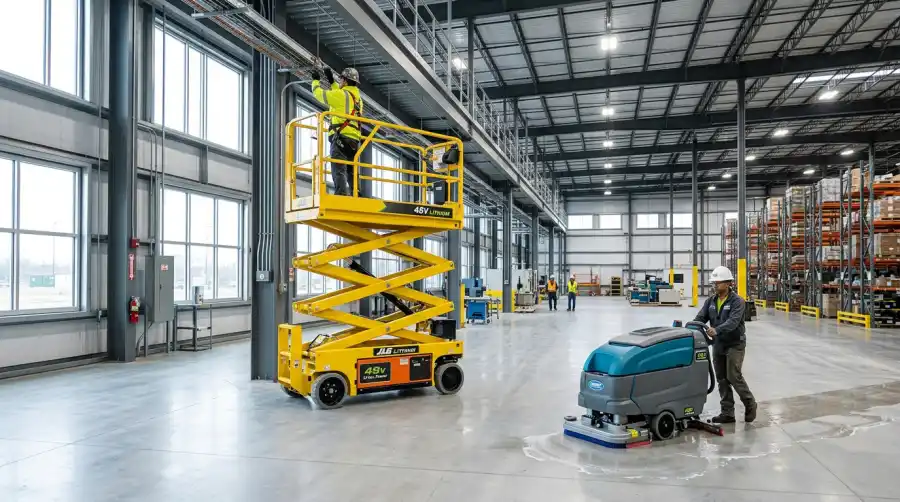
AGV Lithium Batteries: Focus on Completing the Duty Cycle and Charging Schedule
AGV battery requirements depend on payload, route gradient, rolling resistance, and the number of stops. Even two AGVs carrying the same payload may have significantly different energy consumption if they operate on different routes.
For automatically charged AGVs, verify whether the BMS can provide usable SOC, temperature, fault status, and charging-limit data to the control system. Having the same CAN or RS485 interface does not mean two systems are automatically compatible; the communication protocol and control logic must also match.
If the AGV depends on short charging sessions to remain operational, verify that the actual energy added during each charging window is sufficient for the next task rather than comparing charger nameplate power alone.
48V Forklift Lithium Batteries: Current Capability and Counterweight Both Matter
Forklift battery selection should consider loads during travel, acceleration, ramp operation, and lifting, as well as which functions are permitted to operate simultaneously.
For models with regenerative energy recovery, the battery and vehicle should also be evaluated together to determine how regenerative energy is handled when charging is restricted, such as at high SOC or low temperatures.
In addition, battery weight contributes to the counterbalance of some electric forklifts. When switching to a lithium battery, reducing weight should not be the only objective. The equipment manufacturer’s specified battery weight range and mounting requirements should be followed. Toyota’s lithium-ion forklift battery solutions also incorporate ballast designed to meet vehicle weight requirements. Reference: Toyota Forklift Lithium-Ion Battery Solutions
Floor Scrubber Lithium Batteries: Measure Energy Consumption Under Actual Cleaning Conditions
Brush pressure, floor surface, vacuum settings, and travel speed can all affect the load on a floor scrubber battery. Estimating cleaning runtime based only on unloaded travel testing may produce results that differ significantly from actual field operation.
For equipment that operates continuously for long periods, temperature rise in the battery pack and electrical connections should be evaluated carefully. In environments exposed to water mist or cleaning chemicals, the protection design of the enclosure, connectors, and installation location should also be verified.
Aerial Work Platform Lithium Batteries: Validate Critical Functions in Addition to Average Energy Consumption
An aerial work platform may remain stationary at working height for long periods, resulting in relatively low average power consumption over an entire shift. However, lifting startup can still require substantial current. A battery with limited discharge capability should therefore not be selected based on average power alone.
Lifting, travel, and protection behavior at low SOC should be validated under the load and environmental conditions specified by the equipment manufacturer. BMS protection, machine derating, and emergency-lowering functions should be coordinated with the overall machine design. Direct battery shutdown should not be used as a routine energy-management strategy.
What Else Should Be Verified From a Battery Manufacturing Perspective?
After completing the capacity and current calculations, consider including the following requirements in the technical specification or prototype validation plan:
| Validation Item | What Should Be Defined |
| Cell selection | Capacity, internal resistance, rate capability, and cell-matching requirements |
| Electrical connections | Current-carrying capability and temperature rise of busbars, wiring harnesses, and connectors |
| BMS strategy | Voltage, current, and temperature thresholds, along with protection delays |
| Power-up process | Pre-charge and inrush-current control when significant input capacitance is present |
| Communication protocol | Data definitions, update intervals, fault messages, and current-limit commands |
| Thermal design | Performance under sustained loads, repeated peaks, and different temperatures |
| Mechanical design | Vibration, mounting, environmental protection, and maintenance clearance |
| Charging compatibility | Voltage, current, temperature limits, and charge-termination logic |
Protection thresholds should match the capabilities of both the cells and the overall system. If equipment repeatedly triggers overcurrent protection, the actual load, electrical connections, and parameter settings should be investigated first. Simply raising the protection threshold to keep the equipment running is not an appropriate solution.
48V Lithium Battery Selection FAQ
Are 48V and 51.2V Lithium Batteries Directly Interchangeable?
Compatibility cannot be determined from the name alone. The equipment’s allowable voltage range, charger settings, undervoltage thresholds, communication requirements, and mechanical configuration all need to be verified. Some 48V-class systems may be compatible with a 51.2V LiFePO4 battery, but this should be confirmed through equipment-level validation.
How Much Power Can a 48V 100Ah Lithium Battery Deliver?
Capacity alone does not determine power capability. If a particular battery is rated for 100A of continuous discharge under specified conditions, its DC output power would be approximately 4.8kW at 48V. Actual capability still depends on terminal voltage, temperature, the BMS, and electrical connections.
If Battery Capacity Is Doubled, Will Runtime Also Double?
If voltage, load, and usable energy ratio remain approximately the same, increasing battery capacity will generally extend runtime. However, changes in weight, temperature, control strategy, and operating pattern can affect the result, so complete-system testing is still recommended.
Is a Higher BMS Current Rating Always Better?
The BMS should be matched to the actual load and capabilities of the battery system. A higher nominal current rating cannot compensate for insufficient cell discharge capability, overheated connectors, or an inadequately designed wiring harness.
Can Fast Charging Reduce the Battery Capacity Required?
If charging windows are predictable, charging infrastructure is available, and the battery supports the required charging current, opportunity charging may reduce the amount of stored energy required for a full shift. However, the system should still be evaluated to determine whether enough energy remains to complete the required tasks if charging is interrupted, delayed, or limited by temperature.
If a Battery Can Discharge at Low Temperatures, Can It Also Charge Normally?
Not necessarily. Permitted charging and discharging temperature ranges may differ and should be checked separately in the product specifications. For low-temperature operation, current limiting, preheating, and temperature-control strategies may need to be evaluated.
What Information Should You Provide When Requesting a Custom 48V Industrial Lithium Battery?
Provide the equipment model, operating voltage range, load profile, continuous and peak current, target runtime, charging schedule, operating temperature, battery compartment dimensions, weight requirements, and communication protocol. This information helps the battery supplier develop a technical solution that can be properly validated.
HiMAXBATT 48V Lithium Batteries
HiMAXBATT provides custom battery solutions for OEM and ODM projects, including cell configuration, mechanical design, and BMS development based on application requirements, with support for customized communication functions such as CAN and RS485. For 48V-class battery projects involving AGVs, forklifts, floor scrubbers, and aerial work platforms, you can submit equipment specifications and load data to discuss a compatible battery solution. Requirements review, prototype testing, and complete-system validation provide a more reliable basis for determining battery capacity, discharge capability, and charging configuration. To learn more, visit the HiMAXBATT Custom Battery Solutions page.