Commercial Disclosure: The HiMAXBATT Editorial Team brings together expertise in lithium battery manufacturing, battery engineering, power systems, and global application support to provide practical, technically informed content for businesses and industry professionals. Our content covers lithium-ion and LiFePO4 batteries, custom battery packs, BMS technology, charging solutions, battery selection, energy storage, industrial applications, product updates, and HiMAXBATT news. All content reflects HiMAXBATT’s official editorial perspective and our commitment to delivering safe, reliable, and application-focused lithium battery solutions to customers worldwide.
Key Takeaways
- Before choosing the capacity of an RV lithium battery, calculate the daily power consumption of appliances such as your refrigerator, lights, water pump, fans, laptop, and air conditioner.
- Amp-hours (Ah) should always be considered together with battery voltage. A 12V 100Ah battery and a 24V 100Ah battery do not store the same amount of energy.
- A 100Ah lithium battery is a good fit for basic power needs, short trips, or RVs with reliable access to charging.
- A 200Ah lithium battery can meet the everyday needs of many RV owners and offers a practical balance of capacity, weight, installation space, and cost.
- A 300Ah lithium battery is better suited for off-grid camping, extended trips, higher-power appliances, or users who want to charge less frequently.
- If you plan to run an RV air conditioner, induction cooktop, or microwave, you also need to check inverter capacity and the battery’s continuous and peak discharge current.
- Solar panels generate electricity but do not replace battery storage. You still need enough battery capacity to get through cloudy or rainy days.
Introduction
When upgrading an RV electrical system, one of the most common questions is: “What size lithium battery do I actually need for my RV?” Choosing between 100Ah, 200Ah, and 300Ah isn’t just about the size of your RV or how many days you plan to travel. You also need to consider your daily energy consumption, whether you plan to run an air conditioner, how you will recharge your batteries, and how much reserve capacity you want.
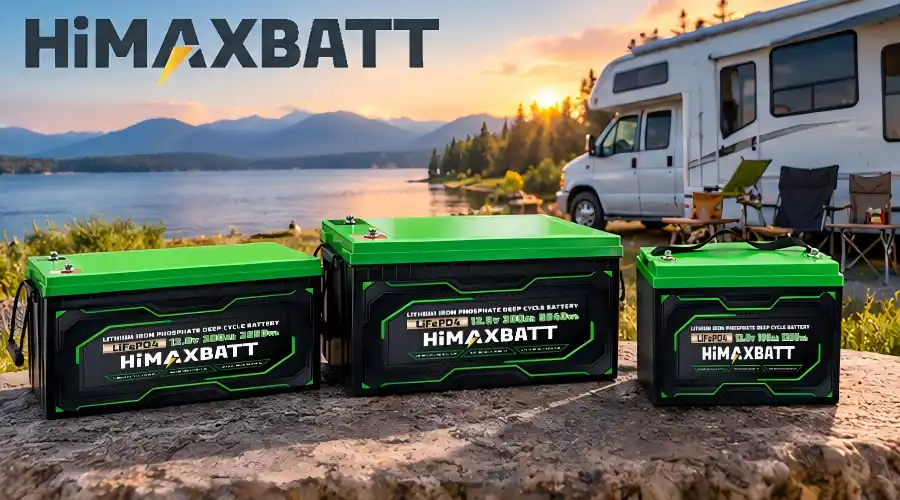
Using common 12V LiFePO4 RV batteries as examples, this guide explains how to calculate the battery capacity your RV needs and compares the typical applications of 100Ah, 200Ah, and 300Ah batteries to help you choose a more practical RV battery solution.
Understanding Ah and Wh: Battery Capacity Is About More Than Amp-Hours
Ah stands for amp-hours and is commonly used to describe battery capacity. Wh stands for watt-hours and is more useful when comparing how much energy a battery can actually store. The basic conversion formula is:
Battery Energy (Wh) = Nominal Battery Voltage (V) × Battery Capacity (Ah)
Using common 12.8V LiFePO4 batteries as an example:
| Battery Capacity | Theoretical Energy Storage | Estimated at 90% Usable Capacity |
| 12.8V 100Ah | 1280Wh | Approx. 1152Wh |
| 12.8V 200Ah | 2560Wh | Approx. 2304Wh |
| 12.8V 300Ah | 3840Wh | Approx. 3456Wh |
The 90% figure in this table is only an example for battery sizing. Not every battery should be used at the same depth of discharge. Actual usable energy depends on factors such as BMS settings, load power, ambient temperature, battery condition, and the manufacturer’s recommended depth of discharge.
If you use an inverter to convert DC power to 120V AC power, there will also be conversion losses. Therefore, when running AC appliances, you should not assume that all of the battery’s theoretical stored energy will be available to the appliances.
How Do You Calculate Your RV’s Daily Power Needs?
The most practical approach is to list the rated power of each appliance, how many hours it is used each day, and how many of each device you have. Then calculate daily energy consumption:
Daily Energy Consumption (Wh) = Appliance Power (W) × Daily Usage Time (h) × Quantity
The following example is intended to demonstrate the calculation. Power consumption can vary significantly by brand and model, so actual battery sizing should be based on the appliance nameplate, owner’s manual, or measured power consumption.
| RV Appliance | Example Power | Daily Usage | Daily Energy Consumption |
| LED Lighting | 30W | 4 hours | 120Wh |
| RV Refrigerator | Approx. 50W average | Equivalent to 10 hours of operation | 500Wh |
| Water Pump | 60W | 0.5 hours | 30Wh |
| Vent Fan | 40W | 3 hours | 120Wh |
| Laptop | 65W | 3 hours | 195Wh |
| Phones and Small Devices | 30W | 2 hours | 60Wh |
| TV | 60W | 2 hours | 120Wh |
| Total | — | — | Approx. 1145Wh |
If most of these loads are DC-powered, a 12.8V 100Ah lithium battery may come close to covering one day of use under ideal conditions, but it would leave little reserve capacity. If you also use an inverter, add cooking appliances, or need extra capacity for cloudy weather, a 200Ah battery will generally provide more breathing room.
Who Is a 100Ah RV Lithium Battery Best For?
A 12.8V 100Ah LiFePO4 battery stores approximately 1.28kWh of energy in theory. It is a practical choice for RVs with relatively low daily power consumption, shorter trips, or reliable access to daily charging.
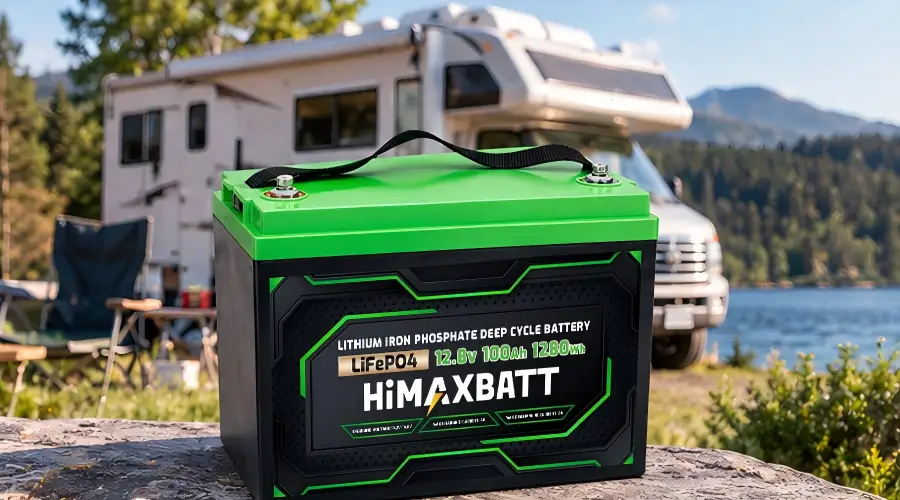
A 100Ah RV lithium battery is commonly suitable for:
- Weekend camping trips;
- Basic loads such as lighting, a water pump, fans, and phone charging;
- A low-power refrigerator;
- Minimal use of high-power 120V appliances;
- Long daily driving periods that allow charging through a DC-DC charger;
- Campgrounds with shore power;
- RVs with solar systems traveling in areas with good sun exposure.
The advantages of a 100Ah setup include a smaller footprint, relatively low weight, flexible installation, and a more manageable initial cost. The tradeoff is limited energy reserve. Several cloudy days, an extended stop, or the addition of unexpected electrical loads may mean more frequent charging.
If you only need to cover basic living loads and do not plan to run air conditioning or electric heating appliances from the battery for extended periods, 100Ah can be a practical entry-level option.
Is a 200Ah Lithium Battery Enough for an RV?
For many RV owners looking for a balance between comfort and installation cost, a 12.8V 200Ah lithium battery is a practical capacity. It stores approximately 2.56kWh of energy in theory and can support longer operation of refrigerators, lighting, ventilation, and electronics.
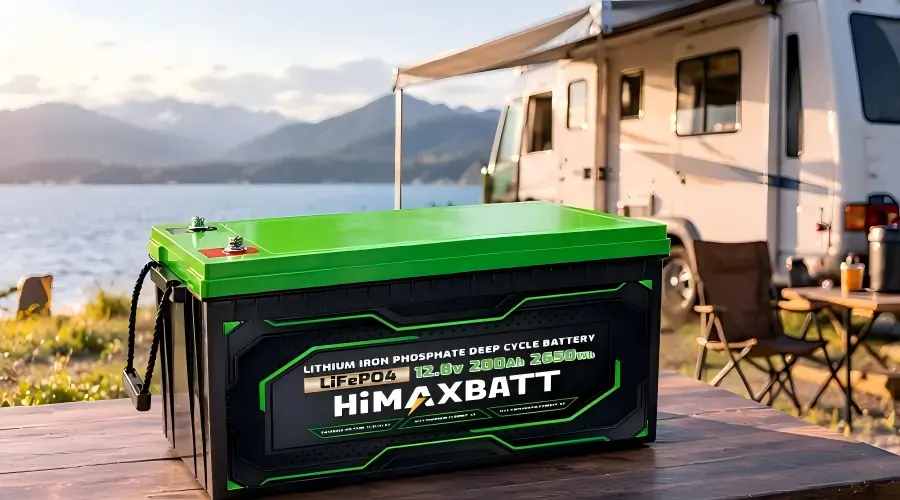
A 200Ah RV lithium battery is well suited for:
- RV travel for couples or small families;
- Around two days of camping with moderate power consumption;
- Frequent use of laptops, TVs, or entertainment equipment;
- Short-term use of certain kitchen appliances through an inverter;
- Users who want to reduce the need for frequent charging;
- RVs equipped with a mid-sized solar system;
- Users who want some reserve capacity for changing weather conditions.
A 200Ah battery does not mean you can run every high-power appliance without limits. Induction cooktops, microwaves, electric water heaters, and RV air conditioners can consume large amounts of energy in a short period. In these situations, you should also check the BMS continuous discharge rating, inverter output rating, cable size, fuses, and connectors.
Overall, if you’re deciding between 100Ah and 200Ah and your RV has enough installation space and payload capacity, 200Ah will usually provide a more flexible and comfortable power setup.
Is a 300Ah RV Lithium Battery a Good Choice for Off-Grid Camping?
A 12.8V 300Ah LiFePO4 battery stores approximately 3.84kWh of energy in theory. It is better suited for RV owners with higher energy demands, extended off-grid stays, or those who simply want to recharge less often.
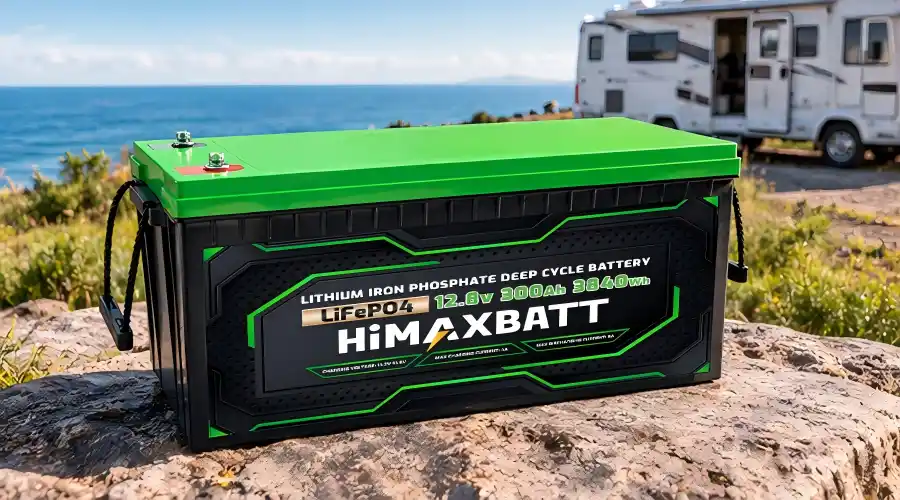
A 300Ah RV lithium battery is commonly suitable for:
- Long-distance RV trips or full-time RV living;
- Camping for several consecutive days without shore power;
- Photography, livestreaming, mobile office, or other equipment-heavy setups;
- Extended inverter use;
- Frequent use of appliances such as coffee makers, microwaves, or induction cooktops;
- Keeping more reserve energy available during cloudy or rainy weather;
- RVs with well-developed solar and alternator charging systems;
- RVs with sufficient installation space and payload capacity.
A 300Ah battery significantly increases energy storage, but it cannot solve a charging shortfall. If your daily energy consumption exceeds the total energy supplied by solar, alternator charging, and shore power, even a large battery bank will eventually run down. A larger battery bank should therefore be paired with adequate charging capacity.
How Do You Choose Between 100Ah, 200Ah, and 300Ah?
| Comparison | 100Ah Lithium Battery | 200Ah Lithium Battery | 300Ah Lithium Battery |
| Theoretical Energy at 12.8V | Approx. 1.28kWh | Approx. 2.56kWh | Approx. 3.84kWh |
| Recommended Loads | Basic lighting, refrigerator, and small devices | Everyday living, work, and short-duration AC loads | Multiple devices, off-grid travel, and higher energy demands |
| Typical Travel Style | Weekend trips and frequent shore power access | Regular RV travel and moderate off-grid use | Extended travel and continuous off-grid use |
| Installation Space | Less | Moderate | More |
| Weight and Cost | Relatively lower | Moderate | Relatively higher |
| Charging Time | Relatively shorter | Moderate | Requires a more capable charging system |
| Reserve Capacity | Limited | More comfortable | Greater |
| Best For | Light power users | Most RV users | High-energy users or extended off-grid travelers |
If your daily energy consumption is below roughly 800Wh and you can recharge every day, a 100Ah battery may be sufficient. If you use around 1000Wh to 1800Wh per day or want more reserve capacity, 200Ah is usually more practical. If your daily energy use is higher, you need to stay off-grid for more than two days, or you regularly use AC appliances, a 300Ah or larger RV lithium battery bank may be worth considering.
These ranges are intended only as a starting point. Your final battery capacity should be calculated using your actual daily energy consumption and expected number of days off-grid.
A Practical Formula for Calculating RV Battery Capacity
You can estimate the required battery storage using the following formula:
Recommended Battery Storage (Wh) = Daily Energy Consumption (Wh) × Planned Off-Grid Days ÷ Target Usable Capacity ÷ System Efficiency
Then convert watt-hours to amp-hours:
Recommended Battery Capacity (Ah) = Recommended Battery Storage (Wh) ÷ Nominal Battery Voltage (V)
For example, suppose your RV uses approximately 1200Wh per day and you want to operate for two days without recharging. Using 90% usable capacity and 90% overall system efficiency:
1200 × 2 ÷ 0.9 ÷ 0.9 ≈ 2963Wh
For a 12.8V LiFePO4 battery:
2963 ÷ 12.8 ≈ 232Ah
In this case, a 200Ah battery would require tighter energy management, while a 300Ah battery would provide a more comfortable reserve. If solar or alternator charging replenishes some of your energy every day, the battery capacity required may be adjusted accordingly.
What Size Lithium Battery Do You Need to Run an RV Air Conditioner?
Air conditioners are among the most power-hungry appliances in an RV. Suppose an air conditioner has an average input power of approximately 1000W and runs continuously for four hours. The air conditioner alone could consume around 4000Wh. After accounting for inverter losses and other loads such as the refrigerator, lights, and water pump, even a 12.8V 300Ah battery may not be enough to last through the night.
Actual air conditioner energy consumption depends on rated power, compressor run time, thermostat setting, insulation, outdoor temperature, and startup method. The power consumption of variable-speed air conditioners will also change as operating conditions vary.
If you want to run an RV air conditioner from lithium batteries, pay particular attention to:
- The air conditioner’s rated and startup power;
- The inverter’s continuous rating and surge capacity;
- The battery BMS’s continuous and peak discharge current;
- Cable sizing between the battery and inverter;
- Ratings for fuses, circuit breakers, and terminals;
- Expected operating time;
- Energy available from solar, a generator, or alternator charging;
- Ventilation, temperature, and installation safety in the battery compartment.
If you use several high-power appliances, it may be worth considering a 24V or 48V RV electrical system. For the same power level, increasing system voltage reduces current and can help minimize voltage drop in the wiring. However, all appliances, chargers, inverters, and protection devices must be compatible with the selected system voltage.
How Should You Pair Solar Panels With Lithium Batteries?
A solar panel’s rated wattage does not mean it will continuously produce that amount of power throughout the day. Weather, season, latitude, shading, mounting angle, temperature, and controller efficiency all affect actual solar production.
For example, a 400W solar array receiving four equivalent peak sun hours could theoretically generate approximately 1600Wh per day. After accounting for losses in the charge controller, wiring, temperature, and other parts of the system, the amount of energy actually stored in the battery will generally be lower.
When sizing a solar system, compare your expected daily solar generation with your actual daily energy consumption, rather than simply comparing solar panel wattage with battery amp-hours. The solar charge controller should also be compatible with the battery voltage and charging parameters. For LiFePO4 batteries, a controller that supports an appropriate lithium charging profile is recommended.
What Should You Know Before Upgrading From Lead-Acid to Lithium Batteries?
Lithium batteries offer several advantages over lead-acid batteries, including lower weight, greater usable capacity, higher charging efficiency, and longer cycle life. However, upgrading involves more than finding a battery with the same physical dimensions.
Before upgrading, check:
- Whether the existing RV charger supports LiFePO4 batteries;
- Whether alternator charging requires a DC-DC charger;
- Whether the solar charge controller can be configured with the correct lithium charging parameters;
- Whether the inverter’s low-voltage protection settings are appropriate;
- Whether the existing cables, terminals, and fuses can safely handle the maximum current;
- Whether the battery includes BMS protection suitable for RV use;
- Whether the battery compartment dimensions, mounting method, and weight capacity are appropriate;
- Whether battery heating is required for low-temperature operation;
- Whether the manufacturer allows multiple batteries to be connected in parallel.
One particularly important consideration is that standard LiFePO4 batteries should not be charged at excessively low temperatures unless they are specifically designed to do so. RV owners who frequently travel in cold climates may want to choose batteries with low-temperature charging protection or built-in self-heating.
What Other Specifications Matter When Choosing an RV Lithium Battery?
Capacity is important, but several other specifications matter just as much.
Continuous Discharge Current
If a battery’s BMS allows a continuous discharge current of 100A, its theoretical DC output at 12.8V is approximately 1280W. After accounting for voltage variation and system losses, the AC load it can reliably support will be lower. Therefore, simply installing a 2000W inverter does not mean the battery can continuously deliver 2000W.
Peak Discharge Current
Motors, compressors, and certain heating appliances may draw a large amount of current at startup. The BMS must be able to handle the corresponding peak current for the required duration; otherwise, it may trigger protection and shut down the output.
Maximum Charging Current
The larger the battery capacity, the longer it will generally take to recharge if charger output remains the same. When choosing a 200Ah or 300Ah battery, check the output capability of your solar charge controller, DC-DC charger, and shore power charger.
Cycle Life
When comparing cycle life, also review the depth of discharge, charge and discharge rates, temperature, and remaining-capacity criteria used in the test. Comparing cycle counts without the associated test conditions provides limited value.
BMS Features
A quality RV lithium battery BMS should typically provide overcharge, over-discharge, overcurrent, short-circuit, and temperature protection. Some batteries also support Bluetooth, CAN, or RS485 communication, allowing users to monitor SOC, voltage, current, and fault status.
Frequently Asked Questions About RV Lithium Batteries (FAQ)
How Long Can a 100Ah Lithium Battery Run an RV Refrigerator?
It depends on the refrigerator’s actual average energy consumption. Assuming a 12.8V 100Ah battery provides 90% usable capacity, approximately 1152Wh would be available. If the refrigerator consumes an average of 40Wh per hour, the theoretical runtime would be approximately 28.8 hours. Actual runtime will also depend on ambient temperature, how often the door is opened, startup current, and other electrical loads.
Is a 200Ah Lithium Battery Enough for an RV?
For typical loads such as lighting, a refrigerator, water pump, fans, phone charging, and moderate laptop use, 200Ah is often a practical choice. However, if you plan to run an air conditioner, induction cooktop, or electric water heater for extended periods, recalculate your battery requirements based on the appliances’ power consumption and operating time.
Can a 300Ah Lithium Battery Run a 2000W Inverter?
Capacity alone does not determine whether it can. You also need to check the battery BMS’s continuous discharge current, peak current, cables, terminals, and protection devices. In a 12.8V system, DC input current at full inverter load can easily exceed 150A, so the entire system must be designed to handle the required current safely.
Do Two 100Ah Batteries in Parallel Equal 200Ah?
If both batteries have the same voltage, are compatible, and the manufacturer allows parallel connection, two 12.8V 100Ah batteries connected in parallel will remain at a nominal 12.8V while providing approximately 200Ah of total capacity. Before connecting batteries in parallel, make sure their SOC and voltage are close and use properly sized cables and protection devices.
Can an RV Lithium Battery Stay Connected to Solar Panels?
Yes, when connected through a suitable solar charge controller. Solar panels should not be connected directly to the battery. The controller’s voltage, charging profile, and maximum current must be compatible with the lithium battery, and the charging parameters should be configured according to the battery manufacturer’s specifications.
Can RV Lithium Batteries Be Used Below Freezing?
LiFePO4 batteries can generally still discharge at low temperatures, although available capacity and output capability may decrease. Charging at low temperatures requires more caution. Always follow the battery’s specified charge and discharge temperature ranges. For cold-weather RV use, batteries with low-temperature protection or built-in heating are recommended.
How Can I Tell How Much Battery Power My RV Has Left?
Estimating the remaining capacity of a lithium battery based only on voltage is often inaccurate. A battery monitor with current sensing or a smart BMS can track energy flowing into and out of the battery and use this data to estimate SOC.
Should I Choose One Large RV Lithium Battery or Multiple Batteries in Parallel?
A single large-capacity battery generally requires simpler wiring and can be easier to manage as one system. Multiple batteries in parallel may provide more flexibility for installation and future expansion, but you need to consider battery compatibility, parallel connection limits, cable lengths, current sharing, and protection design. Always follow the battery manufacturer’s installation requirements.
How Should I Store an RV Lithium Battery When the RV Is Not in Use?
Turn off unnecessary loads and store the battery at the state of charge recommended by the manufacturer in a dry, well-ventilated environment within the recommended temperature range. During long-term storage, periodically check the battery level to prevent the BMS, monitoring equipment, or other standby loads from gradually draining the battery.
HiMAXBATT RV Lithium Batteries
HiMAXBATT is committed to providing reliable lithium battery solutions for RVs, camper vans, and off-grid energy storage applications. Based on each customer’s system voltage, daily energy consumption, installation space, inverter capacity, charging method, and operating environment, we can provide 100Ah, 200Ah, 300Ah, and other LiFePO4 battery solutions for RV applications.
Whether you need longer off-grid runtime, smart BMS monitoring, low-temperature protection, built-in self-heating, series or parallel configurations, communication interfaces, or customized dimensions, HiMAXBATT can help evaluate a solution based on your actual application. Contact HiMAXBATT with your RV appliance list, travel habits, and available charging methods, and we’ll help you select a safer, more stable, and practical lithium battery solution for life on the road.