Commercial Disclosure: The HiMAXBATT Editorial Team brings together expertise in lithium battery manufacturing, battery engineering, power systems, and global application support to provide practical, technically informed content for businesses and industry professionals. Our content covers lithium-ion and LiFePO4 batteries, custom battery packs, BMS technology, charging solutions, battery selection, industrial applications, product updates, and HiMAXBATT news. All content reflects HiMAXBATT’s official editorial perspective and our commitment to delivering safe, reliable, and application-focused lithium battery solutions to customers worldwide.
Key Takeaways
- Aerial work platforms require traction batteries that can handle repeated charge-discharge cycles, intermittent high-current output, and real-world jobsite conditions. Battery selection should consider voltage, capacity, continuous current, and peak current together.
- A platform’s rated load cannot be directly converted into required battery capacity. Lift frequency, travel distance, slope, hydraulic system efficiency, and standby time all affect energy consumption.
- Cycle life should be compared under consistent depth of discharge, temperature, charge/discharge rate, and end-of-life criteria. Looking at cycle count alone can be misleading.
- LiFePO4 batteries can be considered for aerial work platforms, but the charger, BMS, machine controls, and mechanical installation all need to be properly matched.
- Converting from lead-acid to lithium also requires evaluating battery weight and overall machine stability. Similar dimensions and nominal voltage alone do not make a battery a direct replacement.
Introduction
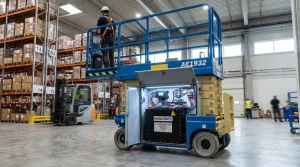
Electric aerial work platforms are commonly used for facility maintenance, warehouse inventory work, construction installation, and other jobs performed at height. For equipment manufacturers and rental fleet operators, the battery needs to support the machine through its required shift while also handling repeated lifting, opportunity charging, and long-term fleet use.
So, what kind of battery does an aerial work platform need? From a battery manufacturing perspective, the answer is: a traction battery system designed for deep-cycle operation, with power output matched to the load and safety controls that work together with the machine. Determining whether a battery is suitable requires evaluating the specific equipment and operating conditions rather than simply comparing amp-hour ratings or purchase prices.
Why Can’t You Choose an Aerial Work Platform Battery Based on Capacity Alone?
Battery capacity is typically rated in amp-hours (Ah). It indicates how much charge a battery can deliver under specified test conditions, but it does not by itself show whether the battery can power the equipment or how long the machine will operate in real-world use.
An aerial work platform battery needs to handle different types of loads:
| Operating Condition | Power Demand Characteristics | Battery Selection Considerations |
| Lift startup | Motor startup and hydraulic pressure buildup may create short-duration high-current demand | Peak current, allowable duration, voltage drop |
| Continuous lifting | Current depends on load, mechanism condition, and system efficiency | Continuous discharge capability, temperature rise |
| Driving and climbing | Slope, surface conditions, and machine weight affect power demand | Continuous output, energy consumption, low-state-of-charge performance |
| Standby and controls | Lower power demand, but it may continue for extended periods | Auxiliary power consumption, sleep strategy |
| Alternating operations | Frequent current fluctuations | Repeated pulse capability, protection-threshold coordination |
For example, two batteries with the same nominal voltage and capacity can perform differently if their discharge capability, internal resistance, or BMS protection settings differ. One battery may complete the lift cycle normally, while another may experience excessive voltage drop or trigger overcurrent protection and interrupt the operation.
For this reason, manufacturers should obtain actual current profiles, verify peak current, pulse duration, and repetition frequency, and validate output capability at low states of charge and low temperatures.
How Do You Determine Voltage, Current, and Capacity Based on the Load?
Voltage Compatibility Must Cover the Entire Operating Range
Battery selection for an aerial work platform should begin by confirming the machine’s system voltage and then checking the allowable voltage ranges of the controller, contactors, charger, and auxiliary power systems.
Similar nominal voltages do not mean two batteries are interchangeable. You also need to compare fully charged voltage, discharge cutoff voltage, and the machine’s undervoltage warning and shutdown thresholds. Lead-acid and lithium batteries have different voltage curves, so the original battery gauge may not accurately indicate the remaining charge of a lithium battery.
Current Capability Must Support Both Continuous and Startup Loads
If battery-side input power is known, current can be estimated using the following relationship:
Current (A) ≈ Battery-Side Input Power (W) ÷ Operating Voltage (V)
For example, if battery-side input power is 3,000W under a particular operating condition and the operating voltage is 48V, the estimated current is approximately 62.5A. This is only an estimate for that specific condition and does not replace startup peak-current testing. If the available power figure represents mechanical motor output instead, drivetrain efficiency must also be taken into account.
Current capability is also determined by more than the cells themselves. The BMS, busbars, wiring harnesses, connectors, contactors, and fuses all need to be matched to the same load conditions.
Capacity Should Be Based on Energy Consumption per Shift
A machine being powered on for eight hours does not mean it operates at rated power continuously for eight hours. A more practical approach is to measure the energy consumed by lifting, driving, and standby operation during a representative shift.
If battery-side energy consumption per shift has already been measured, the following formula can be used for an initial estimate:
Required Nominal Energy ≈ Energy Consumption per Shift ÷ Usable Capacity Ratio ÷ End-of-Life Capacity Retention Ratio
Assume that a machine consumes 4kWh per shift, the design allows 80% of rated battery energy to be used, and the battery is still expected to complete the same shift after its capacity declines to 80% of its initial value. The preliminary nominal energy requirement would be:
4 ÷ 0.8 ÷ 0.8 = 6.25kWh
This figure is only a calculation example and does not represent the specifications of a particular product. The final design should also account for changes in available capacity at low temperatures, variations in load, and operational reserve requirements. If the energy-consumption data is measured at the mechanical output rather than at the battery, system losses should also be included.
Should an Aerial Work Platform Use Lead-Acid or LiFePO4 Batteries?
Deep-cycle lead-acid, AGM, and lithium batteries are all used in aerial work platform applications. The appropriate choice depends on the machine design and operating model. Battery manufacturers’ application information also identifies these technologies for relevant equipment applications.
| Comparison | Deep-Cycle Lead-Acid Battery | LiFePO4 Battery |
| Initial purchase cost | Generally lower, depending on specifications and brand | Generally higher and should be evaluated as part of the complete system |
| Routine maintenance | Flooded batteries require electrolyte-level checks; AGM maintenance requirements differ | Typically does not require watering, but connections and system condition still need inspection |
| Charging compatibility | Requires a charging profile matched to the specific lead-acid type | Requires charging parameters and control logic compatible with the lithium battery |
| Cycle life | Affected by depth of discharge, undercharging, and maintenance | Affected by temperature, C-rate, depth of discharge, and cell consistency |
| Weight and installation | Battery weight may be part of the machine’s counterweight design | Changes in battery weight require the machine’s requirements to be rechecked |
| System management | Depends on the specific battery and machine configuration | Typically monitored and protected by a BMS |
For machines with high utilisation rates and short charging windows, LiFePO4 may be worth evaluating. For equipment with lower utilisation and an existing lead-acid system that is operating reliably, the decision to upgrade should take maintenance requirements and replacement costs into account.
Economics should be evaluated over the planned operating period, including the battery, charger, retrofit validation, maintenance labour, downtime, and replacement costs rather than comparing only the initial
purchase price.
How Do You Evaluate the Cycle Life of an Aerial Work Platform Battery?
A statement such as “X number of cycles” is meaningful only when the test conditions are provided. When purchasing a battery, ask the supplier to specify the following:
| Cycle-Life Parameter | Information to Verify | Why It Matters |
| Depth of discharge (DoD) | Percentage of battery capacity used during each cycle | Shallow-cycle and deep-cycle results cannot be compared directly |
| Charge/discharge rate | Test current and pulse-load conditions | Affects temperature rise and battery degradation |
| Ambient temperature | Test temperature and temperature-control conditions | Laboratory results may not represent field performance |
| End-of-life criterion | Remaining percentage of initial capacity used to end the test | Different criteria can produce different cycle counts |
| Test sample | Individual cell, module, or complete battery pack | Cell-level data cannot be treated as complete pack life |
Cycle life is also not the same as service life in years. Even if a machine is used infrequently, batteries still experience calendar ageing. Extended storage at high temperatures or high states of charge may also affect the rate of degradation.
From a manufacturing perspective, cell capacity and internal-resistance consistency, interconnection quality, temperature distribution, and balancing strategy can all affect battery-pack performance. For rental equipment, it is also useful to consider whether fault records can be retrieved and whether maintenance teams can identify abnormal cells or operating conditions promptly.
What Safety Features Does a Lithium Battery for an Aerial Work Platform Need?
BMS Protection Should Work Together With the Machine’s Control Logic
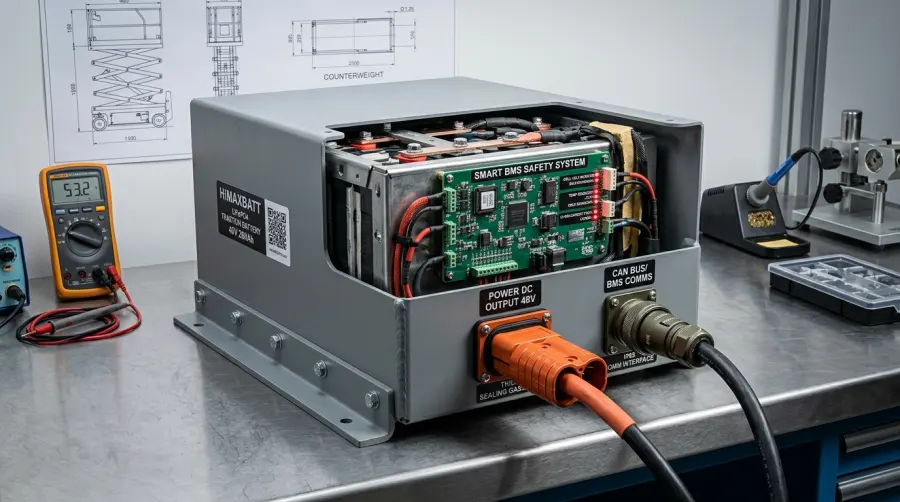
A BMS, or battery management system, typically monitors cell voltage, current, and temperature and provides protection against conditions such as overcharge, overdischarge, and overcurrent.
For aerial work equipment, engineers also need to consider what happens to the machine when battery protection is triggered. The system design should clearly define low-state-of-charge warnings, operating restrictions, fault displays, and emergency lowering procedures. The fact that a battery can disconnect its output should not be treated as proof that the machine’s overall safety design is complete.
Emergency lowering may use an independent power source, manual mechanism, or another method, depending on the machine design and operating manual.
Low-Temperature Charging Requires Dedicated Controls
Standard lithium battery configurations may need to limit or prevent charging at low temperatures. The specific thresholds depend on the cell specifications and battery-system design. Some equipment may include battery heating, but the system should verify the conditions for completing the heating process, temperature-sensor placement, and fault-handling logic.
For example, the service manual for a specific JLG model defines low-temperature charging restrictions when battery heating is not available, illustrating why charging-temperature limits need to be evaluated for the specific product rather than applied universally. Reference: JLG AE1932 Service Manual
The Battery Pack Should Be Designed for Vibration, Dust, and Moisture
Battery-pack construction should account for vibration during machine operation, impacts during transportation, and equipment cleaning practices. Cell retention, anti-loosening measures for connections, wiring protection against abrasion, terminal insulation, and enclosure sealing should all be evaluated.
Ingress protection ratings should be supported by the relevant test conditions, including factors such as whether connectors were mated during testing. A certain level of water resistance should not automatically be interpreted as permission for immersion or high-pressure washing.
Safety Documentation Should Match the Delivered Battery Model
For industrial lithium battery projects, the applicability of standards such as IEC 62619 can be evaluated according to the application and market where the product will be sold. This standard covers safety requirements and testing for secondary lithium cells and batteries used in industrial applications. Reference: IEC 62619:2022
UN 38.3 testing and documentation for transportation should be reviewed separately and should not be treated as a substitute for machine-level operational safety validation. Buyers should also verify that the model, construction, and critical components identified in the documentation correspond to the battery being delivered. Reference: PHMSA Lithium Battery Transportation Guidance
Why Does Counterweight Matter When Converting an Aerial Work Platform From Lead-Acid to Lithium?
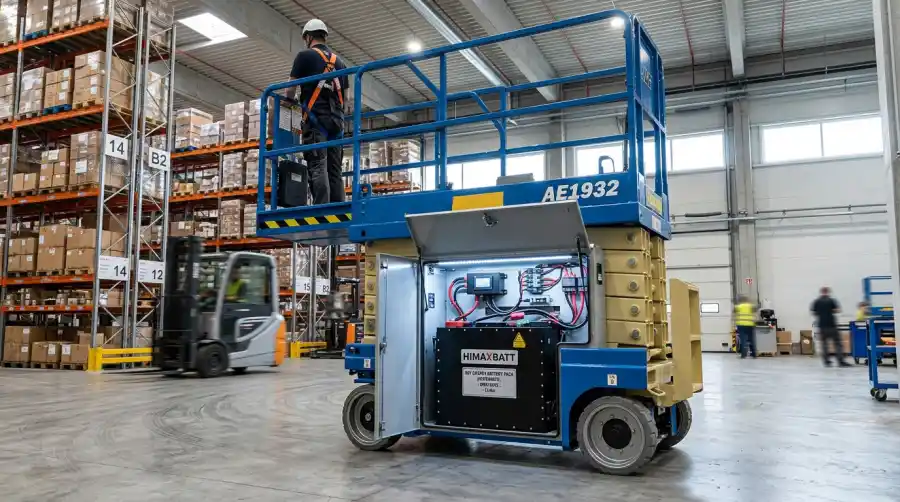
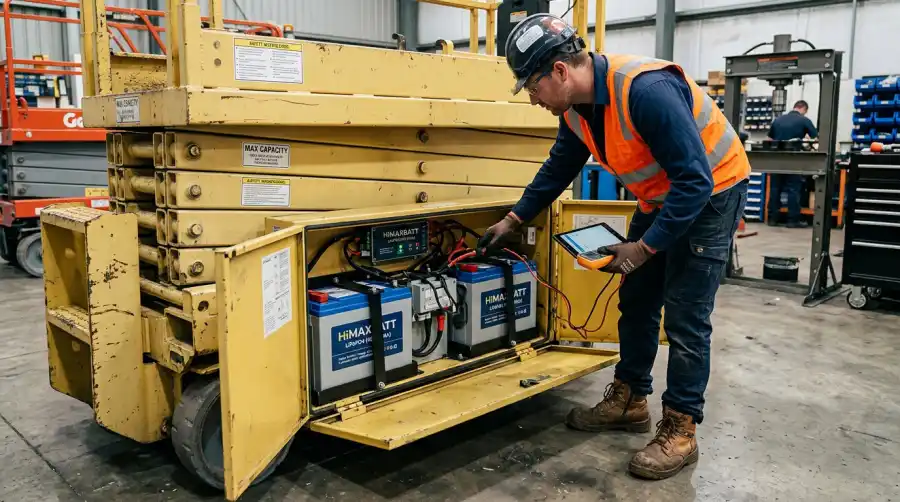
The lower weight of a lithium battery may change the machine’s overall weight distribution. On some aerial work platforms, the original batteries contribute to the machine’s counterweight, so changing battery weight can affect stability.
Operating manuals for certain Genie models specifically state that the batteries are used as counterweights and are critical to machine stability. Before a conversion, documentation for the applicable model and serial number should therefore be reviewed, and the proposed configuration should be confirmed by the equipment manufacturer or an approved technical provider. Reference: Genie Equipment Operator’s Manual
Battery compartment dimensions, mounting methods, charging interlocks, communication protocols, and fault responses should also be checked. For machines with regenerative energy capability, the system should also account for how regenerated energy is handled when the battery cannot accept additional charge, such as when it is fully charged or at a restricted temperature.
Frequently Asked Questions About Aerial Work Platform Batteries
Is a Larger Battery Capacity Always Better for an Aerial Work Platform?
A larger capacity may extend runtime, but it can also affect cost, weight, installation space, and charging time. Start by determining energy consumption per shift, then verify output capability and machine compatibility. A high-capacity battery with insufficient peak-current capability may still be unable to complete lifting operations properly.
Can a Scissor Lift Use a Standard Starting Battery?
A battery should not be substituted simply because the voltage is the same. Starting batteries are primarily designed for short-duration starting loads, while scissor lifts require repeated charge-discharge cycles and sustained power delivery. The battery should be approved for the machine and provide the required deep-cycle and load capabilities.
Can a LiFePO4 Battery Use the Existing Lead-Acid Charger?
The specific battery and charger models need to be checked. Charging voltage, charging profile, equalisation functions, and communication requirements may not be compatible. The original charger should not be reused without verifying compatibility.
Why Won’t the Platform Lift Even Though the Battery Gauge Shows Charge Remaining?
Possible causes include voltage drop under load, cell undervoltage, temperature restrictions, overcurrent protection, or inaccurate state-of-charge estimation. The issue may also come from another part of the machine. BMS records, equipment fault codes, and actual load testing should be reviewed rather than relying solely on the battery gauge.
Can an Aerial Work Platform Lithium Battery Be Opportunity-Charged During a Lunch Break?
A battery-and-charger combination designed for opportunity charging can be partially recharged during breaks, provided the battery is within its allowable temperature and current limits and the site has a suitable power supply. The amount of energy that can be added depends on charging power, remaining state of charge, and thermal restrictions.
How Should an Aerial Work Platform Battery Be Stored During Long Periods of Inactivity?
Follow the product manual for the recommended state of charge, storage temperature, and inspection interval, and account for standby power consumption from the machine. Leaving the battery connected to the equipment may result in continuous discharge. Before returning the machine to service, check battery charge, physical condition, connections, and fault records.
HiMAXBATT Batteries: Evaluating Power Solutions Based on Real Equipment Operating Conditions
HiMAXBATT provides LiFePO4 batteries, lithium-ion batteries, and OEM/ODM battery solutions. For aerial work platform projects, you can provide the machine model, system voltage, load-current profile, required runtime per shift, battery compartment dimensions, and operating environment to discuss battery selection and customization requirements with HiMAXBATT. Specific capacity, discharge capability, communication functions, cycle life, and applicable test documentation should be determined according to the project’s technical specifications and validation results. Learn more about HiMAXBATT batteries and custom battery services to establish a clear technical basis for equipment development or battery upgrades.