Commercial Summary: This HiMAXBATT guide covers key considerations for RV battery upgrades, including series battery configurations, energy and capacity, BMS requirements, charging compatibility, wiring, system protection, and installation factors to support informed lithium battery selection.
Key Takeaways
- When two 6V batteries are connected in series, their voltages add together, but their amp-hour capacity does not. If each battery is rated at 220Ah, the resulting battery bank is 12V 220Ah.
- A 12V 320Ah lithium battery may meet the voltage and nominal capacity requirements for an upgrade, but whether it can serve as a direct replacement depends on the original battery bank specifications, actual loads, and charging system.
- When comparing batteries, consider nominal energy, usable capacity, continuous discharge current, and peak power together rather than comparing Ah ratings alone.
- Before upgrading, check whether the charger, solar charge controller, inverter, cables, fuses, and battery compartment are compatible with the lithium battery.
- The lithium battery’s BMS, low-temperature charging restrictions, mounting requirements, and system protection should also be included in the selection and installation assessment.
Introduction
When an RV originally uses two 6V batteries, owners may consider replacing them with one large-capacity 12V lithium battery to simplify the battery bank and increase usable energy storage. Whether the two configurations are equivalent cannot be determined simply by comparing “12V to 12V” or assuming that “320Ah is larger than the original capacity.” The key factors are how the two 6V batteries are connected, the capacity of each battery, how much power the loads require, and whether the RV’s existing equipment can charge and operate with the lithium battery correctly.
From a battery manufacturing and system application perspective, this article explains how to calculate capacity in a series-connected battery bank, compare energy, and evaluate the equipment and installation conditions that should be checked before replacement. The 320Ah rating used throughout this article is an example of nominal capacity. Actual usable energy and operating performance should be determined from the battery specifications and the RV system requirements.
How Do Two 6V Batteries Make a 12V Battery Bank?
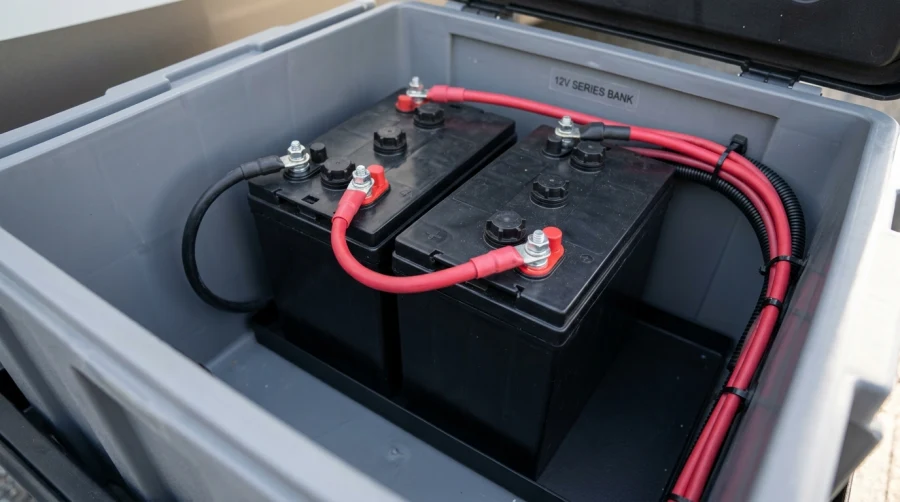
A common RV configuration connects two 6V batteries in series by connecting the positive terminal of one battery to the negative terminal of the other. The system then draws power from the remaining positive and negative terminals. In a series connection, voltage adds together, while capacity in amp-hours (Ah) generally remains equal to the rated capacity of a single battery.
| Example Configuration | Nominal Voltage After Connection | Nominal Battery Bank Capacity | Approximate Nominal Energy |
| Two 6V 220Ah batteries in series | 12V | 220Ah | 2,640Wh |
| Two 6V 250Ah batteries in series | 12V | 250Ah | 3,000Wh |
| One 12.8V 320Ah lithium battery | 12.8V | 320Ah | 4,096Wh |
A simplified way to estimate energy is “nominal voltage × nominal capacity.” For example, 12.8V × 320Ah equals approximately 4,096Wh, or about 4.1kWh. The table is intended only to compare nominal energy. Actual usable energy is also affected by battery chemistry, discharge rate, temperature, BMS settings, battery age, and conversion losses in connected equipment. U.S. Department of Energy battery fundamentals explain that series connections are used to increase voltage, while parallel connections are used to increase capacity. Therefore, when two 6V batteries are connected in series, their Ah ratings should not be added together. U.S. Department of Energy Battery Fundamentals
Can a 320Ah Lithium Battery Replace the Original Battery Bank?
If the original two 6V batteries form a 12V 220Ah or 12V 250Ah bank when connected in series, a 12V 320Ah lithium battery has a higher nominal capacity and may also provide more nominal energy. However, this does not automatically mean it can be installed without modifications. The lithium battery’s charging voltage, allowable charging current, BMS protection logic, and low-temperature charging requirements may differ from those of the original lead-acid battery system.
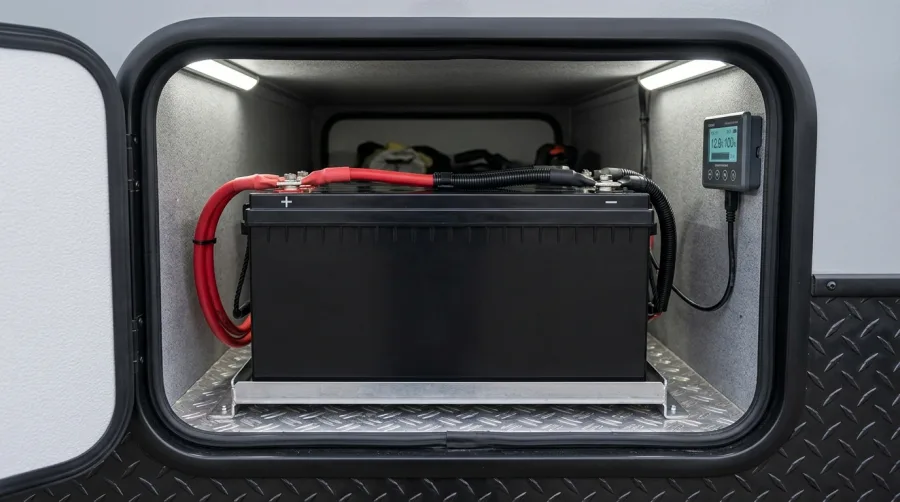
If the original battery bank has a capacity close to or greater than 320Ah, the replacement outcome still cannot be determined by Ah alone. Start by calculating daily energy consumption, then evaluate expected runtime based on usable battery energy and inverter efficiency. Appliances such as air conditioners, induction cooktops, and microwaves may create high instantaneous power demands, while refrigerators, lighting, and communications equipment may place continuous loads on the battery over longer periods. You should also verify the lithium battery’s continuous and peak discharge capabilities to make sure it can support the inverter and other RV loads.
A practical evaluation can follow these steps:
- Confirm the original battery specifications. Check the labels or documentation for both 6V batteries and record their chemistry, Ah capacity, manufacturing date, and connection method.
- Calculate daily energy consumption. Record the power rating and daily operating time of commonly used devices to estimate daily energy use. Include inverter losses and the startup current of high-power equipment.
- Verify battery output capability. Confirm that the 12V 320Ah lithium battery’s continuous discharge current, peak current, BMS protection thresholds, and recommended fuse specifications meet the load requirements.
- Check all charging sources. Review the shore power charger, solar charge controller, and vehicle alternator charging circuit separately to confirm that they support the target lithium battery’s charging parameters.
- Evaluate installation conditions. Measure the battery compartment and check the mounting arrangement, cable size, fuse location, terminal configuration, and available service space.
What Should You Check in an RV Charging System Before Upgrading?
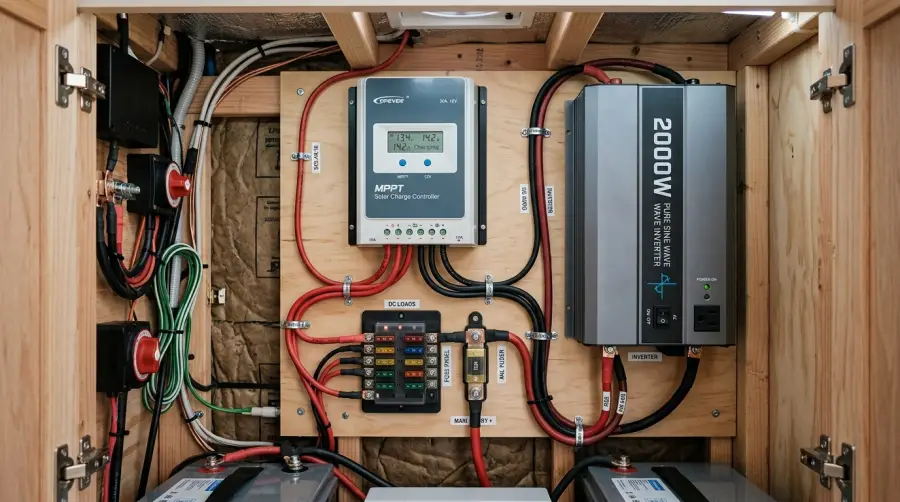
Shore power charger: Check whether the charger has a charging mode suitable for the target lithium battery and whether its charging voltage and current meet the battery manufacturer’s specifications. If the charger only provides a fixed lead-acid charging profile, confirm with the manufacturer whether it can be used with the lithium battery.
Solar charge controller: Verify that the controller can be configured for the required lithium battery charging parameters. Also check whether features such as temperature compensation and equalization charging are compatible with the battery manufacturer’s requirements. Do not assume compatibility simply because the controller displays “12V.”
Vehicle alternator: Charging while driving involves current management among the alternator, starting battery, and house battery. Lithium batteries may accept charge differently from lead-acid batteries, so alternator loading, cable protection, and charging-current control should be evaluated.
Inverter and DC loads: Confirm that the inverter’s DC input voltage range is compatible with the battery system, and check its maximum input current and protection configuration. If the battery BMS disconnects the output because of overcurrent, low voltage, or abnormal temperature, multiple devices in the system may lose power at the same time. This possibility should be considered in the system design.
Safety and Installation Considerations
Before replacing the battery, turn off charging sources and DC loads, and disconnect the system according to the instructions provided by the RV and battery manufacturers. Pay close attention to positive and negative terminal markings during installation to avoid short circuits. Fuse type, rating, and placement should be determined based on cable specifications and overall system design. Do not select a fuse rating simply according to the battery’s Ah capacity, and do not continue using old cables or connectors without verifying their suitability.
If you are using a LiFePO4 battery, pay particular attention to its allowable charging temperature range. Some products use the BMS to limit or stop charging at low temperatures, but protection methods and thresholds vary by model. The battery should be securely mounted to prevent movement caused by vibration while the RV is in motion. The battery compartment should also meet the product’s ventilation, ambient temperature, and environmental protection requirements. If installation or rewiring is beyond your experience, consider having the work performed by a professional familiar with RV DC electrical systems.
Frequently Asked Questions
If Two 6V 225Ah Batteries Are Connected in Series, Do They Become 12V 450Ah?
No. In a series connection, voltage adds together while capacity remains based on the Ah rating of a single battery. The resulting bank would therefore typically be 12V 225Ah. Ah capacity increases only with an appropriate parallel connection. Actual battery configuration should follow the battery manufacturer’s and system designer’s requirements.
What Is the Nominal Energy of a 12V 320Ah Lithium Battery?
If the battery has a nominal voltage of 12.8V, its nominal energy is approximately 12.8 × 320 = 4,096Wh, or about 4.1kWh. Actual usable energy may be lower than the nominal value, so check the product specifications for usable capacity, discharge conditions, and BMS limitations.
If Both Batteries Are 12V, Can I Keep Using the Original Charger?
Not necessarily. Similar nominal voltage does not mean the batteries use the same charging profile. Confirm that the shore power charger, solar charge controller, and alternator charging equipment support the target lithium battery’s charging parameters. Also check the battery manufacturer’s requirements for charging current and temperature.
Will One 12V 320Ah Battery Always Provide Longer Runtime Than Two 6V Batteries?
Not necessarily. Runtime depends on the battery bank’s actual usable energy, load power, operating time, inverter efficiency, and environmental conditions. A better comparison is to evaluate the daily energy consumption of your equipment against the battery’s usable energy rather than comparing rated Ah alone.
Does the Original Battery Monitor Need to Be Reconfigured?
Possibly. After the upgrade, the battery capacity, chemistry, or charging parameters stored in the monitor may no longer be correct. Reconfigure the monitor according to the new battery specifications and the monitor manufacturer’s instructions. If the system uses a shunt or BMS data communication, confirm that the connection method is compatible with the equipment.
About HiMAXBATT
HiMAXBATT provides lithium battery products and power solutions for RVs and other energy storage applications. Upgrading an RV battery system involves several factors, including battery capacity, continuous discharge capability, BMS protection, charger compatibility, and installation space. HiMAXBATT can provide battery product information and selection support based on specific application requirements. Final system configuration should be based on product specifications, RV equipment requirements, and a professional installation assessment.