Commercial Disclosure: The Himax Electronics Editorial Team brings together expertise in battery products, power technologies, engineering applications, and global customer support to share practical information about battery technology, custom battery solutions, and power applications. Our content covers lithium-ion batteries, LiFePO4 batteries, battery pack design and selection, charging and power solutions, industry application guides, product updates, and official Himax Electronics news. Our goal is to help engineers, procurement professionals, and businesses better understand battery technologies and make informed decisions based on their specific application requirements. All content reflects the official editorial perspective of Himax Electronics and our commitment to providing reliable, flexible, and professional custom battery and power solutions for complex applications worldwide.
Key Takeaways
- When selecting a battery for cleaning equipment, consider operating time, load requirements, charging schedules, maintenance conditions, and total operating costs rather than comparing battery price and capacity alone.
- For commercial cleaning equipment that operates across multiple shifts and needs to recharge during work breaks, lithium battery systems designed to support opportunity charging are worth evaluating.
- For equipment used less frequently, with sufficient charging time and a limited budget, compatible deep-cycle lead-acid batteries can still be a practical option.
- Lead-acid batteries include flooded, AGM, and gel types. AGM and gel batteries do not normally require watering during regular use.
- Converting a floor scrubber from lead-acid to lithium requires verification of charger, battery management system, controller, and mechanical compatibility. Similar nominal voltage does not mean the batteries can be directly swapped.
Introduction
In shopping malls, factories, warehouses, hospitals, and hotels, floor scrubbers, floor cleaning machines, and floor polishers handle cleaning tasks with very different operating demands. The battery not only determines how long the equipment can operate but also affects charging schedules, maintenance labor, and equipment downtime.
So, should cleaning equipment use lithium or lead-acid batteries? From a battery manufacturing perspective, the right choice should be based on actual operating conditions and compatibility with the complete machine. This article focuses on battery-powered floor cleaning equipment and provides purchasing teams, equipment manufacturers, and commercial cleaning operators with a practical framework for battery selection.
Understanding Common Battery Types for Cleaning Equipment
Lithium Batteries: Evaluate the Complete Battery System
Lithium batteries include different chemistries, and their performance should not be treated as identical. For commercial cleaning equipment, lithium iron phosphate (LiFePO4) is one technology worth evaluating.
A lithium battery system typically consists of cells, a battery management system (BMS), interconnections, protection components, and an enclosure. Actual performance depends not only on cell chemistry but also on cell consistency, connection quality, thermal management, and protection strategies.
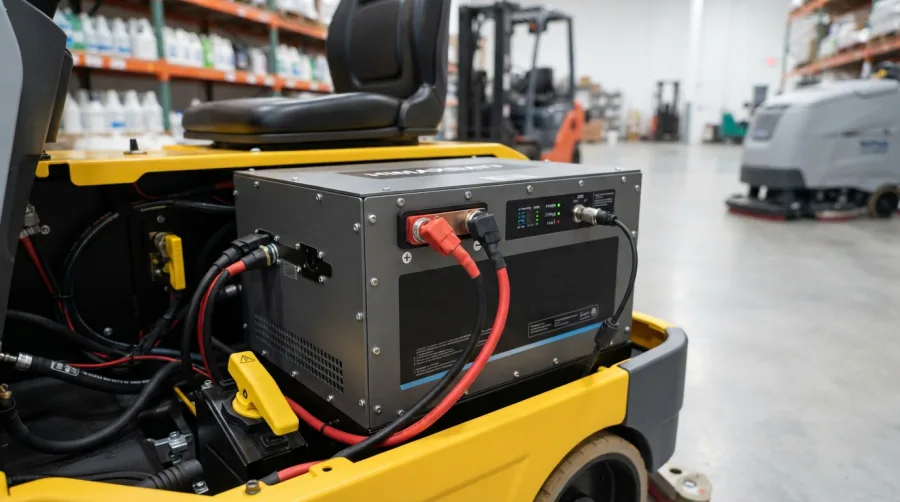
Therefore, in addition to voltage and capacity, buyers should verify continuous discharge current, peak current and its allowable duration, charging conditions, and mechanical design.
Lead-Acid Batteries: Maintenance Requirements Vary by Type
Lead-acid batteries commonly used in cleaning equipment include flooded lead-acid, AGM, and gel batteries. Flooded batteries require electrolyte inspection and watering according to the manufacturer’s instructions. AGM and gel batteries normally do not require watering, but terminals, cables, and charging status should still be inspected.
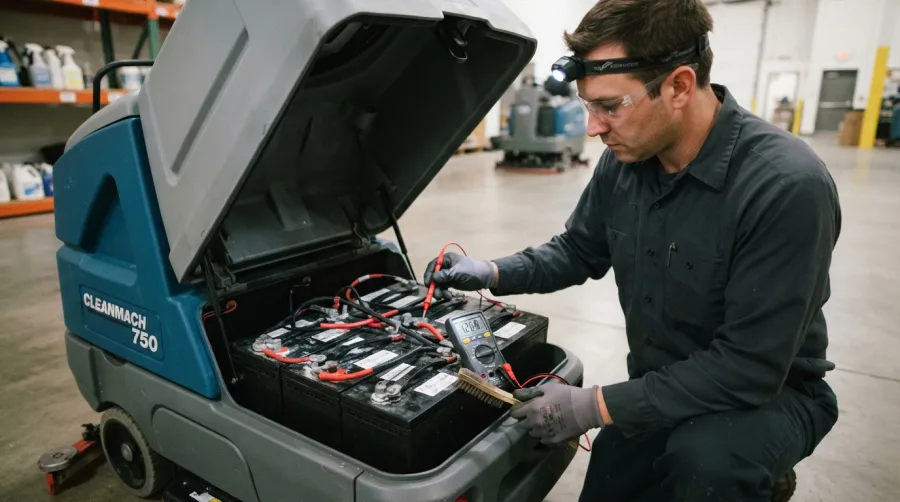
Cleaning equipment manufacturers may offer these battery types as different options rather than applying the same maintenance requirements to all of them.
For cleaning equipment that undergoes repeated charge and discharge cycles, a deep-cycle battery designed for the intended duty should be used. A starting battery should not be substituted simply because it has similar physical dimensions.
Differences Between Lithium and Lead-Acid Batteries
The following comparison reflects common battery-selection considerations. Specific specifications should be verified using candidate product datasheets and complete-machine test results.
| Comparison Factor | Lithium Battery Solution | Lead-Acid Battery Solution |
| Initial investment | Battery and integration costs may be higher for some systems | Common flooded battery solutions generally have lower upfront costs |
| Weight and size | Usually lighter and more compact for the same nominal stored energy | Typically heavier and may require more consideration during handling and installation |
| Usable energy | Depends on cell design, temperature, discharge range, and BMS settings | Depends on discharge current, temperature, cutoff voltage, and other factors |
| Opportunity charging | Systems designed for this function can use short downtime periods for charging | Compatibility with partial-state-of-charge operation should be verified for the specific battery |
| Routine maintenance | No watering required, but routine inspections are still necessary | Flooded batteries require watering; AGM and gel batteries do not |
| Service life | Affected by both cycling conditions and calendar ageing | Also affected by operating, maintenance, and storage conditions |
| System integration | BMS, charger, and machine-control logic must be verified | Battery type, charging profile, and machine settings must be matched |
Floor Scrubber Battery Runtime: Why Can’t You Compare Ah Alone?
“If both batteries are 100Ah, will the lithium battery last longer than the lead-acid battery?” This is a common question when selecting batteries for floor scrubbers.
Ah represents charge capacity and does not directly indicate stored energy. An initial comparison should also consider voltage:
Nominal Energy (Wh) ≈ Nominal Voltage (V) × Rated Capacity (Ah)
However, nominal energy is still not the same as actual usable energy. The allowable discharge range, equipment low-voltage settings, operating temperature, and discharge current can all affect how much energy the machine can actually use.
Particular attention should be paid to the hour rate used to specify lead-acid battery capacity. If the rated capacity in the datasheet was measured at a relatively low discharge current, it should not automatically be treated as the capacity available under higher-load operation.
Floor scrubber power consumption can also change with brush pressure, vacuum motor power, travel speed, and floor slope. Similarly, the load on a floor polisher may vary depending on the flooring material, polishing pad, and operating pressure.
For an initial engineering estimate:
Estimated Runtime ≈ Actual Usable Energy ÷ Average Equipment Input Power
For example, if a battery system can provide 2,000Wh of usable energy under specified operating conditions and the equipment has an average input power of 800W, estimated runtime would be approximately 2.5 hours.
This is only a calculation example, not a product runtime guarantee. Actual battery sizing should also include margins for ageing and variations in operating conditions.
Charging Efficiency: The Key Is Matching the Work Schedule
If cleaning equipment operates for only part of the day and has sufficient time for a full overnight charge, a compatible lead-acid battery solution may meet the operational requirements.
If the equipment operates across multiple shifts and can only recharge during water refills, lunch breaks, or shift changes, a lithium battery system designed for “opportunity charging” may be worth evaluating. Short charging sessions can then be used to restore enough energy for subsequent cleaning tasks.
However, using lithium batteries does not mean charging current can be increased without limits. Charging capability depends on cell specifications, BMS settings, wiring, connectors, charger capability, and temperature conditions.
Lead-acid batteries should also be managed according to the specific battery model. Manufacturer documentation indicates that charging time varies with battery capacity, charger output, and depth of discharge, and lead-acid batteries do not need to be completely discharged before recharging.
When comparing charging speeds between lithium and lead-acid batteries for cleaning equipment, use the same starting state of charge, target state of charge, and environmental conditions. Avoid directly comparing the time required for a short opportunity charge with the time required for a complete charge.
How Should Battery Life and Operating Costs Be Calculated?
Cycle-Life Figures Need Test Conditions
Comparing cycle-life numbers without their test conditions can be misleading. Buyers should ask suppliers to specify:
- Test temperature and charge/discharge rates;
- Depth of discharge for each cycle;
- Capacity-retention criterion used to define end of life;
- Whether the data applies to individual cells or the complete battery pack;
- Applicable operating conditions and warranty coverage.
Cycle life measured under laboratory conditions should not be treated as equivalent to years of field service. High-temperature storage, prolonged inactivity, unsuitable charging, and loads outside the intended design range can all affect real-world performance.
Look Beyond Purchase Price to Total Cost of Ownership
For commercial cleaning equipment, battery costs also include integration, maintenance, and the operational impact of downtime.
Total Cost of Ownership = Purchase and Integration Costs + Charging Electricity Costs + Maintenance Labor + Replacement and Downtime Costs + Net Recycling and Disposal Costs
| Cost Category | What to Evaluate | Primary Decision Factors |
| Battery purchase | Battery pack price, accessories, and warranty coverage | Budget, maintenance conditions, and planned service life |
| Installation and integration | Whether chargers, mounting brackets, wiring, or control settings need modification | Whether available charging time can restore enough energy for subsequent tasks |
| Charging electricity | Actual AC-side electricity consumption required to complete the same cleaning task | Maintenance convenience and equipment compatibility |
| Maintenance labor | Frequency and labor required for inspections, watering, terminal maintenance, and related tasks | Continuous load, charging schedule, and downtime impact |
| Replacement and downtime | Expected replacements over the planned service period and backup-equipment requirements | Peak loads, weight distribution, and operating stability |
| Recycling and disposal | Local recycling service costs and potential residual recycling value | Low-temperature capacity, charging conditions, and thermal-management requirements |
| Machine weight distribution | Whether reduced battery weight affects center of gravity, traction, or operating behavior | |
| Environmental conditions | Whether temperature, water and dust exposure, and contact with cleaning chemicals remain within the design limits |
For equipment used frequently, reducing maintenance or replacement frequency may provide operational value. For equipment used less frequently, a higher upfront investment may not be recovered during the ownership period.
For this reason, a fixed payback period or savings percentage should not be stated without considering the actual operating conditions.
Converting a Floor Scrubber From Lead-Acid to Lithium: What Needs to Be Verified?
Converting from lead-acid to lithium is a complete-system integration project. It is not enough to check whether the new battery physically fits into the battery compartment.
| Verification Item | What Needs to Be Confirmed |
| Voltage range | Whether full-charge voltage, operating voltage, and low-voltage thresholds are compatible with the equipment |
| Discharge capability | Whether continuous and short-duration peak current can support normal operation |
| Charger | Whether the charging profile, output parameters, and charge-termination logic are compatible |
| Battery gauge | Whether the existing state-of-charge estimation method is suitable for the new battery chemistry |
| Communication | Whether interfaces and communication protocols match when required by the equipment |
| Mechanical installation | Whether dimensions, mounting method, connector position, and service clearance are suitable |
| Machine weight distribution | Whether reduced battery weight affects center of gravity, traction, or operating behavior |
| Environmental conditions | Whether temperature, water and dust exposure, and contact with cleaning chemicals remain within the design limits |
Equipment manufacturers’ operating manuals may also require the battery type, charger settings, and machine configuration to be properly matched.
For floor polishers and ride-on floor scrubbers in particular, battery weight may be part of the overall machine design. After conversion, complete-machine testing should be used to verify driving, braking, and cleaning performance rather than assuming that lower battery weight automatically improves performance.
Which Battery Solutions Fit Different Cleaning Applications?
| Application Scenario | Recommended Evaluation Direction | Primary Decision Factors |
| Short daily cleaning with sufficient overnight charging time | Compare deep-cycle lead-acid and lithium batteries | Budget, maintenance conditions, and planned service life |
| Multi-shift operation with short charging opportunities | Lithium battery system designed for opportunity charging | Whether available charging time can restore enough energy for subsequent tasks |
| Watering maintenance is difficult to arrange | Lithium, AGM, or gel batteries | Maintenance convenience and equipment compatibility |
| Frequently operated ride-on floor scrubbers | Compare runtime and cost of the complete battery system | Continuous load, charging schedule, and downtime impact |
| Battery-powered floor polishers | Complete battery solution validated with the machine | Peak loads, weight distribution, and operating stability |
| Low-temperature or high-temperature-variation environments | Compatible battery solution with clearly defined temperature limits | Low-temperature capacity, charging conditions, and thermal-management requirements |
Frequently Asked Questions About Cleaning Equipment Batteries
Is Lithium or Lead-Acid Better for a Floor Scrubber?
Lithium batteries are worth evaluating for multi-shift operation, opportunity charging, or applications where reducing watering maintenance is important. For equipment used less frequently with sufficient charging time, a compatible deep-cycle lead-acid battery may also meet the requirements.
The decision should be based on the specific equipment and total operating costs.
Is an AGM Battery a Lithium Battery?
No. AGM is a type of valve-regulated lead-acid battery. It does not normally require watering, but its charging requirements should still follow the specifications for the applicable lead-acid battery.
Can the Original Lead-Acid Charger Be Used to Charge a Lithium Battery?
Compatibility cannot be determined solely by matching voltage labels or connectors. The charger should only be considered for use after confirming that it supports the charging profile required by the target lithium battery and after completing system-level compatibility validation.
If Lithium Batteries Don’t Need Watering, Does That Mean They Are Maintenance-Free?
No watering does not mean no inspection is required. Connectors, wiring, mounting hardware, and the battery enclosure should still be inspected according to the manufacturer’s instructions. Abnormal temperatures, fault records, and signs of water intrusion should also be monitored.
Can the BMS Replace the Machine’s Overall Protection Design?
A BMS is only one part of the protection system. It should work together with fuses or other protective devices, wiring, connectors, and the machine’s control logic.
The equipment’s behavior after battery protection is triggered should also be considered during system design and validation.
Can a Higher-Capacity Battery Extend Cleaning Equipment Runtime?
Increasing usable energy may extend runtime if voltage, current capability, mechanical installation, and control-system compatibility are maintained. However, battery weight, installation space, and charging time must also be checked. Capacity should not be increased based on Ah alone.
What Information Should You Provide When Requesting a Quote From a Battery Manufacturer?
Provide the equipment model, original battery label, charger specifications, battery-compartment dimensions, continuous and peak current, target operating time, operating temperature, and available daily charging time.
For new equipment development projects, communication requirements and complete-machine validation requirements should also be specified.
HiMAXBATT Batteries for Cleaning Equipment
HiMAXBATT provides custom LiFePO4, lithium-ion, and battery-pack solutions for OEM and ODM projects. For floor scrubbers, floor cleaning machines, floor polishers, and other commercial cleaning equipment, customers can submit equipment specifications and operating requirements to discuss battery selection and integration solutions.
By clearly defining voltage, capacity, discharge capability, BMS functions, installation requirements, and charging conditions—and combining these requirements with prototype and complete-machine testing—buyers and equipment manufacturers can make more informed evaluations of real-world battery performance.
For more product and customization information, visit the HiMAXBATT website.