Commercial Disclosure: The Himax Electronics Editorial Team brings together expertise in battery products, power technologies, engineering applications, and global customer support to share practical information about battery technology, custom battery solutions, and power applications. Our content covers lithium-ion batteries, LiFePO4 batteries, battery pack design and selection, charging and power solutions, industry application guides, product updates, and official Himax Electronics news. Our goal is to help engineers, procurement professionals, and businesses better understand battery technologies and make informed decisions based on their specific application requirements. All content reflects the official editorial perspective of Himax Electronics and our commitment to providing reliable, flexible, and professional custom battery and power solutions for complex applications worldwide.
Key Takeaways
- Choosing a battery for winter outdoor lighting requires considering ambient temperature, lighting power consumption, operating time, and recharging conditions rather than comparing rated capacity alone.
- Low temperatures can reduce usable battery energy and cause greater voltage drop under load. The actual impact should be evaluated using test data for the specific battery model.
- When calculating lighting runtime, use watt-hours (Wh) and account for low-temperature performance, power-conversion losses, and control-circuit consumption.
- A battery’s allowable charging temperature range may differ from its discharge temperature range. A battery that can power a light in cold weather is not necessarily safe to charge at the same temperature.
- Portable camping lights and fixed solar lighting systems have different battery-selection priorities. Consider carrying weight, required backup days, and winter recharging capability separately.
- In addition to the cells, evaluate the battery management system, lighting driver, wiring, and enclosure protection to determine whether the complete system is suitable for the application.
Introduction
Winter camping, nighttime inspections, landscape lighting, and outdoor construction all require reliable lighting power. However, a battery that performs normally indoors may deliver shorter runtime, reduced brightness, or earlier shutdown when exposed to cold conditions.
From a battery manufacturing perspective, cold-weather lighting performance is the combined result of the cells, battery pack, and lighting equipment. Choosing the right battery for winter outdoor lighting requires going beyond the question of “how much energy is stored” and asking: How much energy can the battery continuously deliver at the required power under the target temperature conditions?
Why Do Outdoor Lighting Batteries Lose Power More Quickly in Winter?
Low temperatures can affect ion transport and electrochemical reactions inside a battery, increasing internal resistance. Under the same load, battery terminal voltage may drop more significantly, and the amount of usable energy may decrease.
For LED lighting, actual performance also depends on the driver design:
- Constant-power lighting:Within the driver’s allowable input range, input current may increase as battery voltage falls, placing additional demand on the power system.
- Lighting with low-voltage protection:The light may reduce output or shut down when voltage falls below a set threshold, even if some energy remains in the battery.
- Lighting with limited current regulation:Brightness may gradually decrease as supply voltage changes.
Therefore, “the light still turns on” and “the light maintains the required brightness” are two different performance criteria. For inspection, construction, and similar applications, battery selection should consider effective lighting duration rather than simply measuring the time from startup until the light switches off.
The effect of low temperature is not a fixed percentage. Cell chemistry, discharge current, cutoff voltage, battery ageing, and thermal insulation can all affect the result.
Start by Identifying the Lighting Application
Different lighting products have very different operating patterns, so the same battery-capacity criteria should not be applied to every application.
| Application | Load Characteristics | Winter Battery Selection Priorities |
| Headlamps and flashlights | Multiple brightness settings with possible short periods of high-power operation | Battery size, voltage, continuous discharge capability, spare batteries |
| Camping and tent lights | Low to moderate power with several hours of continuous use | Usable energy, runtime at different brightness levels, interface compatibility |
| Outdoor work lights | Higher power with relatively concentrated operating periods | Continuous output capability, connection reliability, moisture protection |
| Landscape and solar street lights | Operate at night and recharge during the day | Winter energy balance, low-temperature charging protection, energy storage for consecutive cloudy days |
| Remote-area lighting | Limited access for maintenance and recharging | Standby consumption, capacity margin, status monitoring, maintenance intervals |
Before purchasing, document the lighting input voltage, power consumption at each setting, daily operating time, target ambient temperature, and charging method. This information is more useful to a battery supplier than simply requesting a “cold-resistant battery.”
What Type of Battery Should You Choose for Winter Outdoor Lighting?
“Lithium battery” covers multiple chemistries and includes both rechargeable and non-rechargeable products. Before selecting a battery, confirm which battery types the lighting equipment is designed to accept.
| Battery Type | Characteristics to Consider | Conditions to Verify |
| LiFePO4 battery | Commonly considered for lighting energy-storage systems that require repeated cycling | Low-temperature usable capacity, charging temperature, BMS configuration |
| Ternary lithium-ion battery | Typically offers advantages in energy density for designs where weight and size matter | Cell discharge capability, temperature protection, mechanical protection |
| NiMH battery | Can be used in some lights designed for rechargeable AA or AAA batteries | Compatibility with nominal voltage and low-temperature discharge data |
| Primary lithium iron disulfide battery (Li/FeS₂) | Some models provide discharge data over a relatively wide temperature range | Whether the light supports the battery type and applicable load conditions; non-rechargeable |
| Alkaline battery | Suitable for some low-power or temporary lighting applications | Runtime in cold environments and under higher current loads |
For example, manufacturers of primary lithium iron disulfide batteries may provide capacity data at different temperatures and discharge currents. This illustrates why low-temperature battery performance should be evaluated using both temperature and load rather than relying on a single operating-temperature specification.
Also remember that similar physical dimensions do not mean identical electrical specifications. Some 14500 lithium-ion cells are similar in size to AA batteries but operate at different nominal voltages. They should not be substituted without confirmation from the lighting manufacturer.
How Do You Calculate Battery Capacity for Outdoor Lighting?
Compare Battery Energy in Wh
Ah and mAh represent charge capacity and need to be considered together with voltage. When comparing batteries with different voltage platforms, watt-hours provide a more useful energy comparison.
Nominal Energy (Wh) = Nominal Voltage (V) × Capacity (Ah)
For example, a battery rated at 12.8V and 10Ah has a nominal energy of 128Wh. However, this does not mean that the lighting equipment can actually receive the full 128Wh. Discharge conditions and power-path losses also need to be considered.
Calculate the Energy Required by the Lights
Lighting Energy Consumption (Wh) = Average Input Power (W) × Operating Time (h)
The following table uses hypothetical power values to demonstrate the calculation method. It does not represent the specifications of every lighting product.
| Lighting Configuration | Assumed Average Total Power | Operating Time | Energy Required at the Light |
| One small camping light | 5W | 6 hours | 30Wh |
| Two campsite lights | 20W | 6 hours | 120Wh |
| One outdoor work light | 40W | 5 hours | 200Wh |
| One street-lighting load | 30W | 12 hours | 360Wh |
If the lighting system uses scheduled dimming, calculate each operating period separately. For example, if a light operates at 30W for 4 hours and 10W for 8 hours, its nightly energy consumption is:
30 × 4 + 10 × 8 = 200Wh
Do not estimate power consumption directly from advertised brightness. Lumens measure luminous flux, while watts measure power. The relationship between them also depends on luminous efficacy and driver efficiency.
Include Cold-Weather Effects and System Losses
A simplified formula is:
Required Nominal Energy ≈ Energy Required at the Light ÷ (Usable Energy Ratio × Power-Path Efficiency)
Suppose two lights consume an average total of 20W and operate for 6 hours, requiring 120Wh. For demonstration purposes only, assume that 75% of the battery’s energy is usable at the target temperature and that power-path efficiency is 90%:
120 ÷ (0.75 × 0.90) ≈ 178Wh
If an additional 20% planning margin is added, approximately 214Wh of nominal energy would be required.
The 75%, 90%, and 20% values are example assumptions, not universal industry parameters. Actual battery sizing should use data for the specific product and include energy consumed by controller standby operation, battery self-heating, and other auxiliary loads.
If the manufacturer already provides usable energy measured at the lighting output interface, avoid deducting the same conversion losses again.
Low-Temperature Discharge and Low-Temperature Charging Must Be Evaluated Separately
A battery that can power an LED light in cold conditions may not necessarily be charged safely at the same temperature.
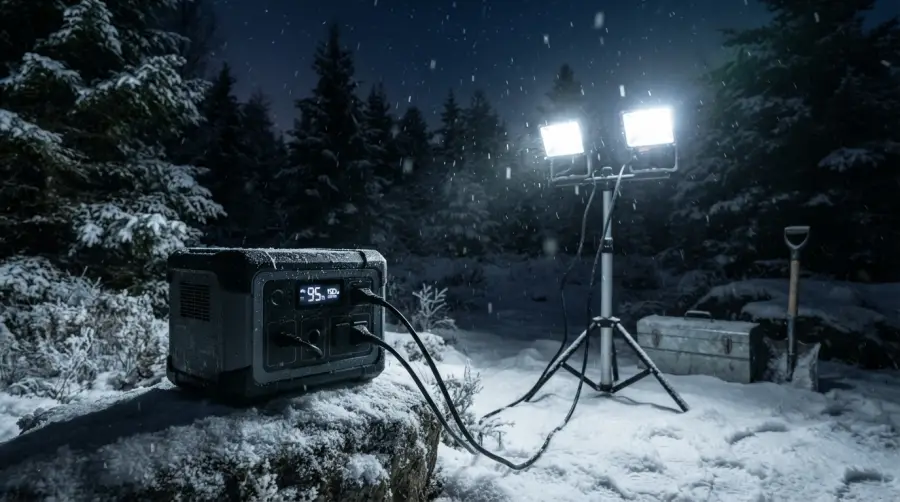
For many conventional lithium-ion batteries with graphite anodes, charging below the permitted temperature range can lead to lithium plating, potentially affecting battery life and safety. Therefore, a winter lighting system should confirm:
- Whether low-temperature charging protection is provided;
- Whether the temperature-sensing location accurately reflects cell temperature;
- Whether the charger or controller can stop charging when protection is triggered;
- How the system resumes operation after temperature returns to an acceptable range;
- Whether energy for a self-heating function comes from an external power source or from the battery itself.
Even if the battery includes self-heating, specific startup and power-supply conditions still need to be met. Self-heating should not be interpreted as proof that the battery is suitable for every cold-weather environment.
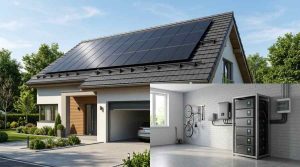
Winter Battery Selection for Solar Street Lights Must Also Consider Recharging Capability
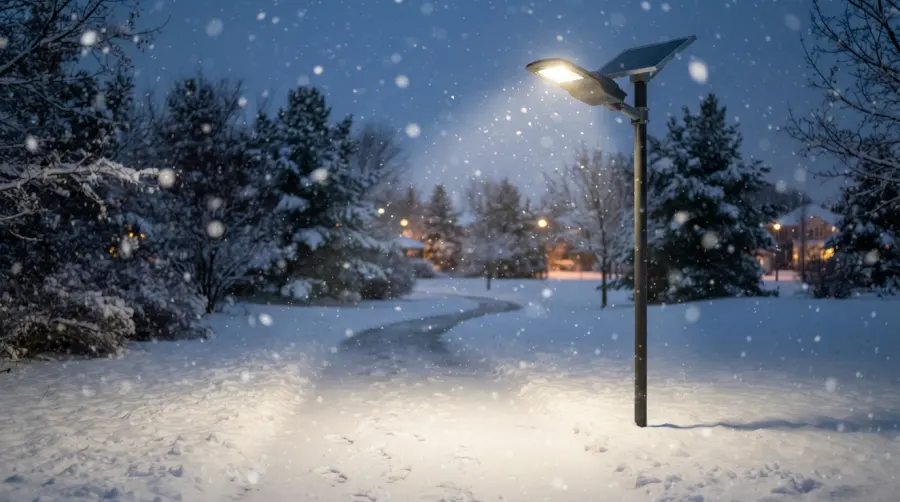
Fixed solar lighting systems need to balance nighttime energy consumption with daytime energy generation. Winter daylight hours, shading, snow accumulation, and consecutive cloudy days can all change the amount of energy available to recharge the battery each day.
If a lighting system consumes 200Wh each night and must operate for three nights without effective recharging, the lighting-side energy requirement is 600Wh. Battery nominal capacity must then be calculated based on usable energy at the target temperature and system losses.
However, increasing battery capacity only extends the energy-storage buffer. If daily energy input remains lower than daily consumption over an extended period, the battery’s state of charge will continue to decline.
Winter battery selection for solar street lights should therefore evaluate the following:
| Evaluation Item | Question to Answer |
| Nighttime lighting strategy | How long does each brightness level operate? |
| Winter solar generation | How much energy is expected to be recharged each day under local winter conditions? |
| Backup duration | How many nights must the system operate without effective recharging? |
| Charging temperature | When solar energy is available, is the cell temperature within the allowable charging range? |
| Heating consumption | Does battery preheating consume generated or stored energy? |
| Recovery capability | After several cloudy days, how long will it take to restore the energy that was consumed? |
Where appropriate, dimming or motion-sensing controls can reduce unnecessary lighting energy consumption, provided that the required illumination level is still maintained.
What Other Quality Details Should Be Verified From a Battery Manufacturing Perspective?
Cell Consistency and Battery Pack Testing
In a series-connected battery pack, differences in cell capacity, internal resistance, and temperature can affect overall pack performance. During procurement, evaluate cell-matching controls and request test information for the complete battery pack rather than relying only on individual cell specifications.
Useful low-temperature test data should identify the test temperature, cold-soak conditions, discharge current, cutoff voltage, and usable energy output.
Matching the BMS With the Lighting Driver
A BMS is a battery management system. In addition to overcharge, over-discharge, overcurrent, and short-circuit protection, verify whether temperature protection covers the actual operating conditions.
Some LED drivers may draw a short-duration inrush current at startup. If the protection thresholds, driver, and wiring are not properly matched, the battery may shut down as soon as the light is switched on. This should be investigated at the complete-system level.
Connections and Environmental Protection
Cold, moisture, and outdoor handling place additional demands on cables, connectors, and sealing structures. Verify the low-temperature suitability of cable materials, connector retention design, and protection under actual operating conditions.
An enclosure’s stated protection rating does not necessarily mean that the same level of protection is maintained when connectors or ports are open.
When a battery is moved from a cold outdoor environment into a warm indoor space, condensation should also be considered. Allow the battery to reach the temperature and dryness conditions specified by the manufacturer before charging.
Frequently Asked Questions About Winter Outdoor Lighting Batteries
If a Battery Is Rated for Use at -20°C, Does That Mean Runtime Will Stay the Same?
No. An operating temperature range defines the conditions under which the product is intended to operate; it does not mean that capacity and output capability remain unchanged throughout that range.
Review the discharge curves and test load at the target temperature.
For Winter Camping Lights, Should You Choose a Larger Battery or One With Better Low-Temperature Performance?
Compare actual usable energy at the target temperature while also considering weight and output requirements. A battery with a higher rated capacity may not necessarily provide longer effective lighting time if a smaller percentage of that capacity is usable in cold conditions.
Are LiFePO4 Batteries Suitable for Winter Outdoor Lighting?
LiFePO4 batteries can be considered for winter outdoor lighting, but the low-temperature discharge capability and charging limitations of the specific model should be verified.
For permanently installed systems, temperature protection, recharging conditions, and any required heating design should also be evaluated.
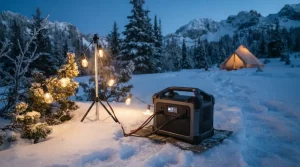
Why Does a Portable Power Station Shut Down Even When the Light Uses Very Little Power?
Some portable power stations include an automatic low-load shutdown function that may interpret a low-power light as having no load.
Check whether the power station offers an always-on mode and consider the standby consumption associated with that mode. Remaining battery capacity does not necessarily mean the output port will stay active indefinitely.
If a Battery Works Again After Bringing It Indoors, Does That Mean Nothing Is Wrong?
As temperature rises, some of the energy that was temporarily unavailable in cold conditions may become usable again. However, this alone is not enough to determine battery health.
If the battery continues to show abnormal heating, swelling, physical damage, or repeated shutdowns, stop using it and contact the supplier for inspection.
Can a Regular Power Bank Run a Camping Light in Winter?
Yes, provided the specifications are compatible. Check the power bank’s operating temperature range, output protocol, low-load shutdown behavior, and actual output energy.
The mAh rating printed on the enclosure is usually based on the voltage of the internal cells and should not be treated directly as the capacity available at the USB output when calculating runtime.
How Can You Extend Outdoor Lighting Runtime in Winter?
Use the lowest brightness setting that still meets your lighting requirements and avoid unnecessary extended operation at maximum brightness. Fully charge the battery according to the manufacturer’s instructions before departure.
For portable lighting, consider carrying a compatible backup power source. Spare batteries should have their terminals individually protected and should not be stored loosely with metal objects.
HiMAXBATT Batteries: Selecting Batteries Around Real-World Lighting Conditions
HiMAXBATT is a lithium battery manufacturer. For winter camping lights, outdoor work lights, and fixed lighting systems, customers can provide HiMAXBATT with information such as lighting input voltage, power consumption, required runtime, ambient temperature, and available installation space to discuss suitable battery products and integration requirements.
By reviewing low-temperature test data, charge and discharge limitations, and protection functions for the specific battery model, battery selection can be more closely aligned with real-world outdoor lighting requirements.