Commercial Disclosure: The HiMAXBATT Editorial Team brings together expertise in lithium battery manufacturing, battery engineering, power systems, and global application support to provide practical, technically informed content for businesses and industry professionals. Our content covers lithium-ion and LiFePO4 batteries, custom battery packs, BMS technology, charging solutions, battery selection, industrial applications, product updates, and HiMAXBATT news. All content reflects HiMAXBATT’s official editorial perspective and our commitment to delivering safe, reliable, and application-focused lithium battery solutions to customers worldwide.
Key Takeaways
- Telecom backup batteries need to match the base station’s DC power system, load demand, and required backup duration. Suitability cannot be determined from a “48V” label or capacity rating alone.
- LiFePO4 batteries are worth evaluating for sites with limited space, frequent power outages, or remote maintenance requirements. Lead-acid batteries may also be suitable for sites where existing infrastructure, budget, and maintenance conditions support their use.
- Base stations with stable utility power should place greater emphasis on calendar life and long-term standby performance. Sites with frequent outages also need to consider cycle life and recharge capability.
- Battery sizing should account for conversion losses, allowable depth of discharge, ambient temperature, and capacity loss due to ageing. Nominal energy should not be treated as directly equivalent to usable backup energy.
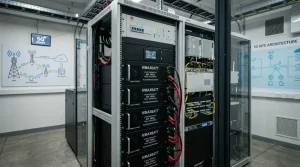
- Reliable base station backup power depends on the cells, BMS, electrical protection, thermal management, and remote monitoring working together, followed by validation under actual operating conditions.
Introduction
A telecom base station backup battery may rarely discharge during normal operation, but when utility power fails, it needs to take over the power supply promptly. If capacity is insufficient, charging settings are incompatible, or battery protection does not coordinate properly with the telecom power system’s control logic, the backup system may not deliver the expected runtime.
From a battery manufacturing perspective, a telecom backup battery suitable for 4G and 5G base stations should meet three fundamental requirements: usable energy sufficient for the backup target, output capability that supports the actual load, and an operating condition that can be monitored and maintained over the long term.
Battery selection should therefore begin with actual site operating conditions rather than a single battery chemistry or specification.
What Do 4G and 5G Base Stations Require From a Telecom Backup Battery?
Equipment configurations, traffic loads, and power conditions vary from one base station to another. Battery capacity cannot be standardized simply by identifying a site as “4G” or “5G.”
For example, multi-standard co-location, additional radio equipment, or expanded transmission equipment can all increase site power consumption. If an existing battery remains in service after an upgrade, the required backup runtime should be recalculated.
| Site Condition | Impact on the Backup Power System | Battery Selection Priorities |
| Stable utility power with few outages | Battery remains in standby for long periods | Calendar life, charging strategy, and condition monitoring |
| Frequent power outages | Repeated charge/discharge cycles, with potentially insufficient time for a full recharge | Cycle life, recharge capability, and usable capacity |
| Outdoor cabinets in high-temperature environments | Increased ageing and thermal management demands | Cell temperature, heat dissipation, and temperature derating |
| Sites in cold climates | Available capacity and charging capability may be limited | Low-temperature discharge performance, charging restrictions, or heating strategy |
| Space- or weight-constrained sites | Battery installation is restricted | Dimensions, weight, and maintenance clearance |
| Remote, unattended sites | Higher on-site maintenance costs | Remote alarms, fault logging, and module serviceability |
For 5G base station backup batteries, the configuration should be based on the actual load after expansion, while also identifying which equipment must remain powered during an outage. If equipment such as AC air conditioning is not connected to the same backup circuit, it should not automatically be included in the DC battery load. At the same time, changes in cooling conditions after a power outage should not be overlooked.
Why Does a 48V Telecom Backup Battery Still Require a Voltage Compatibility Check?
A nominal −48V DC power interface is common in telecommunications equipment, and ETSI EN 300 132-2 specifically addresses power supply interfaces for this type of ICT equipment. Reference: ETSI Standard Information
However, “48V telecom backup battery” describes a voltage class and does not mean that all products are interchangeable. Batteries with different series cell counts, chemistries, and control strategies may have different fully charged voltages and discharge cutoff voltages.
When selecting a battery, verify the following:
- Whether the battery’s operating voltage range is compatible with the rectifier and telecom equipment input range.
- Whether the battery’s charging voltage and current limits match the telecom power system settings.
- Whether the low-voltage disconnect threshold is coordinated with the BMS undervoltage protection.
- Whether cable voltage drop could cause the load to reach its undervoltage threshold prematurely.
- Whether wiring polarity, grounding configuration, and insulation requirements comply with the site design.
The nominal voltage marked on the battery pack and the negative-polarity designation of the telecom power system should not be treated as wiring instructions. Installation should follow verified electrical drawings and equipment manuals.
How Do You Calculate Battery Capacity for Base Station Backup Power?
Battery sizing starts with two inputs: the power demand of the loads that require backup and the required backup duration.
For sites with significant load variation, power data can be collected during representative traffic periods, and an appropriate design load can then be selected for backup calculations. Using a reading taken only during a low-traffic period may underestimate the actual requirement.
A preliminary estimate can be calculated as follows:
Required Nominal Energy (kWh) ≈ Load Power (kW) × Backup Time (h) ÷ System Efficiency ÷ Usable Discharge Ratio ÷ End-of-Life Capacity Retention Ratio ÷ Temperature Correction Factor
Suppose a site needs to support a 2kW load for four hours, using the following design assumptions:
| Parameter | Example Value | Meaning |
| Backup load | 2kW | Design load included in the backup circuit |
| Backup time | 4h | Project-defined backup duration |
| System efficiency | 95% | Estimated losses based on the actual power path |
| Usable discharge ratio | 90% | Percentage of battery energy allowed for use by design |
| End-of-life capacity retention ratio | 80% | Capacity design criterion after battery degradation |
| Temperature correction factor | 1 | No temperature derating assumed in this example |
The required nominal energy is approximately:
2 × 4 ÷ 0.95 ÷ 0.90 ÷ 0.80 ÷ 1.0 ≈ 11.7kWh
These values are provided only to demonstrate the calculation method and do not represent the performance of a specific product or a universal configuration. At a nominal voltage of 51.2V, this corresponds to approximately 229Ah. The actual number of battery modules should still be determined according to product specifications, discharge curves, and redundancy requirements.
If power has already been measured at the battery terminals, avoid applying power-path losses a second time. Temperature and ageing factors should also be based on supplier test data rather than arbitrary fixed coefficients.
Adequate energy capacity does not necessarily mean adequate power capability. For approximately constant-power telecom loads, current increases as battery voltage decreases. The battery, BMS, cables, and power distribution components should therefore also be checked against the current expected at the lower end of the operating voltage range.
Should Telecom Base Stations Use LiFePO4 or Lead-Acid Batteries?
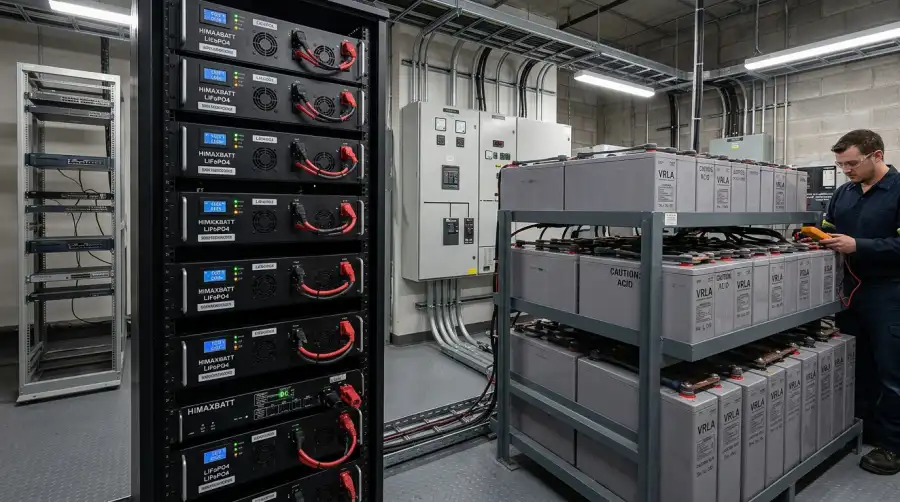
Both LiFePO4 and valve-regulated lead-acid (VRLA) batteries can be considered for telecom backup applications. Their suitability depends on site conditions and the complete system configuration.
| Comparison | VRLA Battery | LiFePO4 Battery |
| Initial purchase cost | Typically lower | Typically higher, depending on BMS and pack configuration |
| Space and weight | Usually larger and heavier for the same backup energy requirement | Typically offers advantages in reducing space and weight |
| Long-term standby | Requires an appropriate float-charging strategy and temperature management | Requires a compatible standby charging strategy and BMS management |
| Frequent cycling | Deep-cycle capability and recovery charging conditions should be verified | Cycle performance and recharge capability can be key evaluation factors |
| Maintenance and monitoring | Voltage, internal resistance, and temperature monitoring can be implemented | The BMS can provide cell-level data and alarms |
| Retrofit requirements | Existing systems may already have compatible infrastructure | Charging, communication, and protection compatibility should be verified |
The value of a LiFePO4 telecom battery should be evaluated based on actual usable energy, maintenance requirements, and the planned service period. Cell chemistry alone does not replace battery-pack safety design, nor does it demonstrate the reliability of the complete backup power system.
For existing sites, battery procurement, charging-system modifications, installation, temperature control, maintenance, and replacement costs can be compared over the same evaluation period rather than making a decision based only on the purchase price of the battery bank.
Why Shouldn’t You Evaluate a Telecom Backup Battery Based Only on Cycle Life?
Cycle life describes a battery’s durability under repeated charge and discharge cycles under specified conditions. Calendar life, by contrast, relates to capacity loss and increases in internal resistance that occur over time. A battery continues to age even if power outages are rare.
Technical literature for stationary lithium battery applications also distinguishes between these two ageing mechanisms and identifies temperature as an important factor affecting calendar life.
For telecom base stations that remain in standby for long periods, battery ageing should be evaluated under the actual operating temperature, state of charge, and charging strategy. For sites with frequent outages, cycle-life test conditions should also be reviewed, including depth of discharge, charge/discharge rate, ambient temperature, and end-of-life capacity criteria.
From a manufacturing perspective, cell-level testing should also be distinguished from battery-pack testing. Cell consistency, interconnection quality, temperature distribution, and balancing strategy all affect pack-level performance. Cycle-life data from an individual cell should not be treated directly as a service-life commitment for the complete battery pack.
How Do BMS and Safety Design Support Reliable Base Station Backup Power?
Battery Protection Should Coordinate With the Site’s Power Management Logic
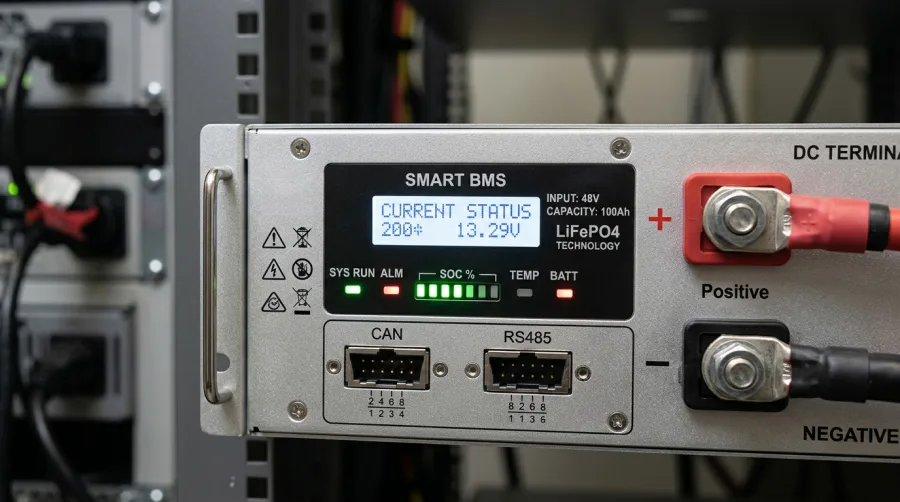
A BMS typically monitors individual cell voltage, current, and temperature while providing protection against conditions such as overcharge, overdischarge, and overcurrent. Reliable backup operation, however, also requires clear control logic for when to issue warnings, when to limit charging or discharging, when to disconnect loads, and how power should be restored.
If the BMS disconnects the battery before the site’s low-voltage management strategy takes effect, actual backup behavior may differ from the intended design. The battery and telecom power system should therefore be validated together.
Remote Communication Requires More Than a Compatible Interface
Having a CAN or RS485 interface does not automatically mean the battery can connect directly to an existing monitoring platform. The communication protocol, address configuration, data units, alarm definitions, and system response to communication loss should also be verified.
Useful monitoring data can include state of charge, cell voltage deviation, temperature, charge/discharge current, and historical fault records. Because LiFePO4 batteries have a relatively flat voltage profile across part of their discharge range, remaining capacity cannot always be accurately determined from terminal voltage alone. An appropriate state-of-charge estimation and calibration strategy is also necessary.
Thermal Management and Electrical Protection Should Cover the Complete Battery Pack
Cell retention, insulation, short-circuit protection, wiring-harness abrasion protection, connection security, fuse protection, and abnormal heat management are all part of battery-pack design. Outdoor cabinets may also need to account for moisture, condensation, dust, and changes in external temperature.
For industrial lithium battery projects, the applicability of standards such as IEC 62619 can be evaluated according to the project requirements and target market. The standard addresses safety requirements and testing for secondary lithium cells and batteries used in industrial applications, but it does not replace on-site system acceptance. Reference: IEC 62619:2022
Why Is Recharge Capability Important at Sites With Frequent Power Outages?
After one outage ends, the battery may not have recovered enough energy before another outage occurs. In this situation, even if the initial battery capacity meets the design requirement, the available backup time during consecutive outages may decrease.
Recharge capability depends on available rectifier capacity, the battery’s allowable charging current, temperature, and current limiting during the later stages of charging. The rectifier must supply both the base station load and battery charging demand, so its entire rated output should not be treated as available charging power.
For parallel battery systems, the maximum number of modules, current-sharing performance, and remaining power capability after one module is taken offline should also be verified. Redundancy design should satisfy both power requirements and the specified backup duration rather than treating “one extra battery module” as sufficient proof of redundancy.
Frequently Asked Questions About Telecom Backup Batteries
Does a 5G Base Station Always Need a Larger Battery Than a 4G Base Station?
Not necessarily. Battery capacity should be calculated based on equipment quantity, actual load, energy-saving strategies, and required backup duration rather than the network generation alone. If an upgrade increases the load, battery capacity will generally need to be reassessed, but a fixed multiplier should not be applied to every site.
How Long Can a 48V 100Ah Telecom Battery Power a Base Station?
A nominal 48V, 100Ah battery provides approximately 4.8kWh of nominal energy. Actual backup time also depends on load power, usable discharge ratio, system losses, temperature, and battery degradation. If the product’s actual nominal voltage is 51.2V, its energy should be calculated using that value. Not all batteries in the “48V class” should be treated as identical.
Can a Lead-Acid Battery at a Telecom Base Station Be Directly Replaced With a Lithium Battery?
A compatibility assessment is required first. Key considerations include rectifier charging settings, low-voltage disconnect thresholds, monitoring protocols, electrical protection, and cabinet installation conditions. Existing lead-acid equalization or temperature-compensation settings should also be reviewed and adjusted as required for the lithium battery.
Can New and Used Telecom Batteries Be Connected in Parallel?
They should not be mixed without proper evaluation. Differences in voltage, internal resistance, remaining capacity, and BMS strategy can lead to uneven current distribution or unexpected protection events. Follow the manufacturer’s approved parallel-connection requirements and validate both the connection process and operating behavior.
Do Outdoor Telecom Lithium Batteries Need Heating?
It depends on the site’s temperature conditions and the battery’s permitted charging range. Some low-temperature environments may require charging to be disabled, current to be limited, or battery heating to be used. If a heating function is included, its energy consumption should also be accounted for when evaluating backup duration and recharge requirements.
HiMAXBATT Batteries: Evaluating Telecom Backup Solutions Around Site Requirements
HiMAXBATT provides LiFePO4 batteries, lithium-ion batteries, and OEM/ODM battery solutions. For 4G and 5G base station backup projects, you can provide the system voltage range, load power, target backup duration, ambient temperature, cabinet dimensions, and communication protocol when discussing battery selection and customization requirements with HiMAXBATT. Specific capacity, recharge capability, parallel configuration, service-life data, and test documentation should be determined according to the project’s technical specifications and validation results.