| Commercial Summary: Generally, HiMAXBATT does not derive revenue from its articles; the editorial viewpoints expressed therein are our own and are published independently. We are a manufacturer of lithium batteries. |
Key Takeaways
- Define operating loads, runtime targets, installation space, and charging requirements before development.
- Balance voltage, capacity, discharge capability, BMS protection, and mechanical design.
- Validate battery performance under actual vacuum cleaner operating conditions.
- Evaluate suppliers’ engineering capabilities, production controls, and traceability.
- Compare total project costs and establish clear milestones from samples to production.
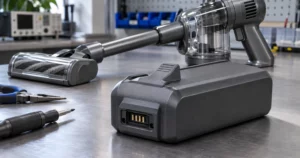
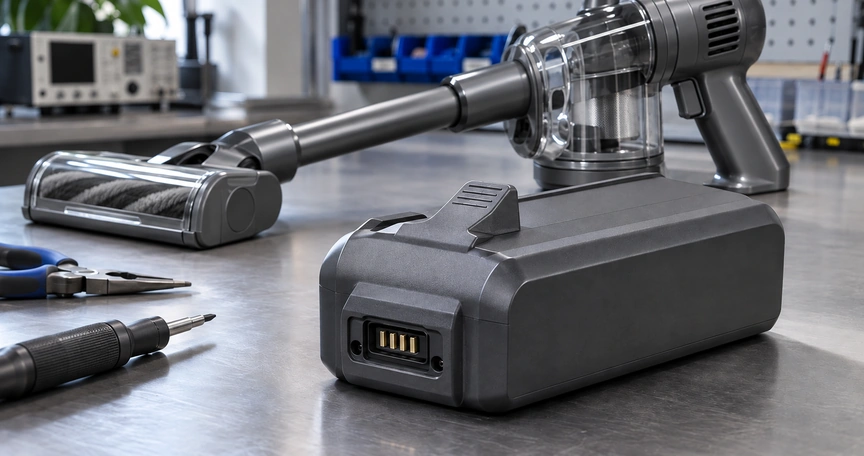
Battery pack design affects a vacuum cleaner’s runtime, power delivery, handling weight, and service needs. For brands and OEM/ODM manufacturers, a custom battery project requires a system-level review of the cells, protection circuitry, mechanical structure, and vacuum cleaner controls.
From a battery manufacturing perspective, clear requirements, a practical validation plan, and consistent production controls provide the foundation for a successful project. This guide explains the key design and purchasing considerations for OEM custom vacuum cleaner battery packs.
Define the Vacuum Cleaner’s Requirements Before Starting Development
Battery manufacturers need actual load requirements to develop a suitable design. If a buyer provides only nominal voltage and capacity, the supplier may not have enough information to determine whether the pack can support motor startup, high-power mode, and sustained operation.
At the start of the project, the vacuum cleaner manufacturer’s engineering and purchasing teams should prepare the following information:
| Requirement Category | Information to Provide | Impact on the Design |
| Operating load | Input power by mode, startup current, and operating time | Cell discharge capability and protection settings |
| Installation constraints | Battery compartment dimensions, weight limit, and mounting method | Cell arrangement and mechanical design |
| Charging requirements | Charger output, charging time, and dock interface | Charging strategy and interface compatibility |
| Operating environment | Operating temperature, storage conditions, and exposure to dust or moisture | Thermal management and enclosure protection |
| Commercial requirements | Target markets, purchasing forecast, and project milestones | Compliance planning and production capacity |
Runtime targets should also specify the test conditions, including the cleaning attachment, floor surface, and operating mode. Both parties need consistent conditions to compare the performance of different designs.
Core Design Requirements for Vacuum Cleaner Battery Packs
Match Voltage, Capacity, and Discharge Capability
The battery’s voltage configuration must work with the motor, controller, and charging system across the full operating range, from a full charge to the discharge cutoff. If the number of cells in series changes, engineers need to reassess component voltage ratings and control logic.
Capacity determines how much electrical charge the battery can store, but runtime also depends on load, conversion efficiency, temperature, and cutoff settings. Watt-hours can help compare the nominal energy of designs with different voltages, while actual runtime requires testing in the vacuum cleaner.
Cell selection should account for continuous discharge capability, pulse-load performance, and internal resistance. A high-capacity cell may not be suitable for sustained high-current operation. Adding parallel cells also affects size, weight, and interconnection requirements.
Coordinate BMS Protection With the Vacuum Cleaner’s Controls
The battery management system, or BMS, should provide overcharge, overdischarge, overcurrent, short-circuit, and temperature protection appropriate to the design. Protection thresholds and delays need to account for cell specifications, startup current, and equipment fault conditions.
Poorly matched overcurrent settings may cause the battery to shut down during normal startup. Settings that are too permissive may allow fault currents to place additional stress on cells or interconnections. Manufacturers therefore need to verify protection activation and recovery behavior through testing.
For designs that use battery communication, both parties should also define the data protocol, battery level reporting, fault reporting, and sleep and wake behavior. This helps prevent situations in which the pack supplies power but the vacuum cleaner fails to recognize it correctly.
Address Thermal Management and Mechanical Connections Together
Temperature-rise assessments should cover cells, power components, interconnects, and terminals. Engineers should position temperature sensors based on current paths, contact resistance, and heat dissipation rather than relying solely on enclosure temperature.
Mechanical design should address cell retention, electrical insulation, wire protection against abrasion, and connectors that prevent incorrect insertion. Removable battery packs also require checks of latch engagement and terminal alignment to reduce connection problems caused by repeated insertion, vibration, or accidental drops.
Testing and Validation for Battery Pack Samples
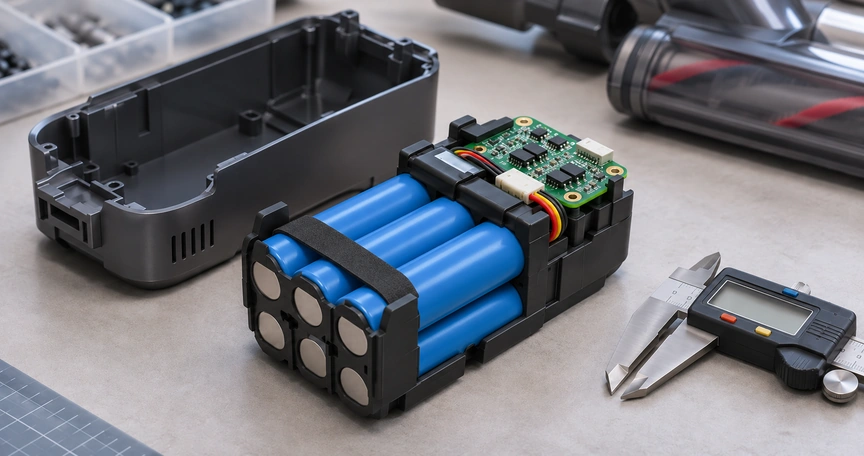
Vacuum cleaner battery testing should cover both the battery pack itself and its operation in the finished appliance. Completing a single charge and discharge cycle does not establish that a sample meets requirements for sustained use, service life, or abnormal conditions.
| Test Area | What to Evaluate | Conditions to Define |
| Capacity and runtime | Usable charge and runtime in each operating mode | Temperature, load, charging procedure, and cutoff conditions |
| Load performance and temperature rise | Voltage drop, startup behavior, and temperatures at key locations | State of charge, operating mode, and test duration |
| Cycle life | Capacity retention, changes in internal resistance, and abnormal behavior | Charge and discharge profiles and rest intervals |
| Protection functions | Activation thresholds, response, and recovery behavior | Fault simulation method and acceptance criteria |
| Mechanical reliability | Retention, insulation, and connection integrity | Vibration, drop, and insertion/removal conditions |
The validation plan should also include low-battery operation, repeated starts, and expected changes in ambient temperature. Some problems appear only when several conditions occur together, so test personnel should document the full operating conditions to support root-cause analysis.
For safety validation, the International Electrotechnical Commission’s overview of safety requirements for portable lithium cells and batteries describes the scope of IEC 62133-2, including requirements and tests addressing intended use and reasonably foreseeable misuse. Each project should confirm its validation needs based on product classification, target markets, and the applicable edition of the standard.
Transportation requirements need a separate review. The U.S. Department of Transportation’s Pipeline and Hazardous Materials Safety Administration provides guidance on lithium battery transportation test summaries, explaining requirements related to UN 38.3 design testing and test summaries. Transportation test documentation does not replace appliance performance validation or independently establish compliance with every requirement in the target market.
Both parties should agree on sample quantities, test sequences, and failure criteria in advance, then retain sample revision details, raw data, and corrective action records.
How to Evaluate a Vacuum Cleaner Battery Pack Supplier
Supplier evaluation should address three questions: Can the design be manufactured? Can quality be maintained consistently? Can problems be traced? Buyers should verify capability claims against actual records.
Start by reviewing how the supplier handles requirements. An engineering team should be able to identify missing information, explain its selection criteria, and propose testable alternatives when performance, space, and cost requirements conflict.
Next, review cell sourcing and incoming inspection. Buyers should understand whether the supplier records cell models, lot numbers, and inspection results, and how it controls differences in capacity, internal resistance, and other specified parameters. Substitute cells also require review; similar dimensions and nominal capacity alone do not justify a replacement.
Production audits should cover welding parameters, insulation assembly, error prevention, and outgoing inspection. A buyer can select a finished-product lot and check whether it can be linked to cell lots, production records, and inspection results. This provides practical evidence that the traceability system is being used.
Test documentation should also correspond to the delivered model, construction, and key materials. Similar document titles do not necessarily mean the documents cover the same products or configurations.
Delivery and after-sales assessments should address critical material availability, capacity planning, issue response, and failure analysis procedures. Clearly assigned responsibilities help both parties resolve production deviations and customer feedback promptly.
Compare Custom Battery Quotes and Total Project Costs
When comparing custom vacuum cleaner battery pack quotes, buyers should first align the technical specifications and scope of supply, then assess the price differences.
| Cost Item | What to Confirm in the Quote |
| Battery pack unit price | Cell model, material configuration, and order quantity |
| Development and tooling | Scope of fees, number of revisions, and tooling ownership |
| Testing | Test scope, sample consumption, and report coverage |
| Delivery and after-sales support | Packaging, shipping, warranty terms, and repair responsibilities |
A low unit price may still lead to higher total spending if development, validation, or packaging costs are excluded. Buyers should also evaluate the ongoing availability of critical cells and the cost of revalidation when materials change.
For scheduled or repeat orders, both parties can agree on quote validity, lead times, and the basis for price adjustments to reduce misunderstandings on future purchases.
Establish Clear Milestones From Samples to Production
Custom battery projects need defined deliverables to maintain revision control. During design review, both parties should confirm the specification, mechanical drawings, and interface definitions. During sample approval, they should document the sample revision, validation results, and unresolved issues.
During pilot production, the manufacturer needs to assess whether the process is practical, whether output remains consistent across the lot, and whether corrective actions are effective. Production release should follow the agreed technical documents and acceptance criteria rather than relying only on early samples.
If cells, BMS firmware, connectors, or enclosure materials change, the supplier should submit an impact assessment. Both parties can then determine whether additional testing, document updates, or renewed sample approval is needed.
For volume shipments, buyers should also specify packaging labels, lot identification, and accompanying documents so that incoming acceptance and after-sales traceability have a clear reference.
HiMAXBATT: Custom Lithium Battery Packs and Integration Support for Vacuum Cleaners
HiMAXBATT is a lithium battery manufacturer. For custom vacuum cleaner battery pack projects, share your appliance specifications, operating conditions, and purchasing plans with HiMAXBATT to discuss design feasibility, sample validation, and delivery arrangements.