| Generally, HiMAXBATT does not derive revenue from its articles; the editorial viewpoints expressed therein are our own and are published independently. We are a manufacturer of lithium batteries. |

Key Takeaways
- When choosing a lithium battery for a 12V fridge, check the fridge’s input voltage, daily energy consumption, battery capacity, and battery management system (BMS) discharge ratings.
- A fridge’s rated running power is different from its average power consumption over a full day. Use measured 24-hour energy consumption whenever possible.
- Amp-hours (Ah) describe charge capacity, while watt-hours (Wh) describe energy. Convert capacity to Wh when comparing batteries with different voltages.
- Runtime estimates should account for usable battery capacity, wiring losses, ambient temperature, and other connected devices.
- AC charging, vehicle charging, and solar charging each have specific requirements. Charging equipment must match the battery’s specifications.
- From a battery manufacturing perspective, cell consistency, BMS protection, mechanical design, and test conditions all matter when evaluating a battery.
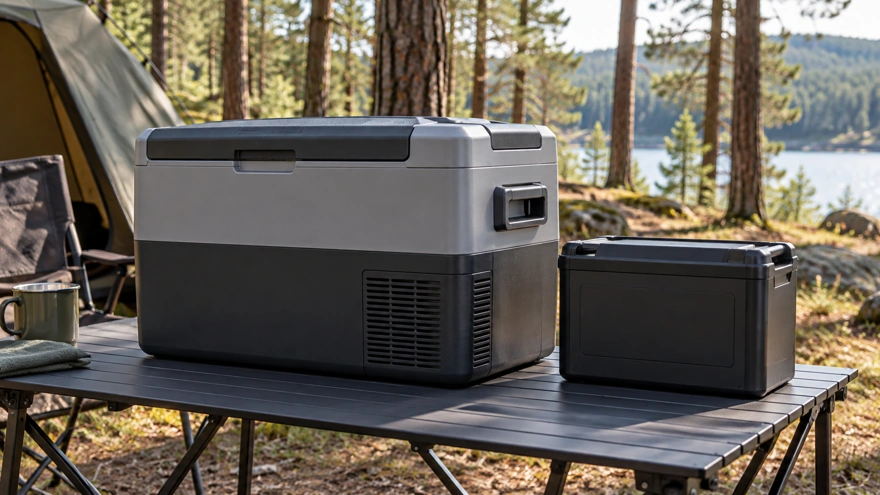
Whether you’re camping, taking a road trip, traveling in an RV, or living off-grid, keeping a 12V fridge running depends on how well the battery works with the rest of the power system. Questions like “Is 50Ah enough?”, “How long will a 100Ah battery last?”, and “Can solar panels run the fridge while charging the battery?” require more than a capacity number.
This guide uses a typical 12V DC compressor fridge paired with a 12.8V lithium iron phosphate (LiFePO4) battery as an example to explain the relationship between power, capacity, runtime, and charging. The calculations are intended for system planning and do not represent tested performance claims for a particular fridge or battery. Thermoelectric coolers and AC refrigerators powered through an inverter require calculations based on their specific operating characteristics.
How Much Power Does a 12V Fridge Battery Need to Supply?
Before choosing a battery, distinguish between three specifications: the fridge’s running power, startup requirements, and daily energy consumption.
| Specification | What It Means | Why It Matters for Battery Selection |
| Running power, in W | Input power while the compressor is running | Helps estimate operating current |
| Startup current and duration | Short-term demand when the compressor starts or the controller powers up | Helps verify BMS, connector, and wiring capacity |
| Daily energy consumption, in Wh/day | Total energy consumed over 24 hours | Determines battery capacity and estimated runtime |
| Input voltage range | Voltage range the fridge accepts | Determines compatibility throughout the battery’s charge and discharge cycle |
For example, a fridge drawing 60W at a 12V input uses approximately:
Operating current = Power ÷ Voltage = 60 ÷ 12 = 5A
However, that does not mean it consumes 60 × 24 = 1,440Wh every day. A compressor typically cycles on and off as the interior temperature changes. Variable-speed models can also adjust compressor power.
Startup current should not be estimated using one fixed multiplier for every compressor fridge. Controllers and startup methods vary. Check the fridge manufacturer’s specifications and measure startup demand if necessary.
How Much Energy Does a 12V Fridge Use Per Day? Start With the Operating Conditions
The same 12V fridge can consume different amounts of energy under different operating conditions.
| Factor | Change in Conditions | Common Effect on Energy Use |
| Ambient temperature | Moving from a cool location to a hot vehicle interior | Higher cooling demand may increase consumption |
| Temperature setting | Switching from refrigeration to freezing | Compressor runtime may increase |
| Initial food temperature | Adding a large amount of room-temperature food | Energy use increases during the initial cooling period |
| Lid-opening frequency | Frequently removing food or drinks | More heat enters the fridge |
| Ventilation | Blocking cooling vents with luggage | Poor heat rejection may extend compressor runtime |
| Pre-cooling | Starting with a warm fridge | First-day consumption may exceed steady-state consumption |
A practical approach is to use a compatible DC energy meter to measure consumption over 24 hours under conditions similar to your trip. Match the expected ambient temperature, food load, and temperature setting as closely as possible. A measurement taken in a cool room may not reflect summer operation inside a vehicle.
If measured data is unavailable, use this preliminary estimate:
Daily energy consumption ≈ Running power × 24 hours × Duty cycle + Standby energy consumption
Duty cycle is the percentage of time the compressor runs during the measurement period. For example, assuming 50W running power and a 40% duty cycle, daily consumption would be approximately 480Wh before adding standby consumption. The 40% duty cycle is an illustrative assumption and should be replaced with measured data.
Ah vs. Wh: Why Battery Capacity Requires More Than an Ah Rating
Amp-hours describe a battery’s charge capacity. Watt-hours describe its stored energy. The relationship is:
Nominal energy in Wh = Nominal voltage in V × Rated capacity in Ah
For a 12.8V LiFePO4 battery:
| Rated Capacity | Nominal Voltage | Nominal Energy |
| 50Ah | 12.8V | 640Wh |
| 100Ah | 12.8V | 1,280Wh |
| 150Ah | 12.8V | 1,920Wh |
| 200Ah | 12.8V | 2,560Wh |
A battery marketed as a “12V LiFePO4 battery” commonly contains four cells connected in series, each with a nominal voltage of 3.2V. This produces a nominal pack voltage of 12.8V. Other lithium chemistries have different cell voltages and charging requirements, so the term “12V lithium battery” alone does not establish compatibility.
Nominal energy also differs from the energy available to the fridge. Discharge settings, temperature, aging, and the cutoff behavior of both the BMS and the fridge can affect usable capacity.
How to Calculate Lithium Battery Runtime for a 12V Fridge
Once you know the fridge’s daily energy consumption, use:
Runtime in days ≈ Battery nominal energy × Usable discharge fraction × Delivery efficiency ÷ Daily energy consumption
The following estimates use these assumptions:
- A 12.8V LiFePO4 battery.
- A usable discharge fraction of 90%.
- A delivery efficiency of 95% between the battery and fridge.
- No charging input and no additional connected loads.
- No additional capacity reduction for cold temperatures or aging.
| Battery Capacity | Estimated Energy Delivered to Fridge | At 300Wh/Day | At 500Wh/Day | At 800Wh/Day |
| 50Ah | About 547Wh | About 1.8 days | About 1.1 days | About 0.7 days |
| 100Ah | About 1,094Wh | About 3.6 days | About 2.2 days | About 1.4 days |
| 150Ah | About 1,642Wh | About 5.5 days | About 3.3 days | About 2.1 days |
| 200Ah | About 2,189Wh | About 7.3 days | About 4.4 days | About 2.7 days |
These figures are calculations based on consistent assumptions, rather than guaranteed runtimes. If daily consumption was measured at the battery output and already includes wiring losses, do not deduct those same losses again.
If the battery also powers lights, phones, or a water pump, add their daily energy consumption before calculating runtime.
Working Backward: How Many Ah Do You Need for Two Days?
Suppose the fridge consumes 500Wh per day, and you want two days of operation without recharging:
Required capacity ≈ 500 × 2 ÷ (12.8 × 90% × 95%) ≈ 91.4Ah
Under these assumptions, a 100Ah battery would be a candidate. Hot weather, additional loads, and future capacity loss may justify an explicit planning allowance.
For example, adding a 20% allowance to the energy requirement increases the calculated capacity to approximately 110Ah. You could then evaluate available 120Ah or 150Ah options. The 20% allowance is an example design choice, rather than a universal requirement.
What Else Matters From a Battery Manufacturing Perspective?
Capacity determines how much energy a battery stores. Cell selection, the BMS, and mechanical design influence how that energy is delivered.
| Evaluation Point | What to Check | Why It Matters |
| Cell consistency | Capacity, internal resistance, self-discharge, and cell-matching controls | Helps reduce early protection trips caused by an individual cell reaching its limit |
| BMS continuous discharge rating | Continuous current and applicable temperature conditions | Supports the fridge and other simultaneous loads |
| BMS short-duration discharge rating | Current rating and permitted duration | Supports startup and other transient demands |
| Low-temperature charging protection | Temperature sensing, charge inhibition, and recovery behavior | Helps prevent charging outside the cells’ permitted temperature range |
| Construction and connections | Mounting, terminals, enclosure protection rating, and operating conditions | Supports the intended installation and vehicle environment |
| Capacity and cycle-life testing | Temperature, charge/discharge rate, depth of discharge, and end-of-life criteria | Enables comparisons under equivalent conditions |
When comparing cycle-life claims, review the test conditions. A cycle count without depth of discharge, temperature, and capacity-retention criteria provides limited value for product comparison.
Also verify that the fridge’s accepted input voltage range covers the battery’s normal charging and discharging voltage range.
How to Charge a Lithium Battery Used With a 12V Fridge
A charging system must meet the battery’s voltage, current, and temperature requirements.
| Charging Method | Typical Use | Compatibility Checks |
| AC battery charger | Charging before departure or at a powered campsite | Correct battery chemistry and manufacturer-approved settings |
| Vehicle DC-to-DC charger | Recharging while driving an RV or other vehicle | Compatibility with the vehicle charging system, appropriate current limiting, and charge control |
| Solar charge controller | Parked or off-grid operation | Correct battery settings, acceptable PV input voltage, and controller ratings |
| Multiple charging sources | Combining vehicle charging, solar, or other sources | Combined charging current and coordination between charging devices |
Battery University, a battery education resource, explains how LiFePO4 charging voltage characteristics differ from those of other lithium-ion chemistries and discusses charging control requirements. In practice, use the settings specified by the battery manufacturer rather than automatically applying another lithium chemistry’s settings or a lead-acid charging profile. Reference: Battery University’s guide to charging lithium iron phosphate
How Long Does It Take to Charge a 100Ah Lithium Battery?
A preliminary estimate is:
Charging time ≈ Capacity to replace in Ah ÷ Effective charging current in A
For example, charging a 100Ah battery from 20% to 100% state of charge requires replacing approximately 80Ah. At an effective charging current of 20A, the idealized calculation is about four hours. Actual charging may take longer because of current taper near full charge, temperature limits, or loads operating during charging.
If the fridge runs while the battery charges, some charger output powers the fridge, reducing the net current available to recharge the battery.
What Size Solar Panel Can Support a 12V Fridge?
Start with a daily energy balance:
Daily solar energy supplied ≈ Panel rated power × Equivalent peak sun hours × Overall system efficiency
For example, a 200W solar panel receiving four equivalent peak sun hours per day at an assumed system efficiency of 75% would supply approximately 600Wh per day. If the fridge consumes 500Wh daily, that leaves an estimated 100Wh margin under those conditions.
Cloud cover, shading, mounting angle, and panel temperature can all change actual solar output, so plan battery storage or another charging source for extended periods of limited sunlight.

FAQ: Choosing a Lithium Battery for a 12V Fridge
How Long Will a 100Ah Lithium Battery Run a 12V Fridge?
For a 12.8V, 100Ah battery, assuming a 90% usable discharge fraction and 95% delivery efficiency, approximately 1,094Wh is available to the fridge. Estimated runtime is about 2.2 days at 500Wh per day or 1.4 days at 800Wh per day. Actual runtime depends on operating conditions.
Is a 50Ah Lithium Battery Suitable for a Camping Fridge?
A 50Ah battery can be considered for short trips or setups with regular charging access. Check daily consumption first. Under this guide’s assumptions, it delivers approximately 547Wh to the fridge. At 500Wh per day, the remaining margin is small, particularly if other devices share the battery or weather conditions increase consumption.
Does a 12V Fridge Need an Inverter?
If the fridge accepts DC power throughout the battery’s operating voltage range, it can generally use a suitable DC connection. Powering an AC input through an inverter adds conversion losses and inverter standby consumption, which must be included in the energy budget.
Why Does the Fridge Stop Even When the Battery Still Has Charge?
The fridge’s low-voltage protection may have activated. Undersized wiring, long cable runs, or poor connections can also cause voltage drop at the fridge input. Check voltage at both the battery and the fridge while the compressor runs or starts, and review the protection settings.
Can a LiFePO4 Battery Be Charged in Winter?
Follow the charging temperature range specified for the particular battery. Low-temperature discharge capability and low-temperature charging capability are different specifications. Batteries with built-in heating also have requirements governing heater operation and charging control.
Can a Vehicle’s 12V Accessory Socket Power a Fridge Continuously?
Check the socket’s current rating, plug condition, and wiring. Some vehicles switch accessory sockets off when the ignition is off. For extended parked use, evaluate a dedicated house battery and a suitable arrangement for isolating it from the starter battery.
Is a Larger Lithium Battery Always a Better Fit for a Fridge?
More capacity increases stored energy, but it also affects cost, weight, installation space, and charging time. Size the battery around daily consumption, desired runtime, and available charging sources, then check BMS ratings and installation requirements.
HiMAXBATT: Evaluating Battery Options Around Your Power Needs
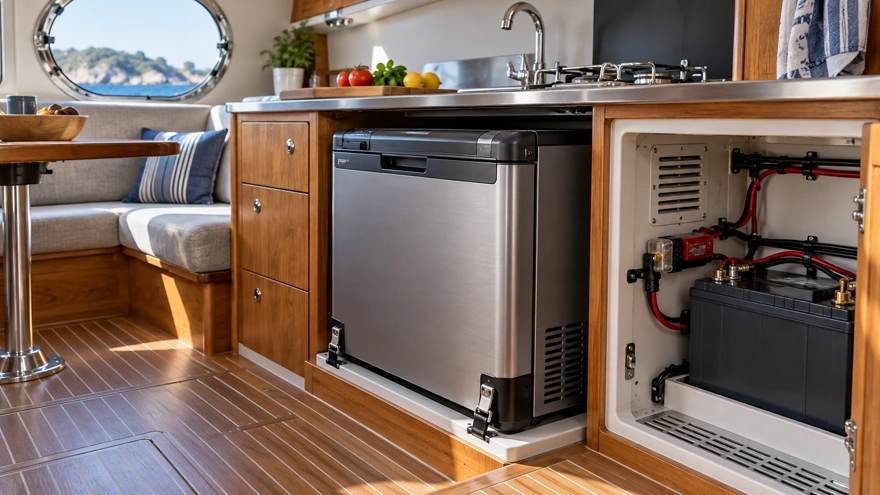
Choosing a lithium battery for a 12V fridge requires evaluating capacity, voltage compatibility, BMS protection, and charging conditions together. When reviewing HiMAXBATT batteries, check each model’s rated energy, charging and discharging specifications, operating temperature range, dimensions, and test conditions. Share your fridge model, measured daily energy consumption, target runtime, and charging setup with HiMAXBATT to discuss suitable battery options and power configurations, giving your selection a clearer technical basis and making everyday energy planning easier.