| Commercial Summary: Generally, HiMAXBATT does not derive revenue from its articles; the editorial viewpoints expressed therein are our own and are published independently. We are a manufacturer of lithium batteries. |
Key Takeaways
- Confirm that you need a starting battery for a gas-powered ATV.
- Match the battery’s voltage, dimensions, terminals, and mounting requirements.
- Compare amp-hour capacity and cold cranking amps separately.
- Choose between flooded lead-acid, AGM, and lithium based on your riding conditions.
- Verify charging compatibility before switching from lead-acid to lithium.
- For bulk orders, evaluate testing records, batch consistency, and warranty terms.
When an ATV cranks slowly or loses its charge during storage, replacing the battery may seem like the obvious solution. However, batteries that look similar can have different starting capabilities, terminal layouts, and charging requirements. Choosing the wrong one can create installation problems and increase maintenance costs.
From a battery manufacturing perspective, choosing the right ATV battery means translating the vehicle’s requirements into specifications you can verify and test. Whether you are replacing a single battery or sourcing batteries for a dealership, start by checking the application, fitment, performance requirements, and operating conditions.
Start With the Application: Starting Battery or Traction Battery?
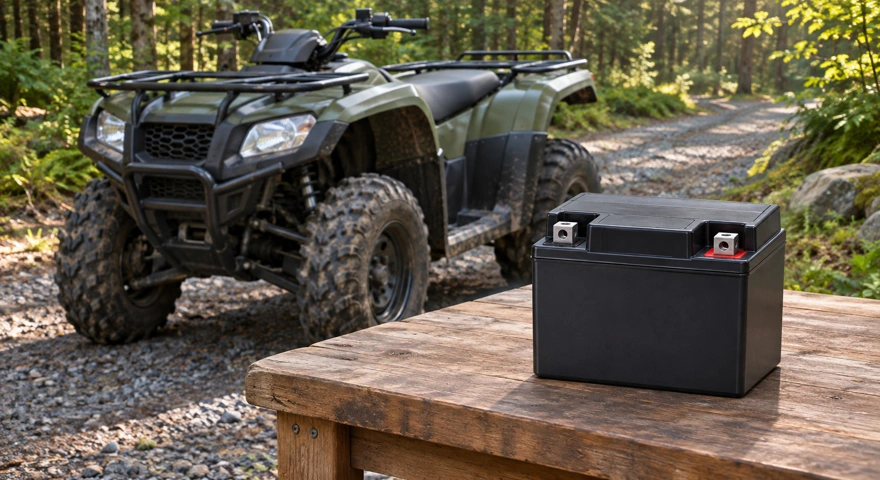
A starting battery in a gas-powered ATV delivers a brief burst of high current to the starter motor. It also powers certain electrical components when the engine is off. Once the engine is running, the vehicle’s charging system supplies electrical power and recharges the battery.
An electric ATV’s traction battery continuously supplies energy to the drivetrain. Selecting one involves evaluating range, continuous discharge capability, controller compatibility, and the vehicle’s system voltage. Starting batteries and traction batteries serve different purposes and should not be treated as interchangeable simply because their capacities or connectors look similar.
This guide focuses on starting batteries for gas-powered ATVs. Tell your supplier that the battery will be used for engine starting so that a general-purpose energy storage or traction battery is not mistakenly selected.
Check Fitment: What Should You Verify Before Buying?
Use the owner’s manual, original equipment parts information, and verified fitment records as your starting point. The existing battery’s label can help, but you should double-check the specifications if the ATV has been modified or previously fitted with an incorrect battery.
| Item to Check | What to Verify |
| Vehicle information | Make, model, model year, and relevant configuration |
| Nominal voltage | Compatibility with the vehicle’s electrical system |
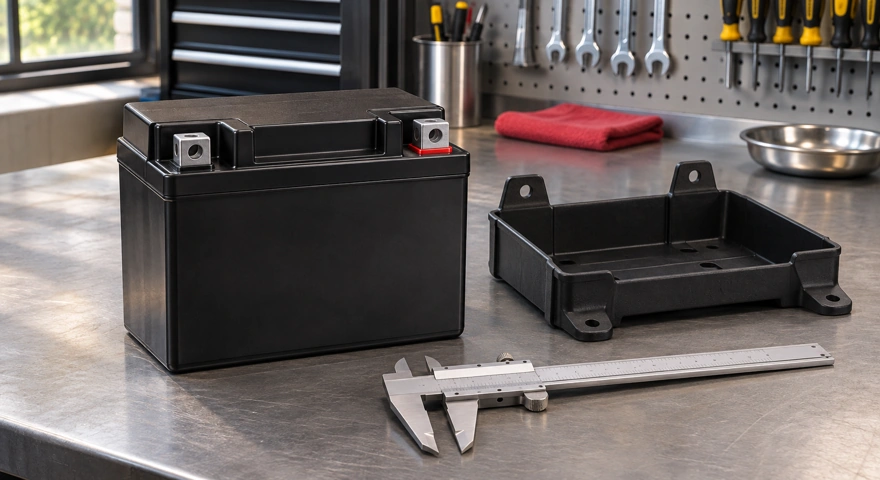
| Battery dimensions | Length, width, height, and clearance around projecting terminals |
| Terminals and polarity | Positive and negative terminal locations, connection type, and cable reach |
| Mounting and installation | Hold-down hardware, battery tray, installation orientation, and venting requirements |
When a manufacturer evaluates a replacement battery, matching the case size is only part of the process. A different terminal position can put tension on the cables, while an inadequate hold-down can allow connections to loosen on rough terrain. Conventional flooded lead-acid batteries also require attention to vent hose connections and routing.
Engine displacement alone does not determine the correct battery. ATVs with the same engine size may have different starting systems and electrical configurations. Dealers should maintain fitment lists organized by model and model year.
Understand the Ratings: How Much Ah Capacity and CCA Do You Need?
Amp-hour capacity, or Ah, describes how much electrical charge a battery can deliver under specified test conditions. Cold cranking amps, or CCA, describe its ability to supply starting current under specified cold-temperature conditions. These ratings answer different questions: how much charge the battery can provide and how much starting current it can deliver in the cold.
Start by meeting the vehicle’s starting requirements. Then evaluate capacity based on electrical draw during storage and the demands of installed accessories. A higher-capacity battery may take longer to discharge, but it will not fix a parasitic drain, a poor connection, or an underperforming charging system.
| Rating | What to Look For When Comparing Batteries |
| Amp-hour capacity | Discharge rate, test temperature, and cutoff voltage |
| Cold cranking amps | Test standard and temperature |
| Pulse cranking current | Pulse duration; do not treat it as equivalent to CCA |
| Lead-acid equivalent capacity | Confirm that it is a comparison rating and check the actual rated capacity separately |
Some lithium batteries use lead-acid equivalent capacity to describe their intended replacement application. Ask the supplier for the actual capacity, supported starting current, and test conditions. Do not use an equivalent capacity figure to calculate accessory runtime.
For bulk purchases, agree on acceptance test methods as well. Temperature and state of charge can affect test results. Consistent test conditions make it easier to compare approved samples with production deliveries.
Flooded Lead-Acid, AGM, or Lithium Iron Phosphate: Which Should You Choose?
Common ATV battery options include conventional flooded lead-acid batteries, AGM lead-acid batteries, and lithium iron phosphate starting batteries. AGM is a type of lead-acid technology, rather than a separate battery chemistry.
According to Battery Council International’s guide to battery terminology, AGM batteries use glass microfiber separators to absorb and retain electrolyte. This construction helps reduce free-flowing electrolyte, but installation orientation must still follow the battery manufacturer’s instructions.
| Comparison | Conventional Flooded Lead-Acid | AGM Lead-Acid | Lithium Iron Phosphate Starting Battery |
| Purchase price | Typically lower | Typically higher than conventional flooded batteries | Typically higher |
| Weight | Relatively heavy | Relatively heavy | Typically lighter for a comparable application |
| Maintenance | Some models require electrolyte level checks | Generally requires no water additions | Requires attention to battery management and charging requirements |
| Cold-weather use | Evaluate CCA and state of charge | Evaluate CCA and state of charge | Check cold-start performance and charging restrictions |
| Main compatibility checks | Venting, mounting, and maintenance access | Charging requirements and installation conditions | Charging system compatibility and starting protection settings |
Before replacing an ATV’s lead-acid battery with lithium, check the vehicle’s actual charging voltage, voltage regulator condition, and the battery’s permitted charging range. Similar nominal voltages do not establish that the batteries are interchangeable.
For batteries equipped with a battery management system, also verify short-duration discharge capability, overcurrent protection thresholds, and the recovery procedure after a protection event. If the protection settings do not match the starter’s demands, the battery may disconnect during cranking.
Match the Battery to Your Riding Conditions
Once you have narrowed down the battery type, consider how the ATV will be used. Room-temperature specifications alone do not fully describe performance in cold weather, on rough terrain, or after extended storage.
| Riding or Storage Scenario | What to Prioritize |
| Recreational riding | Correct fitment, reliable starting, and convenient maintenance |
| Rough off-road terrain | Secure mounting, terminal connections, and vibration test records |
| Winter use | Starting capability and charging limits at the expected temperature |
| Seasonal storage | Standby electrical draw, self-discharge, and storage instructions |
| Added winch or lighting | Accessory load, operating time, and the vehicle’s ability to recharge the battery |
Vibration resistance depends on the case, internal connections, and how the battery is secured in the vehicle. Buyers should review test conditions and pass criteria rather than relying on descriptions such as “built for off-road use.” For water exposure, check the conditions covered by the stated ingress protection rating. Splash resistance does not establish suitability for prolonged submersion.
Starting and charging performance must be evaluated separately in cold weather. Battery University’s technical guide to charging at high and low temperatures explains that temperature affects a battery’s ability to accept a charge. For lithium iron phosphate batteries, check the specific product’s low-temperature charging limits and whether it includes temperature protection or a heating function.
Accessories such as winches can draw substantial current for short periods. Before increasing battery capacity, review the vehicle’s charging output and the accessory’s operating cycle. Determine whether the charging system can replace the energy used between operating sessions.
Buying ATV Batteries in Bulk: How to Evaluate a Supplier
Importers, dealers, and fleet buyers need to evaluate both sample performance and the supplier’s ability to deliver consistently. A single sample passing a starting test does not establish that every production batch will perform the same way.
Before requesting samples, prepare a vehicle list, expected operating temperatures, starting requirements, installation drawings, and estimated order quantities. The supplier can use this information to confirm specifications. Both parties can then validate installation, starting performance, and recharging with sample batteries.
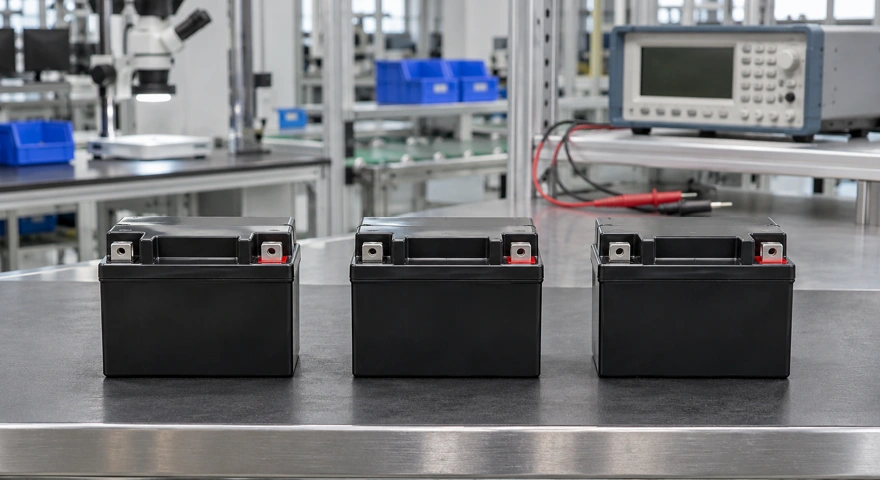
Quality records should identify the relevant model and production batch. Review capacity and starting-performance tests, vibration validation, outgoing inspection procedures, and traceability. Agree on acceptance criteria for appearance, dimensions, and electrical performance.
For lithium battery shipments, review the applicable UN 38.3 test summary and shipping documentation. Prepare the required paperwork for the shipping method and destination. Transport test documentation does not replace vehicle compatibility testing or demonstrate every aspect of operating performance.
When comparing quotes, include lead times, packaging, inventory storage requirements, warranty coverage, and the claims process. Clear troubleshooting and warranty procedures help distinguish battery defects from vehicle charging problems or maintenance-related issues.
After You Buy: Charging, Storage, and Replacement FAQs
How do you choose a charger for an ATV battery?
The charger must match the battery chemistry, charging voltage, and permitted charging current. If you use a charger with multiple modes, select the appropriate setting. Do not use a lead-acid repair or desulfation program on a lithium battery unless the battery’s instructions specifically allow it.
How should you store and recharge a battery during the off-season?
Follow the manufacturer’s recommended storage state of charge and check for standby loads from devices such as security systems. Lead-acid and lithium batteries have different storage requirements, so they should not automatically follow the same recharge schedule. Consult the vehicle’s instructions before disconnecting the battery.
Does slow cranking mean the battery needs to be replaced?
Check the terminals, wiring, starter motor, and charging system before evaluating the battery itself. A normal open-circuit voltage does not, by itself, confirm adequate starting performance. Stop using the battery and arrange an inspection if you notice case swelling, electrolyte leakage, or unusual heat.
Choosing the right ATV battery means matching installation requirements, starting performance, and actual operating conditions. Clearly defined specifications and proper validation can help reduce maintenance costs more effectively than comparing price or capacity alone.
HiMAXBATT: Lithium Battery Manufacturing and Sourcing Services
HiMAXBATT is a lithium battery manufacturer serving importers, distributors, and business buyers. For ATV battery sourcing inquiries, share your vehicle model, existing battery specifications, operating conditions, and order quantity with HiMAXBATT to discuss product compatibility and supply options.