| Commercial Summary: Generally, HiMAXBATT does not derive revenue from its articles; the editorial viewpoints expressed therein are our own and are published independently. We are a manufacturer of lithium batteries. |
Key Takeaways
- Choose a power system based on monitoring duration, site conditions, and maintenance access.
- Compare battery-only power with solar charging and battery storage.
- Measure daily energy use and peak current before selecting components.
- Size batteries for backup runtime and solar panels for energy recovery.
- Check electrical compatibility, temperature protection, and field performance.
- Share operating requirements with your battery supplier before requesting a quote.
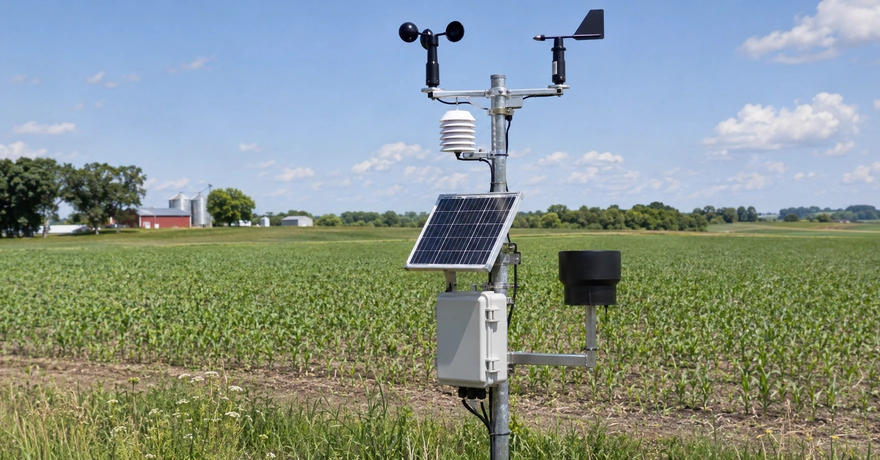
Wireless weather stations are widely used in agriculture, ecological research, and remote environmental monitoring. Their ability to continuously collect and transmit data depends on both sensor and network performance, as well as a power system that can handle local operating conditions.
From a battery manufacturing perspective, power system design needs to account for daily energy use, charging and discharging conditions, battery aging, and maintenance intervals. When comparing solar and battery power for wireless weather stations, start with the project’s monitoring requirements, then determine the battery capacity and supporting components.
What Does Continuous Monitoring Require From a Wireless Weather Station’s Power System?
Weather data often depends on a continuous record over time. Power outages can create gaps that affect rainfall analysis, frost alerts, or irrigation decisions. At hard-to-reach monitoring sites, replacing batteries also involves labor, transportation, and on-site service costs.
A project should therefore define three requirements: how long the equipment needs to operate, how often maintenance is practical, and how many days it must run without an external energy source. Each answer affects the required battery configuration.
Battery suppliers also need to understand the equipment’s input voltage range and peak current requirements. Batteries with the same rated capacity may perform differently if their discharge capabilities, protection settings, or connectors do not match the application. An unsuitable battery may experience a voltage drop when the wireless module starts, causing the device to reboot.
How Do You Choose Between Solar and Battery Power?
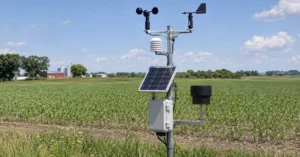
A battery-only system runs on stored energy. A solar-powered system typically combines a solar panel, a charge controller, and a rechargeable battery. During daylight hours, solar energy supports the load and charges the battery. At night or when sunlight is insufficient, the battery supplies power.
| Comparison | Battery-Only Power | Solar Power With Battery Storage |
| Energy replenishment | Battery replacement or scheduled recharging | On-site solar charging |
| Initial setup | Fewer components and relatively simple installation | Requires a panel, controller, and mounting hardware |
| Maintenance | Check remaining charge and replacement intervals | Check the battery, panel, and charging performance |
| Suitable conditions | Short deployments, low power consumption, accessible sites | Long-term operation, usable sunlight, remote sites |
| Main limitation | Finite stored energy | Solar output varies with seasons, shading, and weather |
Battery-only systems also require a distinction between primary and rechargeable batteries. Primary batteries are not rechargeable and must not be connected to a charging circuit. Rechargeable batteries require compatible charging voltage, current, and temperature controls.
Buyers should compare total costs over the project’s operating life. Battery-only power may suit low-power weather stations deployed for short periods. Solar charging with battery storage may suit long-term, unattended monitoring. Sites with limited sunlight or frequent snow cover require a closer assessment of potential energy shortfalls.
How Do You Determine a Weather Station’s Actual Energy Use Before Selecting a Battery?
A wireless weather station does not draw a constant amount of power. Sensor measurements, processor activity, wireless transmissions, and standby operation each have different power requirements. More frequent sampling and shorter upload intervals generally increase daily energy use.
Network conditions also affect consumption. A weak signal may keep the device connected longer or trigger repeated transmission attempts. Stations with heaters, ventilation, or other auxiliary functions need separate calculations for those loads and their operating times. Sizing a battery around the basic monitoring electronics alone can underestimate demand.
Project teams can record each module’s power draw and operating time over a complete cycle, then calculate the daily total. Where practical, measure actual energy use across sampling, transmission, and standby periods. Include representative conditions such as weak network coverage.
Battery manufacturers use this information to determine cell discharge requirements and protection thresholds. Average power consumption informs runtime estimates, while peak current affects reliable startup and communication.
How Do You Calculate Battery Capacity and Solar Panel Power?
For weather station battery sizing, calculate energy in watt-hours first, then convert it to amp-hours. Amp-hour ratings at different voltages are not directly comparable and can give a misleading picture of available energy.
Rated battery energy ≈ Daily energy use × Backup days ÷ Allowable depth of discharge ÷ Power delivery efficiency ÷ Capacity retention factor.
The capacity retention factor accounts for reduced available capacity under the design conditions. Adjustments for low temperatures and end-of-life capacity requirements should be supported by test data. Avoid counting the same reduction more than once.
Consider a low-power weather station project with the following design assumptions:
| Parameter | Example Value |
| Daily load energy use | 6 Wh |
| Backup runtime without useful solar input | 5 days |
| Allowable depth of discharge | 80% |
| Battery-to-load efficiency | 90% |
| Capacity retention factor | 80% |
These assumptions produce a rated battery energy requirement of approximately 52 Wh. For a battery pack with a nominal voltage of 12.8 V, that equals about 4.1 Ah. The actual capacity selection should also account for operating temperatures, available product specifications, and aging requirements. This example should not be applied directly to other equipment.
Solar panel power can be estimated using the following relationship:
Solar panel power ≈ Daily energy use ÷ Design peak sun hours ÷ Overall solar generation and charging efficiency.
If the design assumes two peak sun hours per day and 70% overall efficiency, a panel rated at approximately 4.3 W would theoretically replace the station’s daily 6 Wh consumption. However, that estimate does not include recharging the battery after several cloudy days.
Suppose the system must recover 30 Wh of depleted energy within two days after an extended cloudy period. It would need an additional 15 Wh per day. Using a total daily energy requirement of 21 Wh gives an estimated panel rating of approximately 15 W. The actual selection should use solar resource data for the site’s less favorable season and account for shading, dirt buildup, and mounting angle.
How Do You Combine Power Components Into a Reliable Continuous Monitoring System?
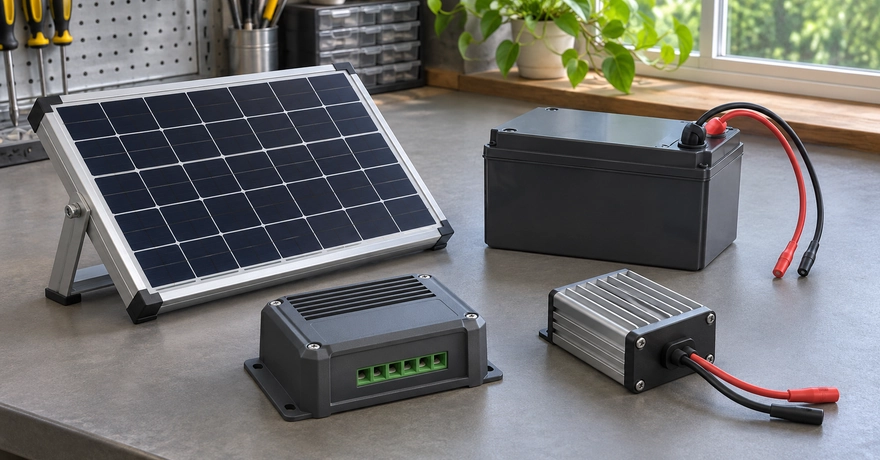
A typical power path is “solar panel—charge controller—storage battery—voltage regulator—weather station.” Some controllers include a load output or voltage regulation, so the actual wiring arrangement should follow the equipment manufacturer’s instructions.
System design requires checking the panel’s open-circuit voltage, the controller’s input range, the battery’s charging requirements, and the weather station’s allowable input voltage. Connectors that physically fit do not establish electrical compatibility.
The charge controller manages battery charging, while the battery protection board provides functions such as overcharge, overdischarge, and overcurrent protection. A protection board does not replace proper charging control, and routine operation should not repeatedly depend on protective shutdowns.
Cold-weather projects require separate checks for charging and discharging limits. Battery University’s technical guide to charging batteries at high and low temperatures explains that conventional lithium-ion batteries have low-temperature charging restrictions. Use the selected cell’s specifications and validation results to establish temperature monitoring and charging limits. If battery heating is required, include its energy use in the power budget.
Outdoor installations also need suitable enclosure sealing, condensation management, weatherproof cable glands, circuit protection, and lightning protection and grounding. Locate the battery enclosure with temperature exposure and service access in mind, and position the solar panel away from significant shading.
A staged energy-saving strategy can help manage declining charge levels. The system might first reduce nonessential uploads while preserving required measurements and local data storage, then send an alert at a defined threshold. These settings should reflect the monitoring task’s acceptable data intervals.
How Do You Verify Power System Performance and Plan Maintenance After Installation?
After installation, project teams should record battery voltage, current, temperature, daily charging energy, and load energy consumption to check the design assumptions. A single voltage reading provides limited information about remaining runtime.
Acceptance checks should cover daytime charging, nighttime discharge, and communication startup. Verify backup runtime under controlled conditions where practical. After a cloudy period, check whether the battery recovers within the planned timeframe so the system does not remain in a persistent energy deficit.
Adjust maintenance intervals using operating records. If solar generation keeps declining, inspect for shading, dirt buildup, and connection problems. If charging appears normal but runtime decreases, investigate changes in load, battery capacity, and temperature exposure.
Project teams should also keep records of equipment configurations, parameter changes, and battery replacements so future issues can be traced to specific operating conditions.

What Information Should You Prepare Before Requesting a Battery Quote?
A useful request for quotation should include the equipment’s voltage range, daily energy use, peak communication current, installation climate, required backup runtime, and planned maintenance interval.
Buyers should also specify battery dimensions, connectors, cables, mounting requirements, and temperature sensing needs. Include the shipping destination and any project-specific testing documentation requirements. These details help suppliers assess cell chemistry, series and parallel configuration, and protection requirements, making quotes easier to compare.
For volume purchases, validate electrical compatibility and field runtime with samples before confirming delivery specifications and batch acceptance requirements. Continuous monitoring performance needs to be verified across the equipment, power components, and actual operating environment.
HiMAXBATT: Lithium Battery Selection and Support for Wireless Weather Stations
HiMAXBATT is a lithium battery manufacturer focused on matching batteries to the operating requirements of wireless weather stations and other equipment. Share your device’s power consumption, installation conditions, and backup runtime requirements with HiMAXBATT to discuss battery selection and project-specific options.