| Commercial Summary: Generally, HiMAXBATT does not derive revenue from its articles; the editorial viewpoints expressed therein are our own and are published independently. We are a manufacturer of lithium batteries. |
Key Takeaways
- Identify whether the battery powers a dedicated DC backup pump or an AC pump through an inverter.
- Calculate capacity using pump wattage, backup time, duty cycle, and system losses.
- Check startup surge requirements separately from battery capacity.
- Compare lead-acid and LiFePO4 batteries based on usable energy and system compatibility.
- Confirm charging, expansion, and testing requirements before ordering.
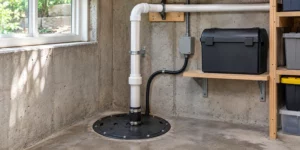
A basement sump pump’s ability to keep running during a power outage depends on the battery’s stored energy, power delivery, and compatibility with the rest of the system. A battery rated at 100Ah can deliver different runtimes depending on the pump, inverter, and drainage conditions.
From a battery manufacturing and system integration perspective, a sump pump backup battery needs to meet three requirements: enough usable energy for the intended backup period, sufficient discharge capability to handle pump startup, and charging and protection settings that work with the equipment. Buyers can use the following steps to determine an appropriate configuration.
Identify the Setup: A Dedicated DC Backup Pump or an AC Pump With an Inverter
Before calculating capacity, determine which pump the battery will power. Two common configurations are outlined below.
| Backup Configuration | How It Works | Key Specifications to Check |
| Dedicated DC backup pump | The battery powers a separate backup pump through a controller | System voltage, operating current, and controller requirements |
| AC pump with an inverter | An inverter converts battery power to AC power to run the pump | Actual input wattage, inverter efficiency, and startup load |
For a DC system, operating voltage and current can be used to estimate power consumption. For an AC system, use the pump’s electrical input power. Do not substitute the motor’s mechanical output rating in the capacity formula. For an AC motor, voltage multiplied by current gives apparent power; it does not directly indicate real power consumption unless power factor is accounted for.
Buyers should also record the actual discharge head and piping conditions. Pump flow, power consumption, and pumping time change with operating conditions, so specifications should be checked against field measurements.
Calculate Capacity and Runtime: Turn Pumping Requirements Into Amp-Hours
Convert Ah to Wh for a Meaningful Comparison
Amp-hours, or Ah, measure charge capacity. Watt-hours, or Wh, measure energy. An amp-hour rating needs to be paired with voltage to indicate how much energy a battery stores:
Nominal energy (Wh) = Nominal voltage (V) × Rated capacity (Ah)
For example, a 12.8V, 100Ah battery stores a nominal 1,280Wh. Discharge limits, conversion losses, and other factors must be accounted for before using that figure to estimate pump runtime.
Calculate Energy Use Based on Duty Cycle
A float switch typically turns a sump pump on and off as the water level changes. An eight-hour backup period does not necessarily mean eight hours of continuous pumping.
Duty cycle = Total pump operating time ÷ Observation period
For example, a pump that runs for a total of three minutes during a 10-minute period has a 30% duty cycle. Whenever possible, use records from heavy rainfall. Pumping frequency during normal weather may underestimate demand during a storm.
For an AC pump powered through an inverter, use this estimate:
Required capacity (Ah) = Pump input power × Backup time × Duty cycle × Sizing margin ÷ (Nominal battery voltage × Usable discharge fraction × Inverter efficiency)
For a DC setup, replace inverter efficiency with the efficiency of the actual power delivery path. Controller consumption and inverter standby consumption should also be included, especially when the pump runs infrequently.
Use One Set of Assumptions to Calculate Capacity and Runtime
Assume an AC pump draws 300W and needs to remain available for eight hours at a 30% duty cycle. The battery system operates at 12.8V, the usable discharge fraction is 80%, inverter efficiency is 90%, and the sizing margin is 1.2.
These values illustrate the calculation. They are not universal specifications for every battery or system.
The calculation is:
300 × 8 × 30% × 1.2 ÷ (12.8 × 80% × 90%) ≈ 94Ah
Under these assumptions, a 100Ah battery is a capacity option worth evaluating further. This estimate does not include standby consumption or confirm startup capability, so it is not a complete purchasing specification.
Using the same 12.8V, 100Ah battery, estimated backup time changes with duty cycle as shown below. These figures exclude the sizing margin and standby consumption.
| Pump Duty Cycle | Total Pumping Time per Hour | Estimated Backup Time |
| 30% | 18 minutes | About 10.2 hours |
| 50% | 30 minutes | About 6.1 hours |
| 100% | 60 minutes | About 3.1 hours |
These results show why the question “How long will a 100Ah battery run a sump pump?” needs operating conditions attached to it. When heavy rain increases incoming water, the pump runs more frequently and backup time decreases.
Battery aging, low temperatures, cable voltage drop, and discharge rate can also affect usable energy. Manufacturers should establish sizing allowances based on temperature and end-of-service-life capacity requirements while avoiding duplicated or missing adjustment factors.
Check Starting Power and Discharge Capability
Capacity determines how much energy a battery stores. Power delivery determines whether it can operate the load. A sump pump may draw substantially more current during startup than during steady operation. The size and duration of that surge depend on the motor design, starting method, and installation conditions.
For an AC setup, check all of the following.
| Item to Check | What to Verify |
| Inverter continuous output | Whether it supports the pump’s running load, including apparent power requirements |
| Inverter surge output | Whether surge output and its rated duration cover the startup event |
| Battery continuous discharge capability | Whether it supports steady pump operation |
| Battery and BMS peak discharge capability | Whether peak current, duration, and protection thresholds match the load |
| Cables and connections | Whether voltage drop, current ratings, and circuit protection are appropriate |
For the 300W load used earlier, estimated battery-side operating current is about 26A at 12.8V and 90% inverter efficiency. As battery voltage falls, the current needed to support the same load increases.
Battery suppliers therefore need to understand both running and startup requirements at a low state of charge. Checking only a fully charged battery may overlook early low-voltage shutdown.
Buyers should obtain startup data from the pump manufacturer or have qualified personnel measure it. Avoid selecting an inverter using a fixed startup multiplier alone. The battery management system’s overcurrent trip threshold should not be treated as an allowable continuous operating current.
Lead-Acid or LiFePO4? Compare Usable Capacity and System Compatibility
Battery chemistry affects usable energy, maintenance, and charging requirements. Two batteries with the same Ah rating may not provide the same pumping time.
| Comparison | Deep-Cycle Lead-Acid Battery | Lithium Iron Phosphate Battery |
| Usable capacity | Depends on discharge depth, discharge rate, and service-life targets | Depends on cell specifications and BMS settings |
| Discharge characteristics | Higher discharge rates can reduce available capacity | A relatively flat voltage profile, with current and temperature limits still applying |
| Maintenance | Flooded batteries require electrolyte checks; sealed types have different requirements | Generally requires no watering; charging and protection status still need monitoring |
| Charging compatibility | The charging profile must match the specific lead-acid type | Charging voltage, operating mode, and temperature limits must match the battery |
Battery Council International’s overview of lead battery applications explains that deep-cycle batteries support sustained power delivery, while starting batteries primarily provide brief bursts of high current. Sump pump backup systems should be selected around their discharge requirements. Automotive starting performance does not establish suitability for extended pumping.
When replacing a lead-acid battery with a LiFePO4 battery, verify that the charger is approved for that use by the equipment or battery supplier. Some lead-acid chargers use equalization or desulfation modes that may be unsuitable for lithium batteries. Controller low-voltage thresholds and battery level indicators also need to be checked.
In cold environments, confirm the cells’ permitted charging temperature range and whether the BMS enforces the required restrictions. Permission to discharge at a low temperature does not mean charging is permitted at that same temperature.
Compare service-life claims under similar temperatures, discharge depths, and capacity retention criteria. Cycle counts on product pages alone do not provide a reliable comparison of operating costs.
Prepare a Specification Checklist Before Ordering
To reduce back-and-forth communication, provide the battery supplier with the following information:
- Equipment specifications: Backup configuration, system voltage, pump model, running load, and startup data.
- Drainage requirements: Actual discharge head, pumping frequency during heavy rainfall, and target backup time.
- Supporting equipment: Controller, inverter, and charger models and specifications.
- Installation conditions: Temperature range, enclosure space, ventilation, moisture protection, and cable length.
- Acceptance criteria: Runtime under defined conditions, startup performance at low charge, and recharge time.
For bulk orders, buyers and suppliers should agree on test conditions and acceptance criteria. Sample testing should include the actual load. A resistive load test alone does not establish motor startup performance.
FAQs: Battery Expansion and Recharging
Can I replace the existing battery with a higher-capacity battery?
Check the charger’s supported battery capacity range, recharge time, and available installation space. A larger battery may take longer to recharge with the existing charger, which can affect the energy available for the next outage.
Can I connect two batteries in parallel to increase capacity?
First, obtain the manufacturer’s approval for the number of batteries and connection method. Battery model, capacity, condition, and connection resistance affect current sharing. Avoid combining new and used batteries without manufacturer guidance.
How long does it take to recharge after an outage?
A basic estimate divides the capacity that needs to be replaced by the effective charging current. For example, replacing 60Ah at an effective charging current of 10A gives a starting estimate of six hours. Actual recharge time also depends on current taper near the end of charging, temperature restrictions, and pump operation while charging.
During extended rainy weather, evaluate both how long the system can run and how much energy it can recover between outages.
HiMAXBATT: Custom Battery Solutions and System Integration for Sump Pump Backup
HiMAXBATT is a lithium battery manufacturer. For sump pump backup applications, share your pump specifications, target backup time, and installation conditions with HiMAXBATT to discuss battery capacity, discharge capability, and system integration requirements.