| Commercial Summary: Generally, HiMAXBATT does not derive revenue from its articles; the editorial viewpoints expressed therein are our own and are published independently. We are a manufacturer of lithium batteries. |
Key Takeaways
- Identify your battery type before choosing a maintenance routine or charger.
- Troubleshoot cold starts before assuming the battery needs replacement.
- Check battery mounting, connections, and charging performance during hot weather.
- Plan winter storage around battery specifications and the motorcycle’s standby power draw.
- Use testing and vehicle compatibility to guide replacement decisions.
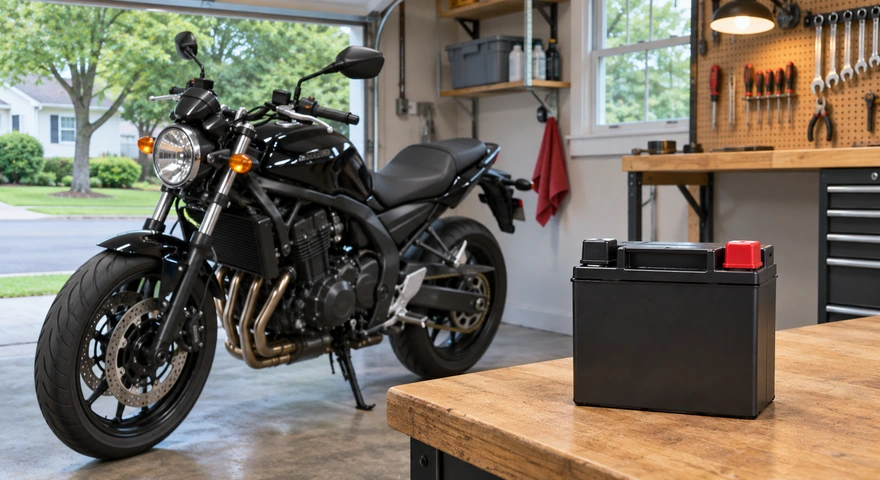
Motorcycles across the United States operate in a wide range of conditions. Cold northern winters, hot Southwestern summers, and seasonal storage can all affect battery starting performance and service life. Even the same battery model may need different maintenance depending on the motorcycle and how it is used.
From a battery manufacturing perspective, motorcycle battery maintenance involves three connected factors: battery chemistry, the motorcycle’s charging system, and riding habits. Start by identifying the battery, then plan inspections around temperature and storage duration. Maintenance instructions for one battery type may not apply to another.
Before You Begin: Identify Your Motorcycle Battery Type
Common motorcycle starting batteries in the U.S. include conventional flooded lead-acid, AGM, and lithium iron phosphate batteries. AGM batteries are a type of lead-acid battery that holds electrolyte in absorbent glass mats. Lithium iron phosphate batteries use a different chemistry and have different charging and protection requirements.
| Battery Type | What to Check | Maintenance Considerations |
| Conventional flooded lead-acid | Battery label, electrolyte level markings, and venting components | Check electrolyte levels only on serviceable models. Add distilled water as instructed. |
| AGM | AGM or valve-regulated lead-acid identification | Do not pry open the sealed case or add water. |
| Lithium iron phosphate | LiFePO₄ identification and protection feature documentation | Verify charging specifications, temperature limits, and protection reset procedures. |
Keep a record of the battery model, installation date, and charging requirements. For importers and distributors, clear specification sheets and maintenance instructions can help reduce service issues caused by customers misidentifying their batteries.
Trouble Starting in Cold Weather? Check These Items First
Cold weather can reduce battery output while increasing the power needed to crank the engine. A hard start in winter does not necessarily mean the battery has failed. Low charge, poor connections, or another motorcycle issue may be responsible.
Before starting, turn off unnecessary aftermarket accessories. Check for loose or corroded terminals, and make sure the cables and ground connections are secure. Also check any clutch, neutral, or side-stand interlocks that may prevent the motorcycle from starting.
| Starting Symptom | Recommended Checks |
| The instrument panel stays dark or dims noticeably | Check battery connections, charge level, and the main fuse. |
| The starter cranks slowly | Check battery charge, cable connections, and starter load. |
| The starter cranks normally, but the engine will not start | Check the fuel system, ignition, and other motorcycle components. |
| A lithium battery suddenly stops supplying power | Follow the battery instructions to check its protection status. Avoid repeated starting attempts. |
Follow the motorcycle owner’s manual for cranking time and the required pause between attempts. If the engine repeatedly fails to start, stop and investigate. Continued cranking can drain the battery further or overheat starting-system components.
Some lithium iron phosphate starting batteries allow a specific cold-weather warm-up procedure, but this is not a universal recommendation. Do not leave the lights on for an extended period to warm the battery unless the manufacturer instructs you to do so. Never use an open flame, hot water, or high-temperature heating equipment. If the instructions are unclear, ask the supplier about approved cold-weather procedures.
Technicians should also distinguish between a temporary drop in cold-weather output and actual battery deterioration. Test results are more useful when the battery’s charge, temperature, and connections meet the testing requirements.
Summer Battery Care: Parking, Inspections, and Charging-System Checks
Summer heat can accelerate internal battery aging. Engine heat, an enclosed battery compartment, and prolonged sun exposure can add to the battery’s heat load. Whenever practical, park in a shaded, well-ventilated location and keep the motorcycle’s original heat shields and ventilation features intact.
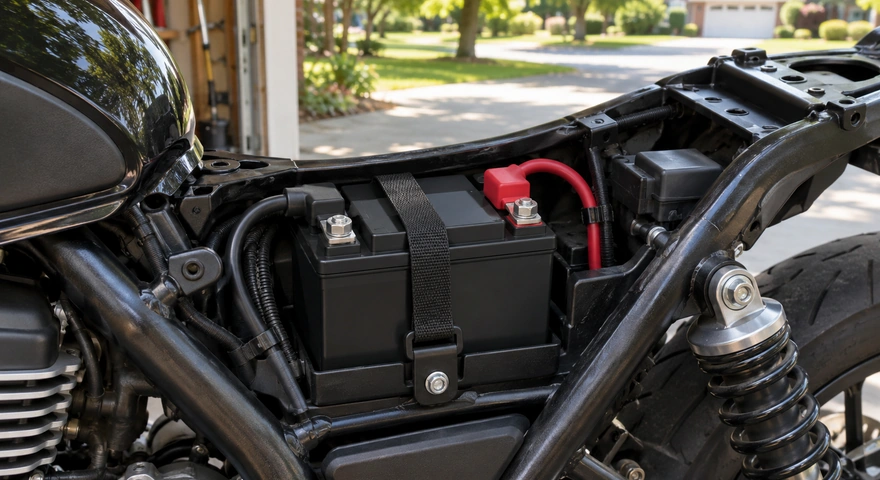
Make sure the battery hold-down is secure to prevent vibration from damaging the case or cables. If the terminals need cleaning, disconnect power and use appropriate protective equipment first. Tighten connections to the specified torque to avoid damaging the terminals.
On serviceable flooded lead-acid batteries, check electrolyte levels as directed. Do not use the same procedure on AGM or lithium iron phosphate batteries. A swollen case, leaks, unusual odors, or excessive heat calls for taking the battery out of service and having it inspected. If you notice smoke or signs of fire, move away and contact emergency services.
Summer maintenance should also include the motorcycle’s charging system. A technician should measure charging voltage at the engine speed and electrical load specified by the motorcycle manufacturer, then inspect the regulator/rectifier and wiring. Replacing the battery alone may not resolve repeated discharge or unusual heating.
For manufacturers and service teams, a useful fault report includes ambient temperature, battery location, and charging measurements. This information helps the supplier determine whether the problem involves the battery, the motorcycle, or operating conditions.
Winter Motorcycle Battery Storage: From Preparation to Spring Startup
Winter storage should limit charge loss and prevent charging outside the battery’s approved temperature range. Alarms, GPS trackers, and onboard electronics may continue drawing power after the ignition is turned off. A low self-discharge rate alone does not protect a battery from these ongoing loads.
Before storage, inspect the case and terminals, check the charge level, clean the battery surface, and record the inspection date. Lead-acid batteries generally should be fully charged before storage. For lithium iron phosphate starting batteries, follow the model-specific storage charge recommendation rather than applying advice intended for phones or stationary energy storage batteries.
| Storage Conditions | Recommended Approach |
| A suitable indoor storage area is available | Follow the motorcycle manual when deciding whether to remove the battery. Protect the terminals and keep the battery stable. |
| The battery stays installed and the motorcycle draws standby power | Disconnect it as directed by the manual, or use an approved maintenance-charging setup. |
| The garage may fall below freezing | Check the battery’s storage temperature limits and separately confirm its permitted charging temperature. |
| No power outlet is available | Check the battery periodically and move it to a suitable location for charging when needed. |
Turn off the ignition before removing or installing the battery. On typical negative-ground motorcycles, disconnect the negative terminal first, followed by the positive terminal. Reconnect in reverse order. Follow the model-specific instructions if the motorcycle has special electrical or security-system requirements.
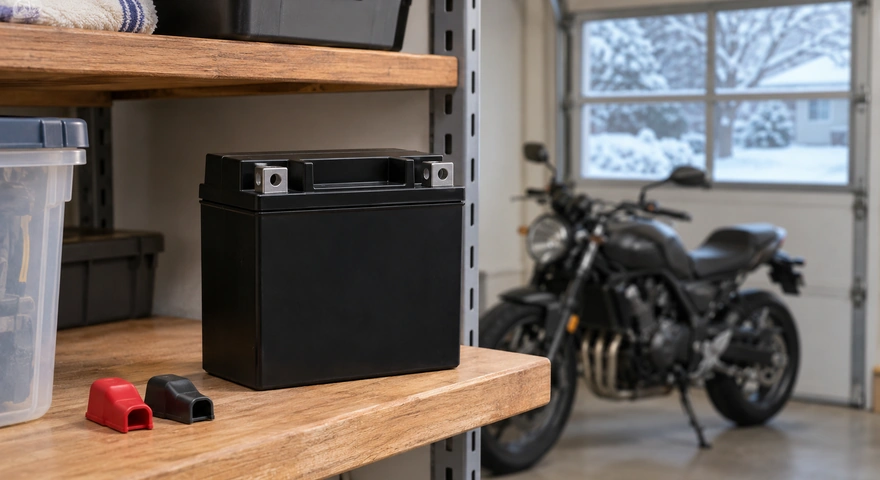
Store the battery in a dry, ventilated location away from heat sources. Keep metal objects away from the terminals. Inspection intervals should reflect the battery instructions, temperature, and the motorcycle’s standby power draw. One fixed charging schedule will not suit every motorcycle.
Battery University’s technical guidance on charging at high and low temperatures explains that charging and discharging have different temperature limits, and that charging conventional lithium-ion batteries below freezing can cause damage. A lithium iron phosphate battery that can start a motorcycle in cold weather may therefore be unable to accept a charge at that same temperature.
For models with heating or low-temperature charging protection, follow the specified operating procedure. Remember that the motorcycle’s charging system supplies power to the battery after the engine starts. Temperature restrictions apply to that charging source as well as an external charger.
A battery maintainer must match the battery chemistry, voltage, and supported capacity range. Do not use a lead-acid repair or desulfation mode on a lithium battery unless the battery manufacturer specifically approves it. Do not bypass the protection system to force charging. Before returning the motorcycle to service in spring, inspect the connections, case, and charge level, then charge and test-start it as instructed.
When Should You Replace a Motorcycle Battery?
Battery age can help determine when to inspect more closely, but it should not be the only reason for replacement. Frequent short rides, extended periods at a low charge, high temperatures, and charging-system problems can all affect how quickly a battery deteriorates.
| Inspection or Test Result | Recommended Action |
| Starting performance returns after proper charging, and the battery holds its charge during storage | Continue using it and adjust the maintenance routine as needed. |
| Starting remains weak after proper charging | Rule out cable and starter problems, then perform an appropriate load or starting-performance test. |
| The battery repeatedly loses charge while parked | Check both the battery’s ability to hold a charge and the motorcycle’s standby current draw. |
| The case is damaged, the battery leaks, or it fails an appropriate test | Take it out of service and arrange replacement and proper recycling. |
Resting voltage provides only part of the picture. It does not fully indicate usable capacity or starting capability. Lithium iron phosphate batteries also have different voltage characteristics from lead-acid batteries, so technicians should use suitable test equipment and evaluation methods.
When choosing a replacement, check case dimensions, terminal polarity, mounting requirements, nominal voltage, and starting performance. When comparing ratings such as cold cranking amps, confirm that the same testing standard was used. Figures measured under different conditions may not be directly comparable.
Before switching to lithium iron phosphate, confirm that the motorcycle’s charging system is compatible, the battery’s protection circuitry supports the starting load, and the product suits local winter conditions. Capacity ratings also need to be understood in context. A replacement-model cross-reference alone does not establish runtime or how long the battery can support the motorcycle while parked.
For importers and distributors serving the U.S. market, product selection should also cover installation instructions, cold-weather restrictions, and after-sales testing procedures. When discussing a motorcycle battery application with HiMAXBATT, provide the motorcycle model, engine displacement, original battery specifications, target region, and expected use to support product matching and validation.
Plan Maintenance Around How Often You Ride
Daily riders should watch for changes in starting and charging performance. Riders who make frequent short trips should check whether the battery is staying adequately charged. Occasional riders should account for power consumption while parked, and seasonal riders should prepare the battery before extended storage.
Effective motorcycle battery care starts with proper selection, correct use, and regular inspections. Matching maintenance to the motorcycle and its operating conditions can help reduce starting problems and provide a sound basis for replacement decisions.
Discuss Motorcycle Battery Selection With HiMAXBATT
HiMAXBATT specializes in lithium battery manufacturing and supplies battery products to business customers worldwide. For motorcycle battery sourcing, we focus on matching product specifications to the vehicle, climate, and intended use. Contact HiMAXBATT to discuss battery selection and bulk purchasing requirements.