| Commercial Summary: Generally, HiMAXBATT does not derive revenue from its articles; the editorial viewpoints expressed therein are our own and are published independently. We are a manufacturer of lithium batteries. |

Key Takeaways
- Capacity and power are different: kWh measures stored energy, while kW measures power output.
- Usable capacity matters: SOC, depth of discharge, and reserve settings affect available energy.
- Performance depends on conditions: Temperature, discharge rate, and efficiency affect real-world results.
- Battery life requires context: Compare cycle life, calendar life, and warranty terms together.
- Compatibility is essential: Check inverter support, communication protocols, and backup capabilities.
- Manufacturing quality matters: Cell matching, protection systems, and testing influence battery performance.
When shopping for a home solar battery, capacity, power output, cycle life, and inverter compatibility all affect whether a product can meet your needs. From a manufacturing perspective, these specifications reflect cell configuration, electrical design, control strategies, and testing conditions. Understanding how they work together makes it easier to compare product data sheets and quotes.
What Is a Home Solar Battery?
In this article, a home solar battery refers to a battery that stores energy for a residential solar power system. Solar panels convert sunlight into electricity, while the battery stores electrical energy and releases it when needed.
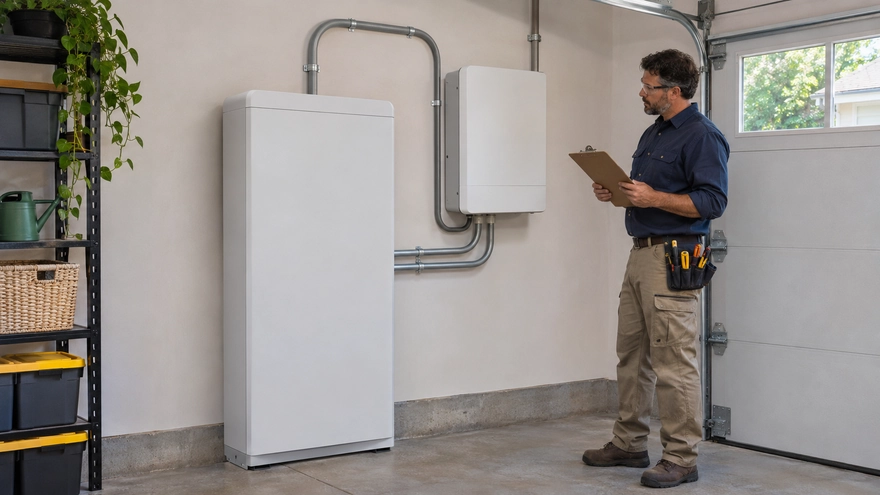
A home solar battery system typically also includes an inverter, metering equipment, and protective devices. A battery can help a household use more of its own solar energy. However, nighttime runtime and outage backup depend on battery configuration, household loads, and system capabilities.
From a manufacturing standpoint, building a home battery involves more than placing cells inside an enclosure. Manufacturers also need to screen and match cells, establish electrical connections, design protective structures, integrate controls, and perform final testing so the product meets its specified operating requirements.
Capacity and Charge Level: kWh, Ah, Nominal Voltage, SOC, and DoD
Kilowatt-hours, or kWh, measure stored energy. One kilowatt-hour is one unit of electrical energy. Amp-hours, or Ah, measure electrical charge capacity. You cannot compare the energy storage capacity of different batteries using Ah alone without considering voltage.
For example, a battery rated at 51.2V and 100Ah has a nominal energy capacity of approximately:
51.2V × 100Ah ÷ 1,000 = 5.12kWh.
Nominal voltage is a reference value used in product design and labeling. Actual operating voltage changes as the battery charges and discharges. System compatibility therefore requires checking the full operating voltage range.
| Term | What It Means | What Buyers Should Check |
| Nominal capacity | The rated energy storage capacity listed on the data sheet | Whether the rating applies to a cell, module, or complete battery |
| Usable capacity | The energy available for use under specified conditions | Whether protective reserves have already been excluded |
| State of charge, or SOC | The percentage of charge remaining | It is an estimate calculated by the control system and has a margin of error |
| Depth of discharge, or DoD | The percentage of battery capacity that has been discharged | The difference between actual discharge depth and the permitted limit |
Suppose a battery has a nominal capacity of 10kWh and permits a 90% depth of discharge. Its estimated usable energy would be approximately 9kWh on that basis. Actual AC energy delivered to the home also depends on conversion losses, temperature, and backup reserve settings. If the manufacturer already specifies usable capacity, buyers should not multiply that figure by DoD again.
Manufacturers manage usable energy through cell capacity testing, cell matching, and control strategies. Two products labeled 10kWh may have different operating windows, so nominal capacity alone does not tell the whole story.
SOC and DoD are generally related, but they must use the same reference basis. A system may also scale its displayed SOC to the usable operating window. As a result, an empty battery indicator does not necessarily mean the cells contain no remaining energy. Check the definitions in the product manual.
Power and Efficiency: kW, Continuous Power, Peak Power, C-Rate, and Round-Trip Efficiency
Kilowatts, or kW, measure power—the rate at which a system can deliver energy at a given moment. Having enough stored energy does not mean a battery can run every appliance at once.
Continuous power is the output a device can sustain under specified conditions. Peak power is the output it can provide briefly, so buyers also need to check how long that output is available. Startup requirements for equipment such as air conditioners and water pumps should be included in system sizing.
Battery power, inverter rated power, and backup output power may differ. Actual system output is constrained by the components involved. One rating should not be treated as the capability of the entire system.
C-rate describes charging or discharging current relative to rated battery capacity. For example, discharging a 100Ah battery at 50A corresponds to 0.5C. A simple capacity-based estimate suggests about two hours of discharge, but actual runtime also depends on cutoff voltage, temperature, and losses. Higher rates generate more heat and place additional demands on cells, electrical connections, and thermal management.
Round-trip efficiency is the ratio of energy delivered during discharge to energy supplied during charging. If a battery takes in 10kWh and delivers 9kWh, its round-trip efficiency is 90%.
Operating temperature is another important condition behind power ratings. Some products limit charging or discharging current at low temperatures, high temperatures, or low SOC. This reduction is called derating. Buyers should review derating curves rather than assume rated power is available in every environment.
Battery Life and Warranties: Cycle Life, Calendar Life, SOH, and Energy Throughput
Cycle life is the number of charge-discharge cycles a battery can complete under specified test conditions before reaching a defined degradation threshold. Test temperature, DoD, C-rate, and the ending capacity-retention threshold all affect the result.
If two products list different cycle counts but use different test conditions, those numbers are not directly comparable. Buyers should also distinguish between cell-level test results and commitments covering the complete battery.
A partial charge and discharge does not necessarily count as one full cycle. Some products use equivalent full cycles, combining multiple partial cycles into the equivalent of a complete cycle. Check the manufacturer’s explanation of how cycles are counted.
Calendar life describes aging over time. Even when a battery is used infrequently, storage temperature and long-term SOC affect its condition. Dividing the stated cycle life by the number of daily cycles does not establish a guaranteed service life.
State of health, or SOH, indicates battery condition. When based on capacity, it generally expresses current capacity as a percentage of a reference capacity. However, calculation methods can differ between systems.
Energy throughput is the cumulative energy charged or discharged. Warranty documents should specify which direction is counted and where the energy is measured. Buyers should review the following conditions together:
| Warranty Item | What to Confirm |
| Time and usage limits | How warranty years, cycle counts, and throughput limits apply together |
| Capacity retention | The capacity level promised at a specified age or usage level |
| Operating conditions | Temperature, C-rate, installation, and operating requirements |
| Service coverage | Who pays for repairs, replacements, shipping, and labor |
A warranty period does not mean capacity will remain unchanged throughout that period. Clear test methods and service terms help buyers and suppliers establish consistent expectations.

Battery Chemistry and Safety: LiFePO₄, BMS, Thermal Runaway, and IP Ratings
LiFePO₄, also called LFP or lithium iron phosphate, is a lithium-ion battery chemistry. Home storage systems may also use chemistries such as nickel manganese cobalt, or NMC. Chemistry affects energy density, thermal stability, and service life, but complete battery performance also depends on manufacturing and system design.
A battery management system, or BMS, monitors voltage, current, and temperature and performs functions such as protection and cell balancing. Cell consistency, sensor placement, and protection logic all affect how well the system manages the battery.
Cell balancing helps reduce differences in state of charge between cells. It does not replace proper cell matching or repair cells that have significantly degraded. Manufacturers still need incoming inspections, batch traceability, and production testing to manage product consistency.
Thermal runaway occurs when heat generation inside a battery becomes uncontrolled. Manufacturers use material selection, structural design, electrical protection, and thermal management to reduce related risks. A BMS alone cannot replace these measures.
An IP rating describes an enclosure’s protection against solid objects, dust, and water. It does not establish fire resistance. Outdoor installations also require checking temperature, sunlight exposure, salt exposure, and standing-water conditions. Certification documents should match the destination market, specific model, and intended scope. Transport testing documentation should not be treated as comprehensive product safety certification.
System Compatibility and Backup Power: Inverters, AC/DC Coupling, and Grid-Connected vs. Off-Grid Systems
An inverter converts electrical power between DC and AC. A hybrid inverter with the appropriate capabilities can also coordinate energy flows among solar panels, batteries, household loads, and the utility grid.
| System Term | Basic Meaning | What to Check |
| AC coupling | Solar and battery storage connect on the AC side | Metering, controls, and backup operating arrangements |
| DC coupling | Solar and battery storage exchange energy through a DC-side connection | Control equipment and voltage and current ranges |
| Grid-connected | The system operates while connected to the utility grid | Local interconnection and protection requirements |
| Off-grid | The system supplies power independently of the utility grid | Continuous power availability and energy replenishment |
High-voltage and low-voltage batteries use different voltage platforms. They cannot be interchanged based only on capacity or connector appearance. Even if both devices support CAN or RS485, their communication protocols may not be compatible. Buyers should check the inverter model, firmware version, battery protocol, and manufacturer compatibility list.
EPS generally refers to an emergency power supply function. Transfer time depends on the specific product. EPS capability does not mean every load will switch over without interruption, nor does it mean solar panels will necessarily continue charging the battery during an outage. Installers should also verify backup circuits, isolation equipment, and load startup requirements.
FAQs: Estimating Home Energy Needs from Battery Specs
How long will a 10kWh battery last?
Assume 10kWh refers to usable capacity, the overall efficiency between that capacity’s measurement point and the appliances is 90%, and the average load is 1kW. Estimated runtime would be about nine hours. This example does not set aside an additional backup reserve. Actual estimates should account for appliance cycling, temperature, and battery aging.
What should I check before adding a battery to an existing solar system?
Start by gathering the existing inverter model, household electricity use by time of day, and available surplus solar generation. An installer can then evaluate retrofit options. Also check electrical panel space, interconnection requirements, and backup circuits. If future expansion is planned, confirm restrictions on mixing new and existing modules, capacity differences, and the timing of additional installations.
HiMAXBATT: A Professional Lithium Battery Manufacturer Focused on Home Solar Energy Storage
HiMAXBATT is a professional lithium battery manufacturer serving global markets. We approach battery selection for home solar storage projects from both a manufacturing and practical application perspective. We focus on matching battery capacity, power output, installation conditions, and inverter compatibility while also considering product delivery and long-term technical requirements. We provide product information and technical support to help customers evaluate energy storage solutions.