| Generally, HiMAXBATT does not derive revenue from its articles; the editorial viewpoints expressed therein are our own and are published independently. We are a manufacturer of lithium batteries. |

Key Takeaways
- Before expanding your RV lithium battery bank, estimate daily energy use and determine whether the issue is storage capacity, power delivery, or charging capacity.
- Parallel connections generally increase capacity while maintaining system voltage. Series connections change voltage and should not be treated as a drop-in expansion option.
- Battery chemistry, model, condition, battery management system (BMS) settings, and manufacturer-approved configurations determine compatibility.
- An expansion also requires checking cables, busbars, overcurrent protection, the inverter, charging equipment, and installation space.
- Usable energy depends on depth of discharge, temperature, aging, and conversion efficiency—not just the amp-hour rating on the label.
- Adequate charging, lower standby consumption, and branch-current monitoring help you put the added capacity to use.
Keeping the refrigerator running, turning on the lights at night, charging devices, and occasionally using a rice cooker or induction cooktop can stretch an RV’s existing battery capacity. Adding a lithium battery may help make off-grid camping more comfortable.
From a battery manufacturing and system integration perspective, however, expanding an RV lithium battery bank involves more than adding amp-hours. The new battery must work with the existing bank, charging equipment must replenish the energy you use, and wiring must handle operating current. This guide focuses on lithium iron phosphate (LiFePO4) house batteries and walks through practical considerations from sizing to installation checks.
Identify the Problem: Not Enough Energy or Not Enough Power?
“The battery isn’t enough” can describe several different problems. Capacity determines how much energy you can store, discharge capability determines how much load you can run at once, and charging capacity affects how quickly you can replace the energy used.
| What You Notice | Possible Cause | What to Check Before Expanding |
| Appliances start normally, but off-grid runtime is too short | Insufficient usable storage or higher-than-expected consumption | Daily energy use, measured battery capacity, standby loads |
| Power shuts off when an induction cooktop or another high-power appliance runs | BMS overcurrent protection, inverter limits, voltage drop, or connection problems | Continuous and surge current, terminal connections, wiring voltage drop |
| The expanded bank often fails to reach a full charge | Inadequate charging capacity or incompatible settings | Shore-power charger, alternator charging, solar production, charging settings |
| Less energy is available in winter, or charging stops | Temperature effects or low-temperature protection | Cell temperature, specified operating ranges, heating provisions |
| The system shuts down while the monitor still shows charge remaining | State-of-charge estimation error, cell imbalance, or a cell reaching a protection threshold | Monitor calibration, BMS data, cell consistency |
Understanding the cause helps you decide whether to add batteries, adjust loads, or upgrade charging and distribution equipment.
How to Calculate RV Battery Capacity: Compare Watt-Hours
An amp-hour (Ah) rating only makes sense alongside voltage. Convert batteries on different voltage platforms to watt-hours (Wh) before comparing them:
Nominal stored energy (Wh) = nominal voltage (V) × rated capacity (Ah)
For example, a 12.8V, 100Ah LiFePO4 battery has a nominal energy rating of 1,280Wh, or 1.28kWh. That is not the same as the energy your AC appliances will receive. The permitted capacity window, temperature, aging, and inverter losses also affect the result.
Consider two 12.8V, 100Ah batteries that the manufacturer has approved for parallel operation:
| Calculation | Example Assumptions | Result |
| Combined rated capacity in parallel | 100Ah + 100Ah | 200Ah |
| Nominal stored energy | 12.8V × 200Ah | 2,560Wh |
| Estimated energy within an 80% capacity-use window | 2,560Wh × 80% | 2,048Wh |
| Energy delivered through an inverter, assuming 90% efficiency | 2,048Wh × 90% | About 1,843Wh |
These percentages illustrate the calculation. They do not establish the permitted depth of discharge for every battery or the actual efficiency of every inverter. If you use both DC and AC appliances, calculate losses for each power path separately.
Size the Expansion Around Your Actual Energy Use
Start by recording a representative camping day:
| Appliance | Example Average Power | Daily Use | Example Energy Consumption |
| RV refrigerator | 40W | 10 equivalent operating hours | 400Wh |
| Lighting | 20W | 5 hours | 100Wh |
| Laptop | 60W | 3 hours | 180Wh |
| Water pump | 60W | 0.3 hours total | 18Wh |
| Rice cooker | 500W | 0.5 equivalent heating hours | 250Wh |
| Total | — | — | 948Wh |
These figures are examples. Refrigerator consumption changes with ambient temperature, door openings, and thermostat settings. A rice cooker’s heating and keep-warm modes also draw different amounts of power. Use measured energy consumption when possible.
For a two-day stay, start with two days of demand, then account for conversion losses, a reserve, and expected charging during the trip. Dividing nominal battery energy by an appliance’s nameplate wattage does not provide a dependable fixed-runtime promise.
Connecting RV Lithium Batteries in Parallel: Check Compatibility First
Adding manufacturer-approved batteries in parallel is a common way to expand an RV bank while retaining its voltage platform. In parallel, nominal voltage stays the same and rated amp-hour capacity adds together. In series, voltage increases, while the amp-hour rating does not increase.
For example, two 12.8V, 100Ah batteries connected in parallel form a 12.8V, 200Ah bank. Connected in series, they form a 25.6V, 100Ah bank. A series connection changes the requirements for the charger, inverter, and DC loads. That is a system voltage conversion requiring its own design.
Before expanding, check the following:
| Item | What to Confirm | Potential Effect of a Mismatch |
| Battery chemistry | Batteries use the same LiFePO4 chemistry | Different charge/discharge behavior and protection strategies |
| Nominal voltage and internal configuration | Voltage platform and series cell count match | Circulating current, abnormal charging, or equipment damage |
| Model and capacity | The manufacturer permits the proposed parallel combination | Uneven current sharing and limited use of capacity |
| Battery condition | Age, cycle history, measured capacity, and internal resistance | New and older batteries carry different currents |
| BMS | Permitted parallel count, current limits, and protection recovery behavior | Other branches may overload when one branch disconnects |
| Communication | Any required master/slave configuration or compatible protocol | Incorrect data or charging-control conflicts |
| State before connection | Voltage and state of charge are adjusted as instructed | Voltage differences can produce substantial equalization current |
LiFePO4 batteries have a relatively flat voltage curve. Similar resting voltages do not establish that two batteries have the same state of charge. Follow the manufacturer’s preparation procedure and have the installer implement any required current-limiting or precharge measures.
Test older batteries before deciding whether to expand around them, especially if they show noticeable degradation, have fault records, or lack technical documentation. A matching brand name or enclosure is not a substitute for compatibility confirmation.
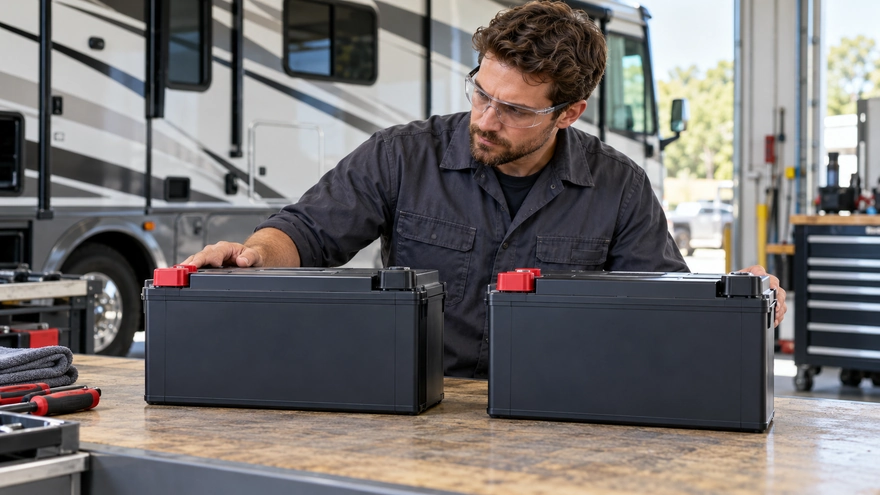
Why BMS Behavior and Battery Consistency Matter
Battery-pack performance depends on more than cell capacity. Cell matching, connection resistance, temperature sensing, and BMS controls also play a role.
Parallel batteries do not share current equally under every operating condition. Differences in branch resistance, cable resistance, and state of charge can cause one battery to carry more current. If that battery disconnects because of overcurrent, temperature, or undervoltage protection, the remaining batteries take over the load and may also reach their protection thresholds.
Do not simply add the continuous discharge ratings on several battery labels and assume the bank can operate at that total indefinitely. Account for manufacturer-specified bank limits, unequal current sharing, and what happens if one branch disconnects.
The BMS cell-balancing function generally manages differences between cells inside its own battery pack. It does not replace compatibility engineering between separate battery packs.
Review Wiring, Protection, and Installation Along With Capacity
The RV Industry Association (RVIA) lists a dedicated standard for RV DC electrical systems. Its 2025 ANSI/RVIA DC standard covers relevant systems and equipment rated at a nominal 60V or less. This supports considering battery upgrades as part of the RV’s electrical system, rather than focusing solely on the battery. Each project still needs to follow applicable requirements, vehicle specifications, and equipment installation instructions. Reference: RVIA Association and ANSI Adopted Standards
Keep Parallel Branch Connections Consistent
A multi-battery system can use appropriately rated busbars, with branch cables matched as closely as practical in size, length, and connection layout to reduce resistance differences.
Choose cable size based on design current, round-trip cable length, routing, ambient temperature, and acceptable voltage drop—not battery capacity alone. Tighten terminals to the specified torque and provide insulation, abrasion protection, and strain relief.
Use Protection Rated for the DC System
Adding batteries changes fault-current conditions. The installer should evaluate branch and main-circuit overcurrent protection, including DC voltage ratings, interrupting capacity, and coordination with cable ratings. A BMS does not replace wiring short-circuit protection.
Recheck Inverter Input Current
Assume a 2,000W AC load, a 12V operating voltage at the battery terminals, and 90% inverter efficiency:
Estimated DC input current ≈ 2,000 ÷ 12 ÷ 0.9 ≈ 185A.
Current can change as battery voltage drops or appliances draw startup surges. Adding stored energy does not automatically increase the inverter’s output rating or make existing cables and switches suitable for larger loads.
Check Weight and Installation Conditions
An expansion also affects vehicle payload, axle loading, mounting brackets, and battery restraints. Follow product installation instructions and protect batteries from standing water, heat sources, mechanical impact, and accidental terminal short circuits. Ventilation, insulation, and heating provisions depend on the product and installation environment.
Do You Need a New Charger After Expanding an RV Battery Bank?
Not necessarily, but the charging system needs to be reassessed.
| Charging Source | What to Check After Expansion | Key Variables |
| Shore-power charger | Charge profile, voltage settings, current, and available charging time | Concurrent loads, thermal derating, later charging stages |
| Alternator charging | DC-DC charger, alternator headroom, and wiring load | Engine speed, temperature, driving time |
| Solar | Charge-controller ratings, panel configuration, and daily energy production | Season, shade, weather, panel angle |
| Multiple sources operating together | Combined charging current and control coordination | Battery current limits, temperature, state of charge |
For example, replacing 160Ah at a sustained net battery-charging current of 40A takes about four hours based on capacity alone. Actual time also depends on current changes during later charging stages and equipment operating conditions.
If you retain the original charging equipment after expanding the bank, replenishing the same percentage of discharged capacity will generally take longer. A solar panel’s nameplate wattage also does not directly establish daily energy production.
Before reusing a lead-acid charger, check its full charging profile. In particular, confirm whether equalization or desulfation functions can be disabled and whether its voltage settings meet the lithium battery’s requirements.

Three Habits That Help You Use the Added Capacity
Track energy in and out. Use a suitable battery monitor or compatible monitoring system to track accumulated energy consumption, charging, and unusual branch behavior. Update capacity settings after expansion and calibrate as instructed.
Reduce continuous standby loads. Inverters, routers, and entertainment equipment can consume energy even when they appear idle. A continuous 10W standby load uses 240Wh over 24 hours.
Plan charging around temperature. Low-temperature charging depends on the battery’s specifications and actual cell temperature. For heated models, check heater activation conditions and the heating energy source; a heater does not remove temperature limits.
After installation, increase loads gradually under controlled conditions. Have the installer verify branch currents, terminal temperature rise, charge termination behavior, and monitoring data before signing off on the system.
FAQ: RV Lithium Battery Bank Expansion
Can I Connect a 100Ah and a 200Ah RV Lithium Battery in Parallel?
Check whether the manufacturer explicitly permits the combination. Different capacities complicate current sharing and protection coordination. Matching nominal voltages alone are not enough. Without documented compatibility, use matched batteries in an approved configuration.
Can I Mix New and Old LiFePO4 Batteries?
That depends on the models, age, measured capacity, internal resistance, and manufacturer requirements. Do not connect a new battery directly to an older bank that shows significant degradation or faults without evaluating it first.
Will Runtime Increase in Direct Proportion to Added Capacity?
Actual runtime also depends on loads, temperature, battery condition, the capacity-use window, and conversion efficiency. A roughly proportional increase is possible only when the other conditions remain similar.
Will More Parallel Batteries Let Me Run Higher-Power Appliances?
System power delivery is constrained by the approved battery-bank current, BMS limits, inverter, cables, and protection devices. Increasing capacity does not automatically raise every component’s power rating.
Can I Parallel Lead-Acid and LiFePO4 Batteries to Expand Capacity?
They should not be directly combined as one house battery bank. Their voltage characteristics and charging requirements differ. If both types remain in the RV, a qualified designer should provide appropriate isolation and charging management.
Can the Starter Battery Be Connected Directly in Parallel With the House Lithium Battery?
Follow the vehicle’s electrical design. Starting and house power serve different functions and generally require appropriate isolation and charging management to control charging current and prevent house loads from compromising engine starting.
What If the Battery Percentage Is Inaccurate After Expansion?
Check the monitor’s capacity setting, shunt wiring, and any current paths that bypass the shunt. Then calibrate according to its instructions. If the bank still reaches protection thresholds early, inspect pack and cell data instead of simply changing the displayed percentage.

Choosing HiMAXBATT Batteries for Your RV Expansion
HiMAXBATT is a lithium battery manufacturing brand. When considering HiMAXBATT batteries for RV house power, evaluate the specific model against your system voltage, target energy storage, continuous and surge loads, charging sources, and installation space. Share your existing battery model, service history, inverter rating, and charging equipment specifications with HiMAXBATT to discuss product compatibility and connection requirements. Parallel capability, low-temperature charging protection, heating, and communication features should be confirmed in the relevant model’s specifications and agreed technical plan, so added capacity fits the way you travel.