Key Takeaways
- A fully charged lead-acid marine battery is significantly more resistant to freezing than a discharged one.
- A discharged flooded or AGM battery may freeze at temperatures around 20°F, depending on its design and condition.
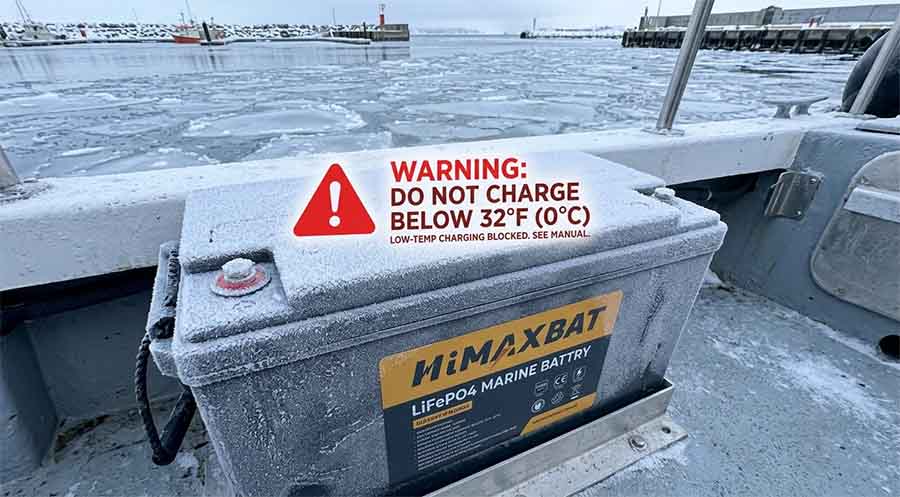
- A standard LiFePO4 marine battery should generally not be charged below 32°F unless its manufacturer specifically permits cold-weather charging.
- Parasitic loads can slowly drain a stored boat battery and increase its freezing risk.
- A battery maintainer must match the battery chemistry, voltage, capacity, and temperature requirements.
- Never charge, jump-start, or continue using a visibly frozen, cracked, or swollen battery.
- Always follow the operating and storage limits listed in the battery manufacturer’s manual.
Can Marine Batteries Actually Freeze?
Yes, some marine batteries can freeze. The level of risk depends largely on battery chemistry, state of charge, battery temperature, and exposure time.
For a flooded lead-acid battery, the electrolyte is a mixture of sulfuric acid and water. As the battery discharges, the electrolyte becomes more water-like, causing its freezing point to rise.
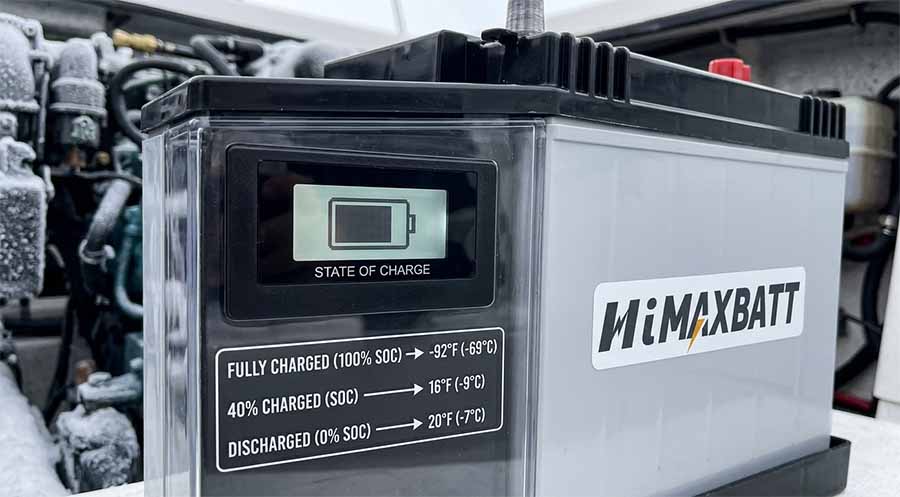
HIMAX Battery reports that the electrolyte in a fully charged flooded battery may not freeze until approximately -92°F, while a battery at about 40% state of charge may freeze near 16°F. U.S. Battery similarly states that fully charged flooded and AGM batteries can have freezing points below -80°F, while a discharged battery may freeze at 20°F or higher. Exact values vary by battery construction, electrolyte concentration, age, and condition.
- What About AGM Marine Batteries?
An AGM battery is also a lead-acid battery, but its electrolyte is absorbed into fiberglass mats rather than moving freely inside the case. This sealed construction reduces spilling and can improve resistance to vibration and cold-weather damage.
However, an AGM marine battery still needs to remain adequately charged during winter storage. Its electrolyte chemistry changes as it discharges, so a deeply discharged AGM battery can still be damaged by freezing conditions.
Do not assume that an AGM label makes a battery completely freeze-proof. Charge it fully, eliminate unnecessary loads, and use an AGM-compatible maintainer when long-term storage requires one.
- Can a LiFePO4 Marine Battery Freeze?
A LiFePO4 marine battery does not face the same water-based electrolyte-freezing mechanism as a flooded lead-acid battery. The more important concern is low-temperature charging.
Charging many standard lithium iron phosphate batteries at or below 32°F can cause lithium plating inside the cells. This may permanently reduce capacity and create internal safety risks. Victron Energy states that temperature information is used to disable lithium charging when the battery is too cold because charging near or below freezing can permanently damage the cells.
Some cold-weather lithium batteries include internal heaters or special low-temperature charging systems. For example, certain heated LiFePO4 products are designed to accept a charge at temperatures as low as -4°F. That capability is product-specific and should never be assumed for a standard lithium marine battery.
Always check three separate temperature specifications:
- The permitted charging temperature
- The permitted discharging temperature
- The permitted storage temperature
Why Cold Weather Causes Marine Battery Problems
Freezing damage is only one cold-weather concern. Even when a battery does not physically freeze, low temperatures slow its internal chemical reactions.
As a result, a marine battery may temporarily provide less usable capacity and lower starting performance during cold weather. At the same time, a cold engine may require more starting power because its lubricants are thicker and its mechanical components are harder to turn.
That combination creates a difficult situation: the engine may demand more power while the battery is temporarily able to deliver less.
Additional winter risks include:
- Parasitic loads from alarms, clocks, trackers, stereos, and monitoring systems
- Corrosion at battery terminals
- Loose cable connections
- Incorrect charger settings
- An unpowered shore connection
- A solar panel covered by snow
- Low electrolyte levels in serviceable flooded batteries
- A battery stored in a compartment that traps moisture
- A battery heater that drains more energy than the charging system supplies
The battery’s actual internal temperature is more important than the reported outdoor air temperature. A battery inside an enclosed compartment may cool more slowly, but after a long cold spell, its temperature can eventually approach the surrounding temperature.
How to Protect a Marine Battery from Freezing
- Identify the Battery Chemistry
Before selecting a charger or storage procedure, confirm whether the battery is:
- Flooded lead-acid
- AGM
- Gel
- LiFePO4
- Another lithium-ion chemistry
Do not use a charging profile intended for flooded lead-acid batteries on a lithium battery. Likewise, do not assume every lithium charger includes a reliable low-temperature cutoff.
Check the battery label, model number, product manual, and charger settings before winter storage.
- Fully Charge Lead-Acid and AGM Batteries
A fully charged lead-acid battery has a much lower freezing point than a discharged battery. Charge the battery according to the manufacturer’s instructions before an expected freeze and before placing the boat into seasonal storage.
Voltage alone does not always provide an accurate state-of-charge reading immediately after charging or operation. Allow the battery to rest before taking an open-circuit voltage measurement, or use a properly calibrated battery monitor. For serviceable flooded batteries, specific gravity measured with a hydrometer can provide a more accurate indication of charge condition.
Do not depend only on a dashboard battery icon.
- Find and Eliminate Parasitic Loads
Turn off the main battery switch when appropriate, but remember that some equipment may bypass it. Automatic bilge pumps, security systems, battery monitors, trackers, radios, and engine control modules may remain connected.
Use a DC clamp meter or multimeter to measure the resting current draw after the boat has been shut down.
For example, a continuous 0.25-amp load consumes:
0.25 amps × 24 hours × 10 days = 60 amp-hours
That is enough to remove 60Ah from a battery bank in only ten days, excluding self-discharge and conversion losses.
Determine which circuits must remain active for safety. Remove unnecessary loads and provide enough charging capacity to support essential equipment.
- Use the Correct Battery Maintainer
For a lead-acid or AGM marine battery, a properly configured smart maintainer can offset self-discharge and small onboard loads. The charger should be approved for the battery’s chemistry, voltage, and capacity.
Cold lead-acid batteries may require temperature-compensated charging. A temperature sensor attached near the battery allows a compatible charger to adjust its voltage according to the battery temperature. Victron notes that cold lead-acid batteries require increased charging voltage, while hot batteries require reduced voltage.
For LiFePO4 batteries, use a charger or BMS that can stop charging when the cells are below their permitted charging temperature. A standard onboard charger may begin charging automatically when shore power, an alternator, or a solar panel becomes available.
- Inspect Flooded Batteries Correctly
For a serviceable flooded marine battery:
- Wear eye and hand protection.
- Inspect the case for cracks or swelling.
- Check electrolyte levels according to the manual.
- Use only distilled water when water is required.
- Do not overfill the cells.
- Keep the top of the battery clean and dry.
- Make sure vent openings remain unobstructed.
Lead-acid batteries can release flammable hydrogen gas while charging, so the charging area must be appropriately ventilated and kept away from flames, sparks, and smoking materials.
- Clean and Secure the Connections
Disconnect power according to the boat and battery manufacturer’s procedures. Inspect terminals, lugs, cables, fuses, and hold-down hardware.
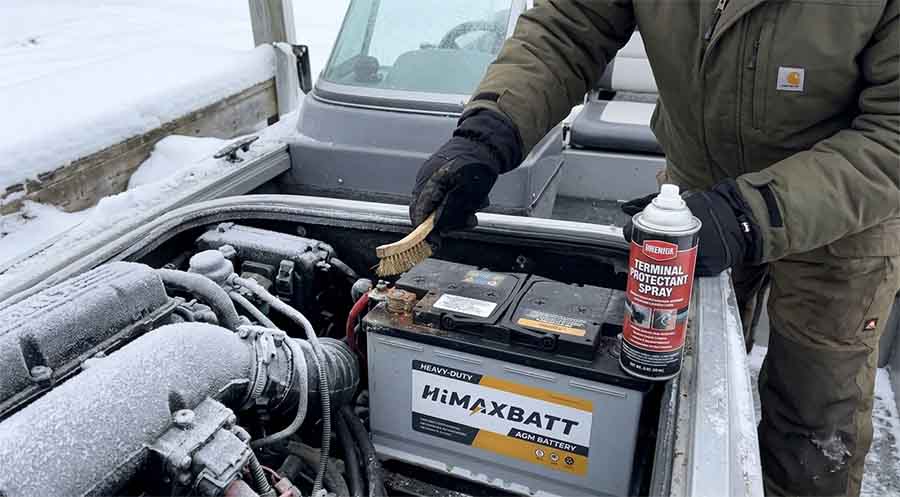
Remove corrosion with an appropriate cleaning method, tighten connections to the specified torque, and apply a terminal protectant when recommended. Do not place grease between the metal terminal and cable contact surfaces unless specifically instructed.
The battery must also remain securely restrained. Winter storms, trailer movement, and repeated freezing and thawing can loosen an improperly mounted battery.
- Remove the Battery When Necessary
Removing the battery may be the best option when:
- The boat has no dependable shore power.
- The battery compartment is exposed to extreme temperatures.
- Parasitic loads cannot be eliminated.
- The boat will remain unattended for several months.
- The existing charger is not suitable for winter maintenance.
- A lithium battery lacks low-temperature charging protection.
Store the battery in a dry, secure, and appropriately ventilated location within its specified storage-temperature range. Keep it upright when required, protect the terminals from accidental short circuits, and prevent unauthorized access.
Do not place a battery directly next to a furnace, space heater, open flame, or other ignition source.
- Use Insulation Carefully
Insulation can slow temperature changes, but it does not create heat. Once a battery and its compartment remain exposed to freezing temperatures long enough, insulation alone may not prevent them from reaching a dangerous temperature.
Do not wrap a vented lead-acid battery in a way that blocks ventilation. For lithium installations, a thermostatically controlled battery heater may be useful, but its energy demand must be included in the battery-bank calculation.
A heated lithium battery should still include appropriate BMS protection. The system should confirm that the cells—not merely the air outside the case—are warm enough before charging begins.
- Monitor Battery Temperature and State of Charge
A winter storage system is more reliable when it measures:
- Battery voltage
- State of charge
- Battery temperature
- Charge and discharge current
- Shore-power status
- Charger status
- Low-voltage or low-temperature alarms
Remote monitoring is especially useful for boats stored several hours away from the owner. However, alerts are only helpful when someone is available to respond.
Cold-Weather Marine Battery Scenarios
The following examples are illustrative. Actual results depend on battery age, chemistry, usable capacity, charger efficiency, wiring, weather exposure, and manufacturer specifications.
Scenario 1: Lake Erie Fishing Boat with a Flooded Battery
A 21-foot fishing boat in northern Ohio has one 12V 100Ah flooded deep-cycle battery. A tracking device and monitoring system draw a combined 0.25 amps while the boat is stored.
After ten days:
0.25A × 24 hours × 10 days = 60Ah consumed
If the battery started near full charge and received no charging input, it could theoretically fall to approximately 40% state of charge before accounting for self-discharge or reduced usable capacity.
The forecast calls for an overnight low of 14°F. Trojan’s published guidance indicates that a flooded battery at approximately 40% state of charge may freeze near 16°F, making this a serious risk.
Recommended action: Fully recharge the battery, eliminate the unnecessary draw, verify electrolyte levels, and connect a properly configured marine battery maintainer before the freeze.
Scenario 2: Maine Sailboat with a 200Ah AGM Bank
A sailboat stored on the Maine coast has two 12V 100Ah AGM batteries wired in parallel for a nominal 200Ah bank. The alarm, bilge-pump controller, and communications equipment create an average continuous draw of 0.35 amps.
Over 21 days:
0.35A × 24 hours × 21 days = 176.4Ah consumed
Without shore power or solar charging, the bank could become deeply discharged. If temperatures fall to 8°F, the combination of low state of charge and prolonged cold exposure may place the AGM bank at risk.
Recommended action: Verify that the charger is operating, confirm that its maintenance current exceeds the average continuous load, test the shore-power connection, and configure a low-voltage alert. If dependable charging is unavailable, remove the batteries or disconnect nonessential circuits.
Scenario 3: Minnesota Fishing Boat with a LiFePO4 Battery
A Minnesota angler uses a 12.8V 100Ah LiFePO4 battery for a trolling motor. The battery has been sitting in an unheated compartment, and its internal temperature is 24°F. The boat’s 20-amp onboard charger turns on automatically when shore power is connected.
If the battery does not have a low-temperature cutoff or internal heating system, charging at that temperature may permanently damage the cells.
Recommended action: Do not begin charging based only on the garage air temperature. Confirm the battery’s internal temperature and manufacturer limits. Warm the battery gradually into its approved charging range, or use a battery specifically designed for low-temperature charging.
Scenario 4: Chesapeake Bay Boat with a Solar Maintainer
A boat in Maryland uses a 20-watt solar panel to maintain a 12V battery bank. The essential standby load averages 0.4 amps, or approximately 4.8 watts at 12 volts.
Although the panel’s rated power exceeds the standby load, real winter output may be reduced by short daylight hours, clouds, shading, snow, charge-controller losses, and poor panel angle.
Recommended action: Do not assume the 20-watt label guarantees adequate daily charging. Compare measured daily amp-hour production with actual daily consumption, inspect the panel after storms, and set a low-state-of-charge alert.
What to Do If a Marine Battery Has Frozen
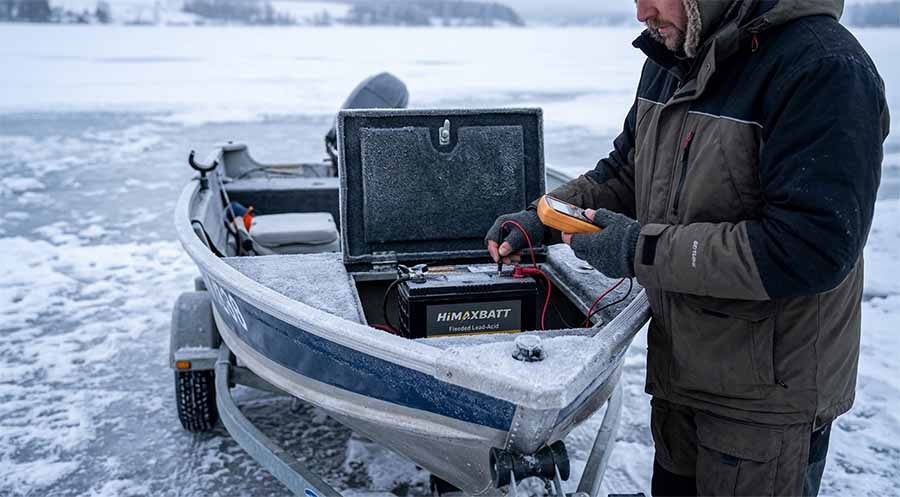
Do not immediately connect a charger, jump pack, or load to a battery that may be frozen.
First, inspect it from a safe distance. Warning signs include:
- A swollen or bulging case
- Cracks in the housing
- Leaking electrolyte
- Displaced terminals
- A strong chemical odor
- Unusual heat after warming
- A battery that will not accept or hold a charge
HIMAX Battery warns that severe bulging can indicate freezing and that frozen batteries may suffer permanent internal damage. A battery that is frozen or has previously frozen should not be used without proper professional evaluation.
Move a suspected battery only when it can be done safely and in accordance with the manufacturer’s instructions. Do not use an open flame, heat gun, or uncontrolled heater to thaw it. Allow it to warm gradually in a suitable area and contact the manufacturer, marine service provider, or qualified battery technician.
For a lithium battery, a low-temperature BMS shutdown does not necessarily mean the battery is damaged. It may simply be blocking charging until the cells warm to an acceptable temperature. Nevertheless, repeated attempts to bypass the protection system are unsafe.
Marine Battery Winterization Checklist
Before the first hard freeze:
- Confirm the battery chemistry and model.
- Review charging, discharging, and storage temperature limits.
- Fully charge flooded and AGM batteries.
- Verify lithium low-temperature charging protection.
- Measure parasitic current draw.
- Disconnect unnecessary electrical loads.
- Inspect the case, terminals, cables, and hold-down hardware.
- Check flooded-battery electrolyte levels according to the manual.
- Clean and protect the terminals.
- Test the shore-power connection and charger.
- Confirm that solar panels are not shaded or obstructed.
- Install battery-temperature and low-voltage monitoring when needed.
- Remove the battery if safe maintenance charging is unavailable.
- Recheck the system after major storms or extended power outages.
Frequently Asked Questions About Marine Batteries and Freezing
At what temperature will a marine battery freeze?
The answer depends on chemistry and state of charge. A fully charged flooded lead-acid battery may remain unfrozen at extremely low temperatures, while a deeply discharged battery may freeze around 20°F or even higher. Always use the specifications for the exact battery model.
Should I remove my boat battery during winter?
Removal is not always necessary. A healthy battery may remain onboard when it is fully charged, securely installed, protected from unnecessary loads, and connected to an appropriate maintenance system. Removal may be safer when the boat lacks dependable charging or will be unattended for a long period.
Can I leave a marine battery charger connected all winter?
Only use a charger specifically designed for long-term maintenance and compatible with the battery chemistry. It should have the correct voltage profile, adequate ventilation, secure wiring, and appropriate temperature controls.
Can an AGM marine battery freeze?
Yes. AGM batteries are more resistant to leakage and may tolerate cold conditions well, but a deeply discharged AGM battery can still be damaged by freezing. Keep it adequately charged during storage.
Can I charge a LiFePO4 marine battery below 32°F?
Do not charge it below 32°F unless the battery manufacturer explicitly permits it. Some models have internal heaters or cold-weather charging technology, while standard models may require the BMS or charger to block charging.
Is it safe to charge a battery that has already frozen?
No. Do not charge a battery while it is frozen or when its case is cracked, swollen, or leaking. Allow a qualified technician or the manufacturer to determine whether the battery can be safely evaluated or must be replaced.
Does disconnecting the negative cable prevent freezing?
Disconnecting the cable can stop many parasitic loads, but it does not recharge the battery or eliminate self-discharge. Begin storage with the correct state of charge and recheck the battery periodically.
Will a battery blanket prevent a marine battery from freezing?
A passive blanket only slows heat loss. It cannot keep a battery warm indefinitely without a heat source. An active battery heater must be appropriately rated, thermostatically controlled, safely installed, and included in the electrical-load calculation.
How often should I check a stored boat battery?
Inspection frequency depends on battery chemistry, storage temperature, charger availability, battery age, and connected loads. Remote monitoring may provide continuous information, but periodic physical inspection is still important.
Power Your Marine Applications with HiMAX Batteries
For marine applications, the right battery must be selected as a complete system—not simply by amp-hour capacity. Operating temperature, charging sources, BMS protection, enclosure design, vibration resistance, current demand, available installation space, and long-term storage conditions must all be considered.
HiMAX works with customers to develop battery solutions around real operating requirements. Whether you are designing power for marine electronics, trolling motors, onboard equipment, navigation systems, or specialized commercial vessels, HiMAX can help evaluate the application and create a safer, more reliable battery configuration.
Find articles related to LiFePO4 Batteries
- Emergency Flashlight Battery Buying Guide
- 2026 Online Buying Guide for Camping Lanterns Batteries
- 2026 Online Buying Guide for Electric Sightseeing Vehicle Batteries
- How to Choose the Right Battery Solution for Electric Boat
- The Forestry Agencies’ Secret: Why It’s Finally Time to Switch to LiFePO4 Batteries for Forest Monitoring Systems
- Security Check Inquiry: Why Don’t Portable Power Banks Use Lithium Iron Phosphate (LiFePO₄) Batteries?
- Hospital Procurement Department Tip: Why It’s Time to Equip Your Portable Ventilators with Rechargeable Lithium Iron Phosphate (LiFePO₄) Batteries
- From Lead-Acid to LFP: Why Forklift Operators Are Making the Switch Right Now
- A Guide for Commercial and Home Users: How to Select the Best Battery Option for Radios Across Different Use Cases