Commercial Disclosure: The HiMAXBATT Editorial Team brings together expertise in lithium battery manufacturing, battery engineering, power systems, and global application support to provide practical, technically informed content for businesses and industry professionals. Our content covers lithium-ion and LiFePO4 batteries, custom battery packs, BMS technology, charging solutions, battery selection, industrial applications, product updates, and HiMAXBATT news. All content reflects HiMAXBATT’s official editorial perspective and our commitment to delivering safe, reliable, and application-focused lithium battery solutions to customers worldwide.
Key Takeaways
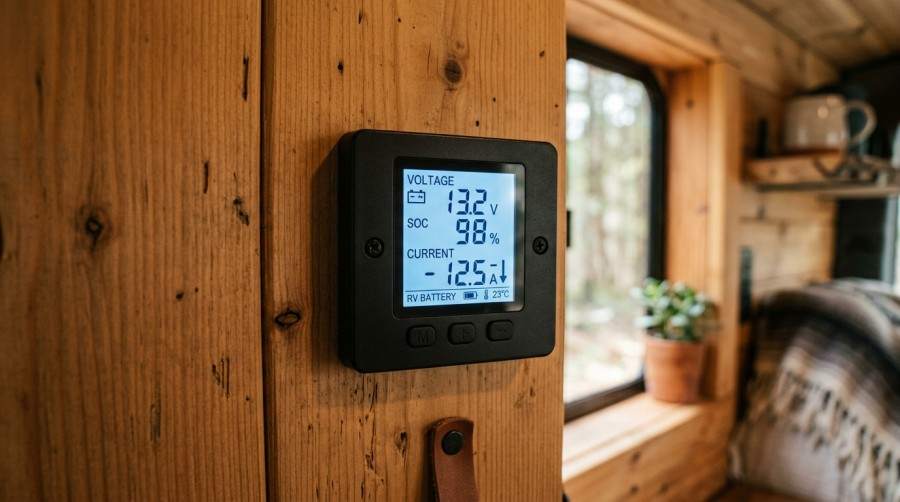
- An RV battery monitor can help you track battery voltage, charge and discharge current, and estimated state of charge, giving you better information for managing power use and planning when to recharge.
- LiFePO4 batteries have relatively small voltage changes across part of their charge and discharge range, making it difficult to accurately estimate remaining capacity using voltage or a simple battery-level indicator alone.
- A BMS focuses primarily on battery management and protection, while a battery monitor focuses on data display and power-use analysis. Some products combine both functions, so the actual configuration should be verified.
- A battery monitor does not increase battery capacity. The reliability of its readings depends on correct wiring, capacity settings, and state-of-charge synchronization.
- When choosing an RV battery monitor, consider system voltage, current range, low-current measurement capability, and display options rather than focusing only on the screen or Bluetooth functionality.
Introduction
Once your RV is parked at a campground, the refrigerator keeps running while the lights, water pump, and phone chargers gradually come into use. At that point, many RV owners start asking the same questions: How much longer will the battery last? Do I need to recharge tonight? If I turn on the inverter, will there still be enough power to keep the refrigerator running through the night?
A voltmeter can provide some useful information, but effective RV power management requires a better understanding of how energy flows into and out of the battery. An RV battery monitor turns those changes into data you can actually use.
This article focuses on RV house battery systems, including common LiFePO4 battery applications. It does not cover specialized diagnostics for vehicle starting batteries.
What Is an RV Battery Monitor, and What Can It Tell You?
An RV battery monitor is a device that measures battery operating parameters and uses those measurements to estimate the battery’s state of charge.
Common shunt-based battery monitors measure current by detecting the small voltage drop across a shunt and then tracking the amount of charge flowing into and out of the battery over time. This method is commonly known as amp-hour counting or coulomb counting. The monitor does not directly “see” how much energy is stored inside the battery; instead, it estimates the remaining charge through measurements and algorithms.
Features vary by model, but commonly displayed data includes:
| Monitored Data | What It Represents | How It Helps With RV Power Management |
| Voltage, V | Battery terminal voltage | Helps monitor charging status, load changes, and abnormal voltage drop |
| Current, A | Current flowing into or out of the battery | Shows whether the battery is currently charging or discharging |
| Power, W | Current charge or discharge power at the battery | Shows how power consumption changes when an appliance is turned on |
| State of Charge, SOC | Estimated percentage of remaining charge | Helps plan recharging and load management |
| Accumulated Ah or Wh | Changes in charge or energy over a period of time | Helps analyze actual energy use while parked |
| Estimated time remaining | Estimated runtime based on current or average load | Helps determine how long the current power-use pattern can continue |
| Temperature and history | Depends on sensors and monitor features | Helps track operating conditions and long-term trends |
Keep in mind that estimated time remaining changes as the load changes. Refrigerator compressor cycling, electric heating appliances, or changes in solar output can all cause the displayed estimate to fluctuate significantly. It should be treated as a dynamic reference rather than a guaranteed runtime.
Why Can’t You Estimate an RV Lithium Battery’s State of Charge From Voltage Alone?
From a battery manufacturing and application perspective, the relationship between voltage and remaining capacity is affected by battery chemistry, temperature, load, and rest time.
LiFePO4 batteries have a relatively flat charge and discharge voltage curve across a significant portion of their operating range. During this period, the battery’s state of charge can change substantially while terminal voltage changes only slightly. As a result, assigning a fixed state-of-charge percentage to a single voltage value can lead to inaccurate estimates.
There are also two common situations that can make voltage readings misleading:
- During charging: Charging equipment affects battery terminal voltage, so a higher voltage does not necessarily mean the battery is fully charged.
- Under heavy loads: Higher current can cause terminal voltage to drop. When the load is removed, the voltage may recover, but this does not mean the battery has regained energy.
Voltage remains a useful operating parameter, but when estimating the remaining capacity of an RV LiFePO4 battery, current counting combined with proper settings and synchronization generally provides more useful information.
What Practical Problems Can an RV Battery Monitor Help Solve?
Make Off-Grid Power Planning More Predictable
Without monitoring data, RV owners often rely on experience or guesswork to determine whether they have enough battery power. With a battery monitor, you can observe how much energy the refrigerator, lights, and water pump actually consume overnight, then decide whether you need alternator charging, solar charging, or campground shore power the following day.
Recording several similar camping scenarios provides a more useful personal energy budget than looking at a single instantaneous current reading.
Identify Standby Loads That Are Easy to Overlook
Inverters, control panels, and some appliances can continue consuming power while in standby mode. Each individual load may be small, but over many hours the total energy consumption can become significant.
For example, if a standby load continuously draws 5W for 24 hours, it will consume approximately 120Wh. This is only a calculation example, but it illustrates why standby loads matter. Turning devices off one at a time while monitoring battery-side power can help identify where that energy is going.
Determine Whether the Battery Is Actually Receiving a Net Charge
A solar charge controller showing output does not necessarily mean the battery is receiving the same amount of charging power because RV appliances may be consuming energy at the same time.
For example, if the solar system produces 200W while onboard loads consume 150W, the battery receives approximately 50W of net charging power, ignoring other losses. A properly installed battery monitor can display net current at the battery, helping you understand the actual charging progress.
However, a single battery monitor generally cannot tell you exactly how much power is coming individually from solar, an alternator charger, and a shore-power charger. Separating those sources requires data from the corresponding equipment or additional measurements.
Adjust Power Use Before Battery Protection Is Triggered
Low state-of-charge alerts can help users turn off nonessential loads or arrange recharging before a sudden shutdown disrupts normal use.
Alert thresholds should be set according to the battery documentation, travel plans, and critical-load requirements. BMS protection thresholds are designed to protect the battery and should not be treated as normal everyday power-management targets.
How Do You Choose the Right Battery Monitor for an RV?
When selecting a battery monitor for an RV lithium battery system, start by checking the following:
| Selection Factor | What to Verify | Why It Matters |
| System voltage | Whether the monitor supports the actual battery voltage and operating range | Compatibility should not be assumed simply because a product is marketed for RVs |
| Current range | Whether it covers continuous current and peak current for the specified duration | Inverter operation and equipment startup may create high current demand |
| Low-current measurement | Accuracy, resolution, and current threshold | Affects how accurately standby consumption is recorded |
| SOC algorithm settings | Whether capacity, charging efficiency, and synchronization conditions can be configured | Affects state-of-charge estimates |
| Display method | Fixed display, Bluetooth, or centralized control platform | Affects everyday monitoring convenience |
| Environmental suitability | Temperature, moisture resistance, and terminal protection | Should match the actual installation location |
| Data features | Historical records, alerts, and communication compatibility | Should match actual power-management needs |
Consider an inverter as an example. If AC output power is 2,000W, battery voltage is 12.8V, and inverter efficiency is 90%, estimated battery-side current would be approximately:
2000 ÷ 12.8 ÷ 0.90 ≈ 174A.
This is a calculated value under specific conditions, not a fixed operating current. Current may increase as battery voltage falls or when additional loads operate simultaneously. The shunt, cables, fuses, and allowable battery output should therefore be evaluated together with the actual equipment.
Installation and Setup: Why Are Battery Monitor Readings Sometimes Inaccurate?
All Monitored Current Must Pass Through the Measurement Path
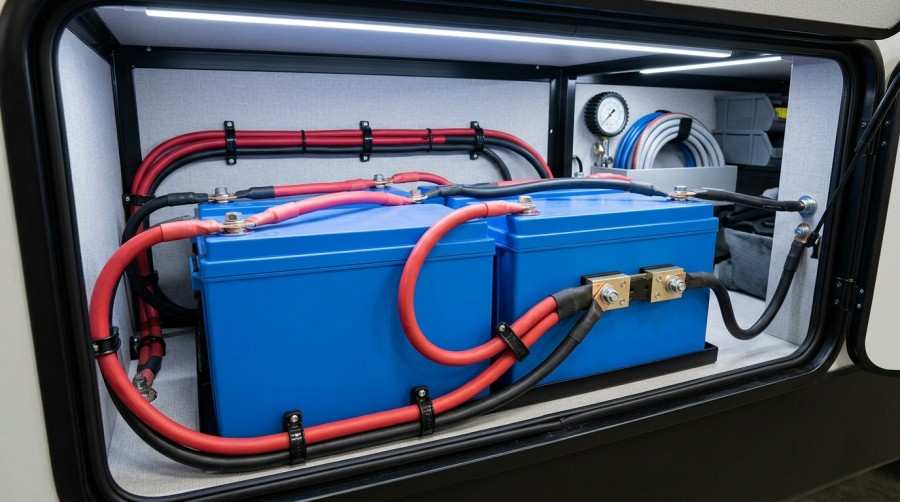
For a typical negative-side shunt installation, the battery negative terminal connects to the battery side of the shunt, while the negative connections from loads and charging equipment connect to the system side.
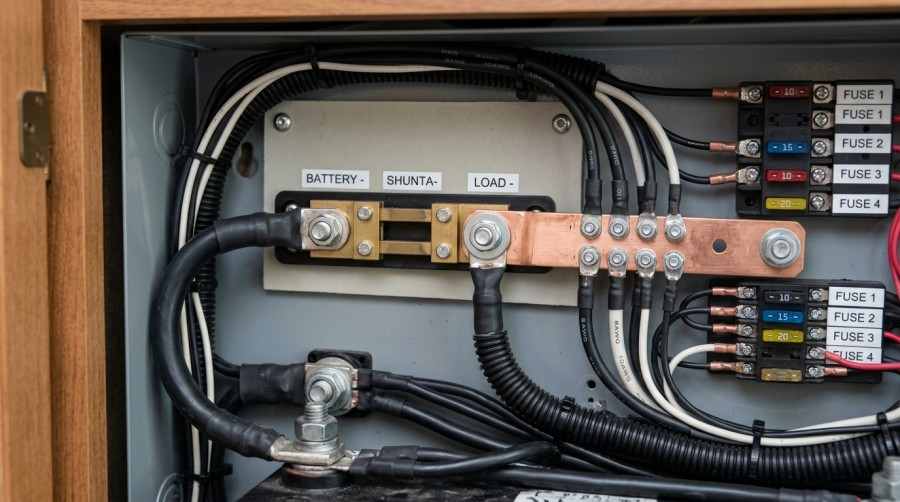
If a device is connected directly to the battery negative terminal and bypasses the shunt, current through that branch may not be recorded. RV chassis-ground return paths should also be checked. Manufacturer installation instructions commonly warn that charging or discharging current that bypasses the shunt will not be included in state-of-charge calculations.
Capacity Settings Should Represent the Entire Monitored Battery Bank
When permitted by the battery manufacturer, two 12.8V, 100Ah batteries connected in parallel create a nominal 200Ah battery bank. If connected in series, they create a 25.6V, 100Ah battery bank. Capacity settings should therefore account for the connection configuration rather than simply multiplying capacity by the number of batteries.
In addition, entering the battery’s rated capacity into the monitor does not mean the monitor has measured the battery’s actual current capacity. As batteries age, changes in actual capacity can also affect SOC estimates.
State-of-Charge Synchronization Should Match Actual Full-Charge Conditions
Some battery monitors synchronize state of charge using a combination of charged voltage, tail current, and the amount of time those conditions are maintained. These settings should follow the battery and monitor documentation rather than being copied directly from another system.
If valid synchronization does not occur for an extended period, measurement errors can gradually accumulate. After replacing batteries, changing the battery-bank configuration, or noticing abnormal readings, check the settings again rather than simply resetting SOC to 100%.
How Can Battery Monitor Data Be Used to Estimate RV Battery Runtime?
A simplified relationship is:
Estimated Runtime ≈ Planned Usable Energy (Wh) ÷ Average Battery-Side Load Power (W).
For example, a battery bank rated at 12.8V and 200Ah has approximately 2,560Wh of nominal energy. If you budget 70% of that energy for this trip and the average battery-side load is 80W, estimated runtime would be:
2560 × 70% ÷ 80 ≈ 22.4 hours.
The 70% figure is only an example energy budget and is not a recommended depth of discharge for every battery. Actual runtime is also affected by battery health, temperature, changing loads, and protection conditions.
If you are calculating from the rated power of AC appliances, inverter losses and operating duty cycle should also be considered. If battery-side power has already been measured, the same conversion loss should not be deducted again.
Frequently Asked Questions
Can an RV Battery Monitor Extend Battery Life?
A battery monitor does not change the performance of the battery cells themselves. It can help users identify conditions such as prolonged low state of charge or abnormal power consumption and adjust their usage accordingly. Actual battery life still depends on battery design, temperature, charge and discharge conditions, and maintenance practices.
What Is the Difference Between a Bluetooth Battery and a Bluetooth Battery Monitor?
“Bluetooth” only describes the method used to communicate data. A Bluetooth-enabled battery typically provides data from its built-in BMS, while an external Bluetooth battery monitor usually takes measurements through an independent sensor or shunt.
Compare the actual parameters, measurement range, and data-logging capabilities rather than choosing based only on whether the information can be viewed on a smartphone.
Why Does the Monitor Show Remaining Charge While the BMS Has Already Disconnected the Output?
SOC is an estimate. The BMS may trigger protection because of individual cell undervoltage, overcurrent, temperature, or other conditions. In this situation, review BMS fault records, individual cell voltages, and load conditions rather than determining battery health from SOC alone.
Can One Battery Monitor Track Both the Starting Battery and the House Battery?
It depends on the device. Some models can display the voltage of an additional battery, but that does not necessarily mean they can independently track current and SOC for two separate battery banks.
If complete data is required for both battery systems, separate measurements or a system that supports multiple monitoring channels may be necessary.
Can a Battery Monitor Measure the Battery’s Actual Capacity?
The SOC displayed by a typical battery monitor during everyday use is not the same as a battery capacity test. Capacity should be evaluated under specified temperature, charge and discharge, and cutoff conditions using complete test data. Energy consumption recorded during a single camping trip should not be treated as verification of rated battery capacity.
Does a Battery Monitor Consume Power While the RV Is in Long-Term Storage?
Yes. Power consumption varies depending on the model and whether its display or communication functions remain active. During long-term RV storage, the monitor and other standby devices should be included in the energy-consumption assessment, and battery storage and inspection should follow the battery manufacturer’s instructions.
About HiMAXBATT Batteries
HiMAXBATT specializes in lithium battery products, with an emphasis on matching battery performance to real-world power requirements. For RV house battery systems, battery selection should consider capacity, continuous output capability, charging compatibility, installation environment, and monitoring requirements together.
You can provide HiMAXBATT with your RV system voltage, major appliance power requirements, and off-grid energy-use plan to discuss a suitable battery solution. BMS functions, communication options, operating conditions, and services for specific models are subject to the applicable product specifications and officially published information.