Commercial Disclosure: The HiMAXBATT Editorial Team brings together expertise in lithium battery manufacturing, battery engineering, power systems, and global application support to provide practical, technically informed content for businesses and industry professionals. Our content covers lithium-ion and LiFePO4 batteries, custom battery packs, BMS technology, charging solutions, battery selection, energy storage, industrial applications, product updates, and HiMAXBATT news. All content reflects HiMAXBATT’s official editorial perspective and our commitment to delivering safe, reliable, and application-focused lithium battery solutions to customers worldwide.
Key Takeaways
- How long a mobility scooter battery lasts on a single charge depends on usable battery energy, vehicle power consumption, rider and cargo weight, road conditions, and ambient temperature. There is no single answer that applies to every scooter.
- Ah measures charge capacity, while Wh measures energy. When comparing batteries with different voltages, Wh should be considered rather than Ah alone.
- Driving range, continuous driving time, and total time away from home are three different concepts. Time spent parked, shopping, or resting should not be counted directly as driving time.
- Range estimates should be based on actual average energy consumption. The motor’s nameplate power should not simply be treated as the vehicle’s continuous power draw.
- When replacing a battery, check not only capacity but also the voltage range, charger, output current, installation dimensions, and protection settings.
- Proper charging, routine inspections, and keeping a reserve for the return trip can help reduce the risk of running out of power while away from home.
Introduction
“Can I make it to the grocery store and back on one full charge?” “How far can a 20Ah battery go?” “Why do two scooters with the same rated range perform differently in real-world use?” These are common questions when choosing and using a mobility scooter.
From a battery manufacturing perspective, range is the result of both the battery and the vehicle. The battery stores and delivers energy, while the scooter consumes that energy based on rider weight, speed, terrain, and operating conditions. Understanding how the two work together is more useful than comparing battery capacity numbers alone.
This article focuses mainly on three-wheel and four-wheel electric mobility scooters used for mobility assistance. Different types of vehicles can vary significantly in weight, speed, and drivetrain design, so the same range figures should not be applied across all models.
- How Long Does a Mobility Scooter Battery Last on a Single Charge?

To determine how long one charge will last, first clarify what kind of “time” you are trying to measure.
| Metric | Meaning | Typical Use |
| Range per charge | Distance the scooter can travel from a full charge to a specified end condition | Determines whether a round trip fits within the available energy budget |
| Continuous driving time | Total time spent driving under specified operating conditions | Helps assess sustained mobility needs |
| Total outing time | Includes driving, parking, shopping, and rest time | Useful for planning a trip, but does not directly represent driving range |
| Battery service life | Period during which the battery continues to meet performance requirements after aging | Helps determine maintenance and replacement needs |
For example, an outing may last 3 hours, but the scooter may only be driven for 1 hour while the remaining time is spent parked or resting. That does not mean the battery has powered the scooter continuously for 3 hours. If the lights, display, or other accessories remain on while parked, they may still consume energy.
How far a scooter can travel and how long it can run on one charge depend on both usable battery energy and actual power consumption.
- What Are Ah and Wh, and Why Shouldn’t You Look at Capacity Alone?
Ah: A Measure of Charge Capacity
Ah stands for amp-hours. For example, a 20Ah battery is rated to deliver a certain amount of electrical charge under specified test conditions.
It does not mean the battery can always deliver 20A for exactly 1 hour. Actual performance is also affected by discharge current, temperature, battery aging, and cutoff voltage.
Wh: A Measure of Stored Energy
Wh stands for watt-hours and represents how much energy a battery stores.
Nominal Energy (Wh) ≈ Nominal Voltage (V) × Rated Capacity (Ah)
| Example Battery Specification | Nominal Energy Calculation | Nominal Energy |
| 24V 20Ah | 24 × 20 | 480Wh |
| 24V 30Ah | 24 × 30 | 720Wh |
| 25.6V 20Ah | 25.6 × 20 | 512Wh |
| 48V 20Ah | 48 × 20 | 960Wh |
These examples are only intended to show the calculation relationship. They do not mean these batteries are interchangeable.
Two batteries may both be rated at 20Ah, but if their voltages are different, their nominal energy will also be different. Conversely, a battery with more energy does not necessarily provide more driving range, because vehicle weight, motor system, and operating speed may also be different.
Also remember that nominal voltage is not the same as charging voltage. When replacing a battery, the full operating voltage range and charging requirements should be checked.
If Two Batteries Are Connected in Series, Does the Ah Rating Double?
No. For example, two matched 12V 20Ah batteries connected in series create a battery system of approximately 24V 20Ah, with a nominal energy of about 480Wh.
Connecting batteries in series increases voltage, but the Ah rating does not add together. Users should not change a battery’s series or parallel configuration on their own, because this can affect charging, protection, and compatibility with the scooter.
- How Do You Calculate Mobility Scooter Battery Range?
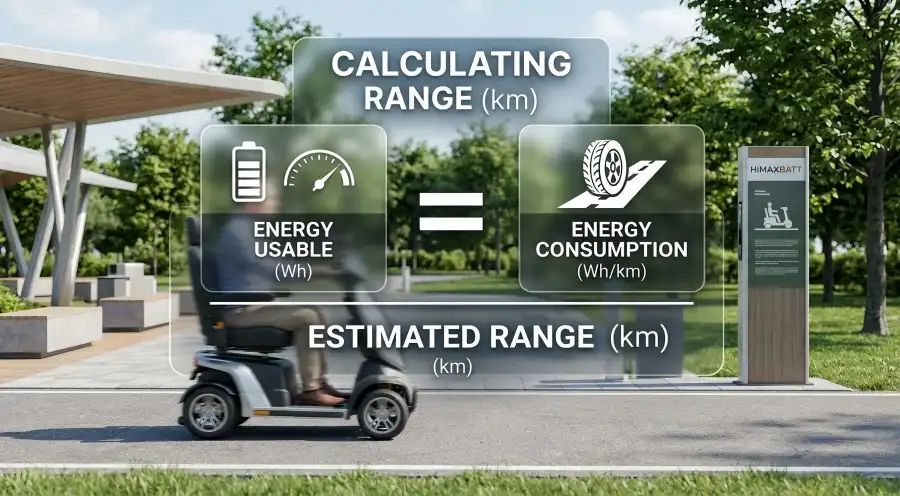
A simple way to estimate range is:
Range (km) ≈ Energy Available for Driving (Wh) ÷ Energy Consumption per Kilometer (Wh/km)
Where:
Energy Available for Driving ≈ Nominal Energy × Usable Energy Percentage
The usable energy percentage reflects the effects of battery aging, temperature, cutoff conditions, and planned reserve capacity. It should be determined based on testing and use requirements rather than treated as a fixed industry value.
Suppose a battery is rated at 24V 20Ah, giving it a nominal energy of 480Wh. For demonstration purposes, assume that 80% of the nominal energy is available for this trip:
Energy Available for Driving = 480 × 80% = 384Wh
Under different assumed energy consumption rates, the estimated range would be:
| Assumed Energy Consumption | Calculation | Estimated Range |
| 12Wh/km | 384 ÷ 12 | 32km |
| 16Wh/km | 384 ÷ 16 | 24km |
| 20Wh/km | 384 ÷ 20 | 19.2km |
The energy consumption figures and the 80% usable energy assumption in this table are for educational purposes only. They are not universal test values or range claims for any specific battery.
This example shows that the same battery can provide less range when vehicle energy consumption increases. That is why the question “How far can a 20Ah battery go?” cannot be answered accurately without considering the scooter and its operating conditions.
If the energy consumption per kilometer is measured at the battery output and already includes relevant vehicle losses, motor or controller efficiency should not be deducted again.
- How Do You Convert Driving Range Into Actual Runtime?
Continuous driving time can be estimated using:
Driving Time (h) ≈ Range (km) ÷ Average Driving Speed (km/h)
For example, if the estimated range is 24km and the average speed while driving is 6km/h:
24 ÷ 6 = 4 hours
Runtime can also be estimated from average power consumption:
Runtime (h) ≈ Usable Energy (Wh) ÷ Average Battery Output Power (W)
If usable energy is 384Wh and average battery output power is 96W, the estimated runtime is also 4 hours.
The speed, power consumption, and range figures used in these calculations should come from corresponding operating conditions. You should not combine range data measured on flat terrain under a light load with speed data from a different operating condition.
Why Can’t You Just Use the Motor’s Nameplate Power?
The motor’s rated power does not necessarily equal the scooter’s average electrical power draw from the battery throughout an entire trip. Slow travel on level ground, startup, and hill climbing all place different loads on the system. The motor’s mechanical output power is also not the same as the battery’s electrical input power.
For that reason, simply calculating “battery Wh ÷ motor rated W” usually produces only a rough estimate and should not be treated as a real-world range result.
- What Factors Can Reduce Real-World Mobility Scooter Range?
Mobility scooter manufacturers often note that range depends on factors such as rider weight, terrain, battery condition, and tire condition. Pride Mobility, for example, lists several of these variables in its product specifications. Reference: Pride Mobility range conditions
| Factor | How It Affects Range | What to Watch for During Use |
| Rider and cargo weight | Increases energy demand during acceleration and hill climbing | Stay within the vehicle’s rated weight capacity |
| Hills and soft surfaces | Increase drivetrain load or rolling resistance | Consider slope and surface conditions when planning routes |
| Frequent stops and starts | Increase energy use from repeated acceleration | Operate smoothly when conditions allow |
| Tire condition | Low tire pressure or abnormal wear can increase rolling resistance | Check tire pressure according to the vehicle manufacturer’s requirements |
| Cold temperatures | Can increase internal resistance and reduce usable energy | Keep a larger energy reserve in cold weather |
| Battery aging | Reduces capacity and may cause greater voltage sag under load | Compare range under similar conditions over time |
| Accessory power use | Lights and other electrical accessories increase total energy consumption | Include accessory use in the energy budget |
For lead-acid batteries, the discharge rate used to determine the Ah rating should also be considered. The Ah value shown on the label is measured under specified conditions, and the actual available capacity may decrease at higher discharge currents. Ah ratings from different chemistries or test conditions should not be compared without considering those conditions.
- Will a Higher-Capacity Battery Increase Range Proportionally?

When voltage, vehicle conditions, operating conditions, and usable energy percentages are similar, increasing Ah generally increases the amount of usable energy. However, real-world range does not always increase in exact proportion to battery capacity.
For example, increasing capacity from 20Ah to 30Ah represents a 50% increase in rated charge capacity, but battery weight, installation design, protection settings, and actual usable energy may also change.
Before replacing a mobility scooter battery, check the following:
| Item to Verify | What Needs to Be Confirmed |
| Voltage range | Nominal voltage, fully charged voltage, and discharge cutoff voltage |
| Battery chemistry | Whether lead-acid, lithium-ion, LiFePO4, or another chemistry is supported by the vehicle |
| Charger | Whether charging voltage, charging current, and control method are compatible |
| Output capability | Whether the battery can support continuous driving, startup, and hill-climbing loads |
| BMS settings | Whether overcurrent, undervoltage, and temperature protection are coordinated with the scooter |
| Installation and connectors | Dimensions, mounting method, polarity, connectors, and communication requirements |
A lead-acid battery should not be replaced with a lithium battery simply because the nominal voltage appears similar. Compatibility should be confirmed by the vehicle manufacturer or a qualified service provider, especially for the charger, controller, and battery level display system.
- How Can You Determine How Long Your Battery Actually Lasts?
For everyday users, it is generally more practical to follow the scooter manual and track performance on familiar routes rather than intentionally discharging the battery until the scooter stops.
You can choose a short, familiar route that allows you to return easily and record the battery’s state of charge, travel distance, rider and cargo weight, weather, and battery gauge behavior. Repeating this under similar conditions can help establish a more realistic trip-planning baseline.
Keep in mind that the number of bars on a battery gauge may not correspond directly to the remaining range. A voltage drop while climbing a hill, followed by a higher reading after stopping, does not mean the battery has regained energy.
From a battery manufacturing and vehicle validation perspective, a more rigorous test would record battery-side voltage, current, and cumulative Wh output while also documenting ambient temperature, rider load, speed, route, and the test termination condition. This produces data that is much more useful for comparison.
In daily use, charge the battery according to the manufacturer’s instructions, use a compatible charger, and inspect for loose connectors, unusual heat, or housing damage. Do not rely on a BMS protection shutdown as a normal signal for when to turn back. Leave an appropriate reserve before the return trip.
- Frequently Asked Questions
How Far Can a 24V 20Ah Mobility Scooter Battery Go?
Its nominal energy is approximately 480Wh, but actual driving distance depends on usable battery energy and the scooter’s energy consumption. The specific vehicle’s test conditions and your real-world route should be considered. A fixed range cannot be determined from the 24V 20Ah rating alone.
Will a 30Ah Battery Always Go Farther Than a 20Ah Battery?
The comparison only makes sense when voltage, vehicle, load, and battery condition are similar. If the voltage is different, or if the 30Ah battery is installed in a heavier or more energy-intensive scooter, Ah alone cannot determine range.
How Long Can a Fully Charged Battery Sit Before Use?
It depends on the battery chemistry, scooter standby power consumption, environmental conditions, and manufacturer requirements. Even when the scooter is not being driven, onboard electronics may continue to consume power. After a longer period of non-use, check the battery level and condition according to the owner’s manual before starting a trip.
Does Reduced Winter Range Mean the Battery Is Damaged?
Not necessarily. Low temperatures can reduce usable energy and cause more voltage drop under load. If range remains significantly reduced after returning to the specified normal temperature range, or if there are charging problems or unexpected shutdowns, the battery and vehicle should be inspected further.
Why Does My Scooter Still Have Poor Range Even When the Charger Shows a Full Charge?
A full charge only means the battery has reached the charger’s specified charge termination condition. It does not mean the battery still has its original capacity. Battery aging, cell imbalance, charger issues, or increased vehicle resistance can all reduce range and should be checked separately.
If Battery Capacity Doubles, Will Charging Time Also Double?
If charger current, starting state of charge, and charging method are similar, charging time will generally increase, but not necessarily by exactly 100%. The full charging process can also be affected by current tapering near the end of charge, balancing, and temperature controls.
Do Lithium and Lead-Acid Batteries with the Same Ah Rating Provide the Same Range?
Not necessarily. Nominal voltage, actual usable Wh, discharge conditions, battery weight, and aging condition should all be considered. The same Ah rating does not prove that two battery systems will provide the same range.
About HiMAXBATT Batteries
HiMAXBATT provides custom lithium-ion, LiFePO4, lithium-polymer, and NiMH battery products. For mobility scooter battery projects, battery solutions can be evaluated based on the vehicle’s operating voltage, target range, continuous and peak current requirements, installation space, and charging method. Learn more about HiMAXBATT
If you are developing a mobility scooter or evaluating a battery configuration, you can submit your requirements to HiMAXBATT. Combining Ah and Wh with real-world operating conditions can help define the appropriate capacity and validation plan. Specific parameters, compatibility, and range performance should be based on mutually confirmed technical documentation and complete vehicle testing.