Key Takeaways
- Charging to 80% can reduce high-state-of-charge stress in many lithium-ion batteries, especially when the battery would otherwise remain fully charged for long periods.
- The 80% rule is most useful for batteries that are used lightly, charged frequently, or exposed to warm operating conditions.
- Charging to 100% is still appropriate when maximum runtime, driving range, backup capacity, or emergency readiness is required.
- Lithium iron phosphate batteries may require occasional full charging to support accurate state-of-charge calibration and cell balancing, depending on the battery management system.
- Temperature control, charging current, depth of discharge, storage conditions, and battery quality can be just as important as the maximum charging percentage.
- Commercial users should use application-specific charging profiles instead of applying one universal 80% limit to every battery system.
- The battery manufacturer’s voltage, temperature, and charging-current specifications should always take priority over generic online advice.
What Does an 80% Charging Limit Mean?
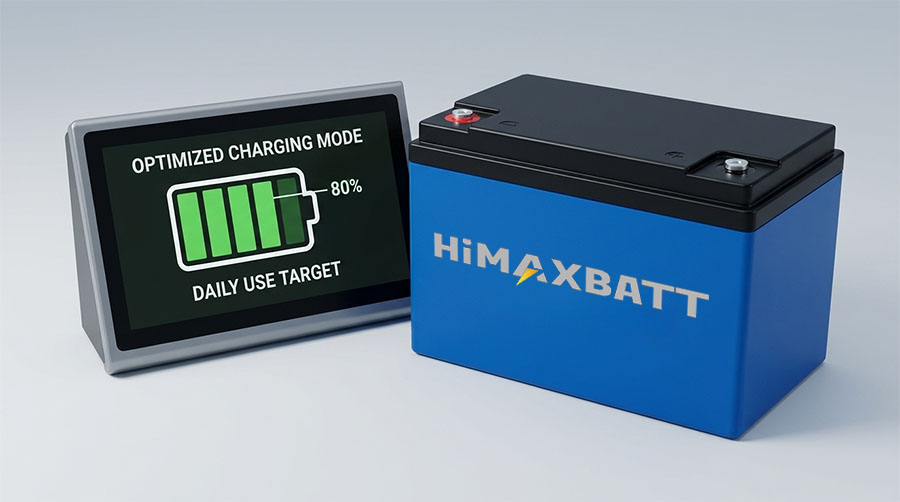
An 80% charging limit means that the charger or battery management system stops regular charging when the battery reaches approximately 80% state of charge, commonly abbreviated as SOC.
For example, a nominal 100Ah lithium battery charged to 80% contains approximately 80Ah of usable stored capacity before accounting for system losses, reserve settings, and battery-management restrictions.
The purpose is not to prevent immediate overcharging. A properly designed lithium battery should already include charging controls and a battery management system that protects the cells from exceeding their maximum voltage.
Instead, the 80% limit is intended to reduce the amount of time the battery spends near its upper voltage range. The U.S. Department of Energy identifies extended operation at a high state of charge as a significant contributor to calendar-life capacity fade in current lithium-ion systems.
This is why some consumer electronics and electric vehicles offer optimized charging features. Apple devices, for example, may delay charging beyond 80% when the system predicts that the device will remain connected to power for an extended period. Tesla also recommends an approximately 80% daily limit for vehicle models that display that recommendation, while reserving 100% charging for longer trips.
Why High State of Charge Can Accelerate Battery Aging
Lithium batteries age through two main processes:
Calendar Aging
Calendar aging occurs over time, even when the battery is not actively cycling. The rate of calendar aging is influenced by factors that include:
- State of charge
- Cell voltage
- Storage temperature
- Battery chemistry
- Time spent at elevated voltage
A battery stored at a high SOC in a hot environment generally experiences more stress than the same battery stored at a moderate SOC in a cool environment.
Cycle Aging
Cycle aging is associated with charging and discharging. Important variables include:
- Depth of discharge
- Charge and discharge current
- Cell temperature
- Maximum and minimum voltage
- Number of equivalent full cycles
An equivalent full cycle does not necessarily mean one charging session. Two discharges of 50% each may equal approximately one full equivalent cycle.
The 80% rule mainly targets high-SOC stress. It does not eliminate degradation caused by extreme temperatures, deep discharge, excessive current, poor cell balancing, or unsuitable charging equipment.
Does Charging to 80% Really Extend Lithium Battery Life?
In many applications, yes—but the size of the benefit varies.
An 80% charging limit can be effective when a battery:
- Remains connected to a charger for many hours
- Is stored between uses
- Operates in a warm environment
- Has more capacity than the application normally requires
- Is charged daily but only partially discharged
- Uses a lithium-ion chemistry that is sensitive to sustained high voltage
However, the benefit may be limited when:
- The battery is discharged soon after reaching 100%
- Maximum runtime is required every day
- The application already uses conservative internal voltage limits
- The battery system automatically manages charge windows
- The battery uses a chemistry and control strategy designed for frequent full charging
- Limiting charging causes the battery to be discharged too deeply during normal use
The last point is important. Reducing the upper charge limit from 100% to 80% is not helpful if the battery is then regularly driven close to 0%.
For example, operating between 20% and 80% provides a 60% working window. Operating between 5% and 100% provides a 95% working window. The best choice depends on the required energy, peak loads, operating schedule, and available charging opportunities.
The 80% Rule Is Not the Same for Every Lithium Chemistry
“Lithium battery” is a broad category. Different lithium chemistries have different voltage profiles, thermal characteristics, energy densities, and maintenance requirements.
NMC and NCA Lithium-Ion Batteries
Nickel manganese cobalt and nickel cobalt aluminum batteries are widely used in electric vehicles, portable electronics, power tools, and high-energy battery packs.
These chemistries can benefit from reduced time at high SOC, particularly when the battery is stored or parked in warm conditions. For daily use with surplus capacity, an 80% to 90% charging window may offer a practical balance between battery life and runtime.
Lithium Iron Phosphate Batteries
Lithium iron phosphate, or LiFePO4, is widely used in RV, marine, solar, backup power, mobility, and industrial applications.
LiFePO4 batteries generally provide strong cycle life, thermal stability, and a relatively flat discharge-voltage curve. They may not require a strict 80% charging limit for every daily-use application.
However, continuously avoiding full charge can create another issue: because the voltage curve is so flat, some battery monitors have difficulty estimating SOC accurately. In addition, many battery management systems perform top balancing near the upper end of the charging range.
Therefore, a LiFePO4 battery may be operated below full charge during normal daily use while still receiving a controlled full charge periodically, based on the manufacturer’s instructions.
Lithium Titanate and Other Specialized Chemistries
Lithium titanate batteries may support high charge rates, long cycle life, and strong low-temperature performance, but they have different voltage limits and operating characteristics.
Specialized industrial chemistries should always use a manufacturer-defined charging profile rather than a general consumer rule.
Industry Solution: Use an Operating SOC Window, Not a Fixed Percentage
For professional applications, the better question is not simply, “Should we charge to 80%?”
The better question is:
What operating SOC window delivers the required energy while controlling degradation, temperature, downtime, and safety risk?
A proper battery solution should evaluate:
- Daily energy consumption
- Peak current demand
- Required backup reserve
- Available charging time
- Ambient and cell temperature
- Battery chemistry
- Expected cycle life
- Storage duration
- Charger voltage and current
- Battery management system behavior
For some applications, a 20% to 80% operating window is practical. Others may require 10% to 90%, 20% to 100%, or nearly the full available range.
The solution should be engineered around the application rather than copied from a phone or electric vehicle setting.
Application Scenario 1: Residential Solar Energy Storage
Consider a home in Phoenix, Arizona, using a 48V 200Ah LiFePO4 battery bank.
The nominal stored energy is:
48V × 200Ah = 9.6kWh
Assume the home uses an average of 5.2kWh overnight for lighting, refrigeration, internet equipment, fans, and selected appliances.
Limiting regular charging to 80% provides approximately:
9.6kWh × 80% = 7.68kWh
If the system maintains a 15% emergency reserve, the normal usable energy between 80% and 15% is approximately:
9.6kWh × 65% = 6.24kWh
That is enough for the estimated 5.2kWh overnight load, with about 1.04kWh of additional margin before conversion losses.
In this case, an 80% regular target may be reasonable during sunny months. However, before a forecasted outage or severe storm, charging to 100% may be more valuable than the potential long-term benefit of remaining at 80%.
An intelligent energy-storage controller could therefore use:
- 80% during normal daily operation
- 90% during periods of reduced solar production
- 100% before severe weather or a planned utility outage
This adaptive strategy is more useful than enforcing one limit throughout the year.

Application Scenario 2: RV Battery System
A family in Colorado uses a 12.8V 300Ah LiFePO4 battery in a travel trailer.
The nominal stored energy is:
12.8V × 300Ah = 3.84kWh
Their typical daily consumption includes:
- 12V refrigerator: 1,000Wh
- Lighting and electronics: 350Wh
- Water pump: 100Wh
- Furnace blower: 500Wh
- Inverter loads: 600Wh
Total daily energy use is approximately 2.55kWh.
At an 80% charge limit, the battery stores about:
3.84kWh × 80% = 3.07kWh
If the owner avoids discharging below 15%, the available energy is only:
3.84kWh × 65% = 2.50kWh
That is slightly below the estimated daily demand.
In this case, a strict 80% limit could increase the risk of reaching a low SOC overnight. A 90% or 100% charge may be more appropriate during cold-weather camping when the furnace blower runs frequently.
During summer trips with solar charging available throughout the day, the system could operate between approximately 20% and 85%.
The correct limit changes with season, load profile, and charging access.
Application Scenario 3: Recreational Fishing Boat
A boat owner in Florida operates a 24V 100Ah LiFePO4 trolling-motor battery.
The nominal energy is:
25.6V × 100Ah = 2.56kWh
The trolling motor draws an average of 30A at 25.6V during moderate use:
25.6V × 30A = 768W
At full charge, the theoretical runtime before system limits and losses is approximately:
2.56kWh ÷ 0.768kW = 3.33 hours
At an 80% charge level, available stored energy falls to approximately 2.05kWh, producing a theoretical runtime of roughly 2.67 hours before considering reserve capacity.
For a two-hour fishing trip, 80% may be sufficient. For a full day on the water, charging to 100% provides a more valuable safety margin.
A good marine battery strategy could include:
- Charge to 100% before long trips
- Recharge promptly after use
- Avoid leaving the battery fully charged for weeks in a hot compartment
- Store at a moderate SOC during the off-season
- Verify that the charger matches the battery chemistry
- Maintain ventilation and thermal protection around the battery enclosure
Application Scenario 4: Warehouse Equipment
A distribution center in Texas uses a 48V 100Ah lithium battery in compact material-handling equipment.
The battery has approximately 4.8kWh of nominal energy. Each shift consumes about 2.7kWh, and the equipment can receive a 45-minute opportunity charge during lunch.
Because the battery does not need its full capacity for each shift, the facility might operate between 25% and 85% SOC. This avoids prolonged high-SOC storage while maintaining a 60% working window.
However, fleet managers must consider more than the charging percentage. They should also monitor:
- Charger output current
- Battery temperature during opportunity charging
- Cell-voltage imbalance
- Energy used per shift
- Unexpected increases in internal resistance
- BMS fault history
- Capacity variation across the fleet
For commercial fleets, charging limits should be integrated into a broader battery-health management program.

When Should You Charge a Lithium Battery to 100%?
Charging to 100% is appropriate when the additional stored energy has immediate operational value.
Examples include:
- Before an electric vehicle road trip
- Before an RV boondocking trip
- Before a marine excursion
- Before a hurricane, wildfire, ice storm, or grid outage
- Before using battery-powered medical equipment away from a charging source
- Before a long industrial shift
- When required for BMS cell balancing
- When needed to recalibrate a compatible SOC monitor
- When instructed by the battery manufacturer

The main maintenance concern is usually not the act of reaching 100%. It is the combination of high SOC, elevated temperature, and extended time.
Charging to 100% shortly before use is generally different from charging to 100% and leaving the battery in a hot location for several weeks.
Temperature May Matter More Than the 80% Limit
Temperature is one of the most important lithium battery maintenance factors.
A battery charged to 80% but stored in excessive heat may age faster than a battery charged to a higher level and stored under controlled conditions.
Apple notes that exposure to high ambient temperatures can permanently reduce battery capacity and that charging may be limited above 80% when battery temperatures exceed the recommended range.
For larger lithium battery systems, users should:
- Keep batteries away from engines, exhaust systems, and direct sunlight
- Provide suitable enclosure ventilation or thermal management
- Monitor internal battery temperature rather than relying only on outdoor temperature
- Avoid charging below the manufacturer’s permitted low-temperature threshold
- Use low-temperature charge protection where required
- Reduce charging current if the battery or charger approaches its thermal limit
LiFePO4 batteries typically require special attention when charging below freezing. Unless the battery contains a heating system or is specifically designed for low-temperature charging, charging in freezing conditions may damage the cells.
Charging Current and Charger Quality Also Affect Battery Life
A charging limit does not compensate for an unsuitable charger.
A quality lithium battery charger should provide the correct:
- Maximum voltage
- Charge-current limit
- Charging stages
- Termination behavior
- Temperature response
- Communication protocol
- Battery-chemistry profile
For example, a 100Ah battery charged at 20A is charging at approximately 0.2C. The same battery charged at 100A is charging at 1C.
A higher rate may reduce charging time, but it can also produce more heat and increase stress if the cells, busbars, BMS, connectors, or enclosure were not designed for that current.
Commercial system designers should select the charging current according to the cell specification, thermal environment, required turnaround time, and expected life.
Recommended Lithium Battery Maintenance Strategy
Instead of following a rigid 80% rule, HiMAXBATT recommends a layered maintenance strategy.
- For Daily Use
Use a moderate operating window when full capacity is unnecessary. Depending on the chemistry and application, this may be approximately 20% to 80%, 20% to 90%, or another manufacturer-approved range.
- For Maximum Runtime
Charge to 100% shortly before use when the additional energy is needed.
- For Storage
Avoid storing the battery at a very high or very low SOC. Follow the manufacturer’s recommended storage SOC, disconnect unnecessary loads, and inspect the battery periodically.
- or High-Temperature Environments
Reduce exposure to heat, improve ventilation, monitor battery temperature, and avoid leaving the battery fully charged longer than necessary.
- For LiFePO4 Systems
Confirm whether periodic full charging is needed for balancing or SOC calibration. Do not assume that the charging behavior of a smartphone applies directly to a large LiFePO4 pack.
- For Commercial Fleets
Use battery monitoring data to track temperature, energy throughput, current, SOC range, fault events, and capacity trends. Adjust the charge profile based on real operating data.
Common Mistakes to Avoid
One common mistake is assuming that 80% is a universal scientific threshold. Battery degradation does not suddenly begin at 81%. Stress generally changes across a range of voltage, temperature, and operating conditions.
Another mistake is focusing only on the upper charge limit while repeatedly discharging the battery to an extremely low SOC.
Users should also avoid:
- Using a lead-acid charger without confirming lithium compatibility
- Charging a cold battery outside its permitted temperature range
- Storing batteries fully depleted
- Ignoring loose or corroded connections
- Installing batteries near uncontrolled heat sources
- Mixing batteries with different capacities, ages, or states of health
- Bypassing BMS protection
- Assuming a displayed SOC percentage is always perfectly accurate
- Leaving parasitic loads connected during long-term storage
Build a Better Lithium Battery Solution with HiMAXBATT
HiMAXBATT develops lithium battery cells, modules, and customized battery packs for consumer electronics, energy storage, marine systems, RV applications, medical equipment, mobility products, industrial devices, and other demanding applications.
Rather than applying one generic charging rule to every product, the HiMAXBATT engineering team evaluates battery chemistry, capacity, operating voltage, charge and discharge current, temperature range, cycle-life targets, enclosure requirements, communication protocols, and battery management functions.
Whether your application requires a compact lithium-ion pack, a long-life LiFePO4 battery, a high-current industrial solution, or a customized battery management strategy, HiMAXBATT can help match the battery design and charging profile to your actual operating environment.
Find articles related to Lithium-ion Battery
- Price Comparison of 6 Common Lithium-Ion Battery Voltages (3.7V–22.2V)
- Lithium-ion Battery Classification Guide: Exploring Chemical Compositions, Common Sizes, and Application Scenarios
- Lithium-Ion Battery Packs vs. Cells: Differences & Application Scenario Exploration
- Responding to Amazon US Lithium Battery Compliance Upgrades: Supply Chain Tech Guide
- A Must-Read for Business Buyers: Uncovering the “Sand-Filled” High-End Lithium Battery Scam — A Guide to Spotting Traps and Choosing Reliable Suppliers
- Procurement Secrets for Geological Exploration Companies: Why It’s Time to Equip Your Surveying Equipment with Rechargeable Lithium-Ion Batteries
- OEM vs. Aftermarket Road E-Bike Replacement Batteries – Which One Offers Greater Peace of Mind?
- Why Not All Lithium Batteries Are Suitable for Power Applications
Car Battery vs. EV Battery: Can You Swap Them Without Damaging Your Vehicle?