| Commercial Summary: Generally, HiMAXBATT does not derive revenue from its articles; the editorial viewpoints expressed therein are our own and are published independently. We are a manufacturer of lithium batteries. |
Key Takeaways
- Off-Grid Power: Use LiFePO4 batteries and solar charging to power a 12V fridge independently of the electrical grid.
- Power Consumption: Fridge size, ambient temperature, insulation, and compressor runtime affect daily energy consumption.
- Battery Advantages: LiFePO4 batteries offer stable discharge voltage, high usable capacity, and a long cycle life.
- Battery Capacity: Select battery capacity based on daily energy consumption, expected runtime, and operating conditions.
- Solar Charging: Match solar panel wattage to daily energy demand, available sunlight, and system efficiency.
- System Compatibility: Ensure proper voltage matching, BMS protection, and charging equipment compatibility.
- Runtime Optimization: Pre-cooling, proper ventilation, and efficient energy management help extend battery runtime.
During RV trips, outdoor camping, overlanding adventures, and long-term off-grid living, a 12V fridge provides a refrigerated environment for food, beverages, and other items that require cold storage. However, keeping a fridge running without access to the electrical grid is a challenge that off-grid power system designers need to address.
Lithium iron phosphate (LiFePO4) batteries offer relatively high usable capacity, stable discharge voltage, and a long cycle life. When combined with a solar charging system, these batteries allow users to build a relatively independent energy storage and power supply system. Proper planning of fridge power consumption, battery capacity, solar energy production, and charging methods helps improve off-grid power reliability.
What Is Off-Grid Power for a 12V Fridge?
Off-grid power for a 12V fridge refers to supplying continuous DC power through energy storage batteries and compatible charging equipment without relying on a fixed AC electrical grid.
This article focuses primarily on 12V DC compressor refrigerators. These refrigerators cool their interiors through compressor cycling. Once the internal temperature reaches the set point, the compressor can reduce its operating power or temporarily stop running.
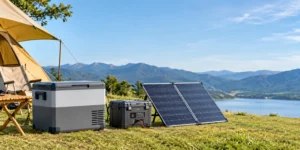
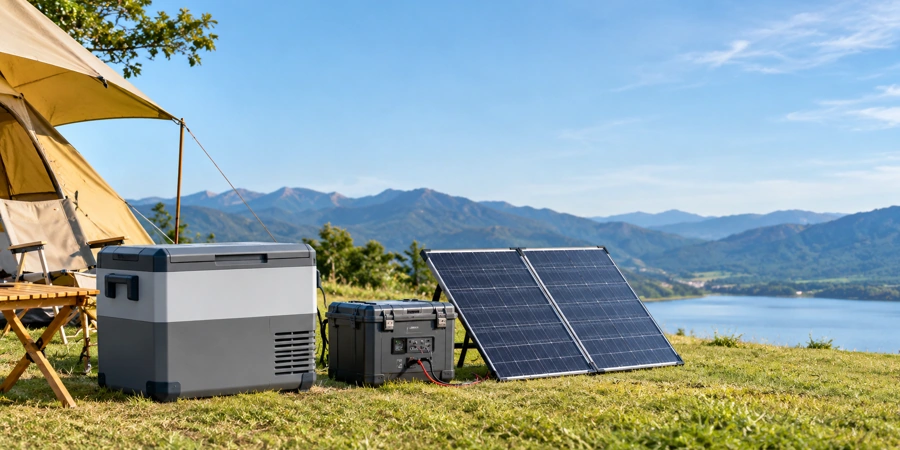
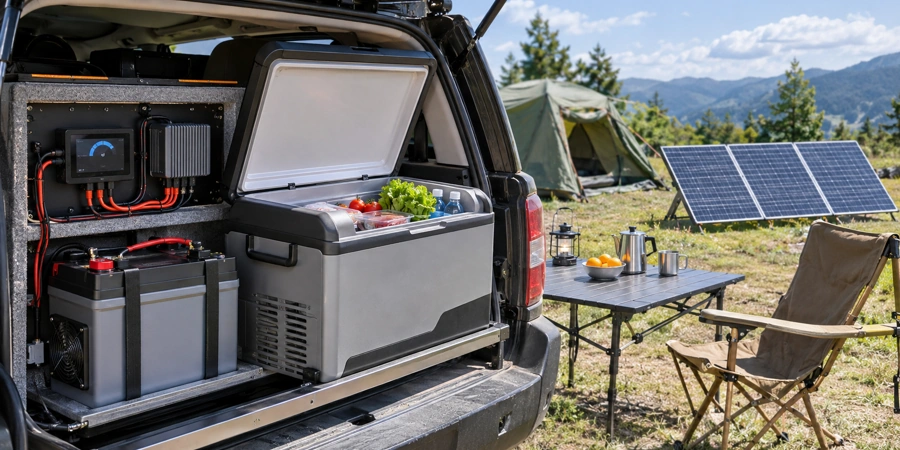
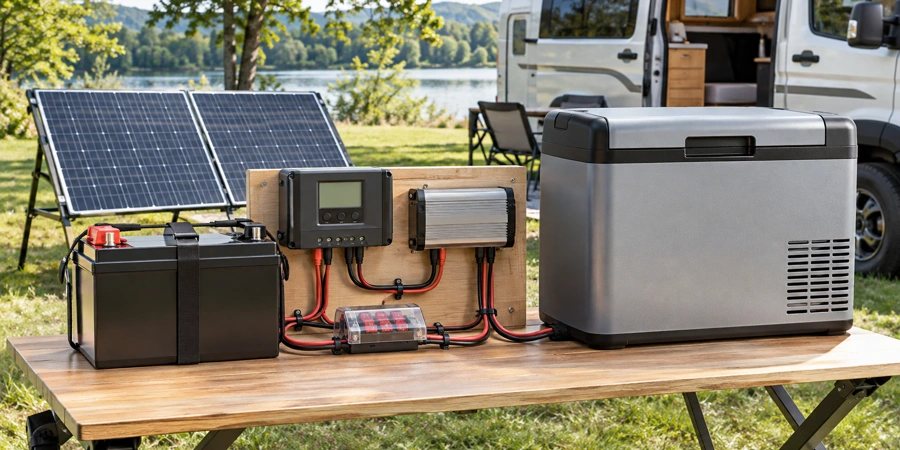
A typical off-grid power system consists of an energy storage battery, charging equipment, power distribution and circuit protection devices, and a refrigerator. The battery stores and delivers electrical energy, while solar panels or a vehicle’s charging system replenish the battery to meet the fridge’s power requirements throughout the day.
How Much Power Does a 12V Fridge Consume?
The rated power of a 12V fridge does not represent its average power consumption throughout the day. The compressor typically operates intermittently in response to temperature changes, so users need to consider actual operating time when estimating daily energy consumption.
The main factors affecting fridge energy consumption include:
- Fridge capacity and compressor operating power;
- Ambient temperature and internal temperature settings;
- Insulation thickness and sealing performance;
- Differences between refrigerator and freezer modes;
- Food load and compressor duty cycle.
The following table provides example power consumption ranges for 12V compressor refrigerators of different sizes.
| Fridge Capacity | Compressor Operating Power | Estimated Daily Energy Consumption |
| 15–25L | 30–45W | 200–350Wh |
| 30–45L | 40–60W | 300–500Wh |
| 50–65L | 45–75W | 400–700Wh |
| 70–100L | 60–100W | 500–1,000Wh |
These figures are intended for preliminary power system planning only. Actual energy consumption should be determined using equipment specifications and measured operating data.
Why Are LiFePO4 Batteries Suitable for Powering a 12V Fridge?
A 12V fridge is an electrical appliance that operates for extended periods and places recurring discharge demands on its battery. Unlike power tools that operate for short periods, refrigerators require sufficient usable battery capacity, stable output voltage, and a long cycle life.
A 12V-class LiFePO4 battery typically uses four cells connected in series (4S), providing a nominal voltage of 12.8V. As long as the battery operates within the fridge’s allowable input voltage range, it can provide stable power to a 12V DC refrigerator.
According to the U.S. Department of Energy’s (DOE) 2022 Grid Energy Storage Technology Cost and Performance Assessment, cycle life and calendar life are important factors when evaluating the long-term operating costs of battery energy storage systems.
The following table compares LiFePO4 batteries with conventional deep-cycle lead-acid batteries.
| Comparison Factor | LiFePO4 Battery | Deep-Cycle Lead-Acid Battery |
| Nominal Voltage | 12.8V | 12V |
| Typical Depth of Discharge | 80%–90% | Approximately 50% |
| Estimated Cycle Life | 2,000–5,000 cycles | 300–1,000 cycles |
| Charging Efficiency | Higher | Relatively lower |
| Discharge Voltage Stability | Higher | Declines as the battery discharges |
| Weight at Equivalent Capacity | Lighter | Heavier |
| Initial Purchase Cost | Higher | Relatively lower |
| Long-Term Cycling Cost | Generally lower | Depends on replacement frequency |
Note: The figures in the table represent typical reference ranges. Actual performance depends on cell quality, depth of discharge, operating temperature, and testing conditions.
From a battery manufacturing perspective, the relatively stable discharge voltage of LiFePO4 batteries helps reduce the likelihood of a refrigerator prematurely triggering its low-voltage protection due to declining supply voltage. With a properly designed battery management system (BMS), the battery can also provide overcharge, over-discharge, overcurrent, short-circuit, and temperature protection.
How to Choose the Right Battery Capacity and Estimate Runtime for a 12V Fridge
An undersized battery may cause the fridge to lose power overnight or during cloudy and rainy weather. An oversized battery, on the other hand, increases system weight, installation space requirements, and purchasing costs. Battery manufacturers therefore need to design battery capacity around actual electrical loads and operating cycles.
How Long Can Different LiFePO4 Battery Capacities Run a Fridge?
Based on a 12.8V LiFePO4 battery, a 90% depth of discharge, and 95% system efficiency, the estimated runtime for different battery capacities is shown below.
| Battery Capacity | Nominal Energy Storage | Usable Energy | 300Wh/Day | 500Wh/Day | 700Wh/Day |
| 50Ah | 640Wh | 547Wh | 43.8 hours | 26.3 hours | 18.8 hours |
| 100Ah | 1,280Wh | 1,094Wh | 87.6 hours | 52.5 hours | 37.5 hours |
| 150Ah | 1,920Wh | 1,642Wh | 131.3 hours | 78.8 hours | 56.3 hours |
| 200Ah | 2,560Wh | 2,189Wh | 175.1 hours | 105.1 hours | 75.0 hours |
These estimates assume that the battery is fully charged at the beginning of operation and that there are no external charging sources or additional electrical loads during use.
For refrigeration systems that require continuous operation, buyers should also consider the battery’s continuous discharge current, peak discharge current, and capacity reduction at low temperatures rather than selecting a battery based solely on its amp-hour rating.
How to Use Solar Power to Keep a 12V Fridge Running Off-Grid
Solar charging replenishes battery energy during daylight hours, reducing the fridge’s dependence on fixed charging facilities. However, whether a solar power system can sustain long-term refrigerator operation depends on whether its daily usable energy production can cover daily energy consumption.
What Size Solar Panel Do You Need for a 12V Fridge?
Assuming the fridge consumes 420Wh per day, the location receives four peak sun hours daily, and the overall energy utilization efficiency is 75%, the required solar panel wattage is approximately 140W.
To account for changing weather conditions and partial shading, users can install 180–200W of solar panels to provide additional daily energy production.
| Daily Fridge Energy Consumption | 4 Peak Sun Hours/Day | 3 Peak Sun Hours/Day | 2 Peak Sun Hours/Day |
| 300Wh | 100W | 134W | 200W |
| 500Wh | 167W | 223W | 334W |
| 700Wh | 234W | 312W | 467W |
| 1,000Wh | 334W | 445W | 667W |
These estimated solar panel wattage requirements are based on an overall energy utilization efficiency of 75%. They do not include the additional energy needed to recharge depleted batteries after several consecutive days of cloudy or rainy weather.
According to research on photovoltaic system energy production modeling published by the National Renewable Energy Laboratory (NREL), solar irradiance, solar cell temperature, and system losses all affect actual photovoltaic energy production. Therefore, system designers should not simply multiply a solar panel’s rated wattage by the total number of daylight hours to estimate daily energy production.
How to Handle Cloudy Weather and Limited Sunlight
Solar energy production varies depending on the season, geographic location, and weather conditions. When daily solar energy production falls below the fridge’s daily energy consumption, the battery must cover the remaining energy deficit.
For long-term off-grid applications, system designers can provide two to three days of battery storage based on local sunlight conditions and incorporate vehicle charging or other backup charging methods. The solar power system should also have sufficient additional generating capacity to replenish battery energy once weather conditions improve.
How to Build a Safe and Reliable Off-Grid Power System for a 12V Fridge
A complete off-grid power system requires more than matching battery capacity to the refrigerator’s energy consumption. It also requires careful consideration of charging and discharging parameters, equipment compatibility, and circuit protection.
| Core Component | Primary Function | Selection Considerations |
| LiFePO4 Battery | Stores and delivers electrical energy | Capacity, voltage, discharge current |
| Solar Panel | Converts solar energy into electricity | Rated wattage, installation space |
| MPPT Charge Controller | Optimizes solar charging | Input voltage, output current, charging parameters |
| DC-DC Charger | Charges the battery using the vehicle’s charging system | Alternator compatibility, charging current |
| BMS | Manages battery cells and provides protection | Current, temperature, and voltage protection parameters |
| Fuses and Cables | Carry electrical current and protect circuits | Current-carrying capacity, voltage drop, short-circuit protection |
Voltage Compatibility Between the Battery and Fridge
The charging voltage of a 12.8V LiFePO4 battery typically ranges from 14.2V to 14.6V, depending on the battery manufacturer’s design specifications. System integrators should verify that the fridge’s allowable input voltage range covers both the battery’s actual operating voltage and charging voltage.
Matching Charging Equipment With BMS Parameters
MPPT charge controllers and DC-DC chargers should support LiFePO4 battery charging profiles. Charging voltage and current should be configured according to the battery’s specifications. When multiple charging devices operate simultaneously, their combined charging current must not exceed the battery’s allowable charging current.
In addition, the system should include a DC-rated fuse installed close to the battery’s positive terminal. Cable gauge should be selected based on load current, cable length, and installation conditions to reduce the risk of overheating and excessive voltage drop.
Off-Grid Power Configurations for Different 12V Fridge Applications
Different applications have varying requirements for refrigerator runtime, equipment weight, installation space, and supplementary charging methods.
| Application | Estimated Daily Energy Consumption | Recommended Battery Capacity | Suggested Solar Panel Wattage | Backup Charging Method |
| Weekend Camping | 200–350Wh | 50–100Ah | 100–150W | AC charging |
| Extended RV Travel | 350–600Wh | 100–150Ah | 200–300W | DC-DC charging while driving |
| Overlanding Adventures | 400–700Wh | 100–200Ah | 200–350W | DC-DC charging while driving |
| Small Boat Refrigeration | 400–800Wh | 150–200Ah | 200–400W | Onboard charging system |
| Long-Term Off-Grid Living | 600–1,000Wh | 200–300Ah | 300–500W | Backup generator |
These configurations are based on 12.8V LiFePO4 batteries, approximately four peak sun hours per day, and a refrigerator as the sole electrical load.
If the energy storage system also powers lighting, communication equipment, water pumps, or other appliances, system integrators should include the energy consumption of these devices in the overall battery capacity design.
For RV and boat manufacturers, battery enclosure protection, vibration resistance, mounting structures, and connection interfaces should also be designed according to the equipment’s installation location.
How to Extend the Off-Grid Runtime of a 12V Fridge
In addition to increasing battery capacity and solar energy production, reducing the fridge’s actual energy consumption can help extend system runtime.
- Pre-Cool the Fridge: Cool the fridge and its contents before disconnecting from a fixed power source to reduce the initial cooling load on the battery.
- Set Appropriate Temperatures: Avoid unnecessarily low temperature settings while maintaining food safety requirements.
- Improve Ventilation: Provide adequate ventilation around the compressor and condenser to reduce cooling demand in hot environments.
- Minimize Cold Air Loss: Reduce the frequency of door openings and regularly inspect the fridge’s door seals.
- Reduce Wiring Losses: Use properly sized DC cables and reliable connectors to minimize energy losses during power delivery.
- Monitor Battery Status: Use a battery monitor with coulomb-counting capabilities to track remaining capacity and actual energy consumption, allowing for better charging schedules.
By optimizing energy management, users can improve the efficiency of their existing energy storage systems without increasing battery capacity.
FAQs: Off-Grid Power for 12V Fridges
Can a 12V Fridge Run Directly on Solar Panels?
Connecting solar panels directly to a fridge is generally not recommended. Solar panel output voltage and current fluctuate with sunlight conditions, which can cause unstable refrigerator operation. Users should incorporate a charge controller and an energy storage battery to establish a stable power supply system.
Can LiFePO4 Batteries Be Charged Below Freezing?
Standard LiFePO4 cells generally do not support charging below 32°F (0°C), as this may cause lithium plating and damage battery performance. Off-grid power systems operating in cold climates can use batteries equipped with low-temperature charging protection or built-in heating functions. Specific charging temperature limits should follow the battery manufacturer’s specifications.
Do You Need an Inverter to Run a 12V Fridge on a LiFePO4 Battery?
An inverter is generally unnecessary if the fridge supports a DC input voltage that matches the battery’s operating voltage. Direct DC power reduces energy losses associated with converting electricity between DC and AC.
Can You Connect LiFePO4 Batteries in Parallel to Extend Fridge Runtime?
Yes. However, the batteries must support parallel connections and have compatible voltage, capacity, and BMS parameters. System designers should follow the battery manufacturer’s connection requirements and ensure that each parallel branch has appropriate circuit protection.
Why Does a 12V Fridge Shut Off When the LiFePO4 Battery Still Has Power?
This may be related to the fridge’s low-voltage protection threshold, wiring voltage drop, connector contact resistance, or BMS protection. Users should check the actual operating voltage at the fridge’s input terminals and troubleshoot the relevant protection settings according to equipment specifications rather than simply disabling low-voltage protection.
HiMAXBATT: LiFePO4 Battery Manufacturing and Custom Solutions for 12V Fridges
HiMAXBATT is a battery manufacturer specializing in the development, manufacturing, and supply of rechargeable lithium batteries and custom battery packs, providing OEM/ODM LiFePO4 battery solutions for RV manufacturers, vehicle refrigerator manufacturers, outdoor refrigeration equipment manufacturers, and off-grid power system integrators worldwide. To meet different refrigeration and off-grid power requirements, HiMAXBATT offers customized battery designs covering voltage, capacity, cell configuration, charging and discharging performance, BMS protection functions, enclosure structures, and connection interfaces, helping B2B customers develop energy storage and power supply systems tailored to their specific applications.