| Commercial Summary: Generally, HiMAXBATT does not derive revenue from its articles; the editorial viewpoints expressed therein are our own and are published independently. We are a manufacturer of lithium batteries. |
Key Takeaways
- Upgrading to LiFePO4 batteries can improve acceleration and power delivery, but it does not necessarily increase a golf cart’s top speed.
- Lighter battery weight, stable discharge voltage, and reduced voltage sag can improve hill-climbing and heavy-load performance.
- Golf cart speed depends on battery voltage, motor power, controller settings, and vehicle speed limits.
- Higher battery capacity primarily extends driving range, while discharge current plays an important role in power delivery.
- Golf cart manufacturers and conversion specialists should consider BMS specifications, drivetrain compatibility, and operating conditions when selecting batteries.
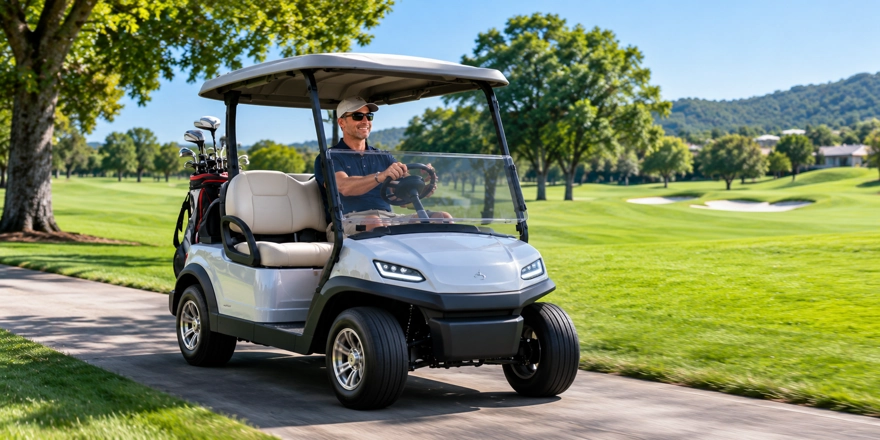
As lithium battery technology becomes more widely adopted in low-speed electric vehicles, more golf cart manufacturers, dealers, and fleet operators are replacing traditional lead-acid batteries with lithium iron phosphate (LiFePO4) batteries. Beyond driving range and battery lifespan, acceleration, hill-climbing ability, and power output have become important considerations when upgrading batteries.
So, can switching to golf cart lithium batteries actually make a golf cart faster? From a battery manufacturing perspective, answering this question requires a closer look at both battery electrical performance and the vehicle’s drivetrain.
Do Lithium Batteries Really Make Golf Carts Faster?
The answer depends on the golf cart’s existing drivetrain, battery performance, and upgrade configuration.
If a golf cart’s original lead-acid batteries have aged, developed higher internal resistance, or experienced significant voltage sag under load, replacing them with properly matched LiFePO4 batteries can provide more consistent power and potentially restore or improve driving performance.
However, vehicle performance should be evaluated across three separate areas:
| Performance Factor | Potential Changes After Upgrading to LiFePO4 Batteries |
| Top speed | Limited by the motor, controller, and speed settings; may not increase |
| Acceleration from a stop | May improve when sufficient discharge current is available |
| Sustained power output | Can help reduce power loss during hill climbing, heavy-load operation, and low-charge driving |
Therefore, the performance benefits of LiFePO4 batteries are more likely to appear in throttle response, acceleration, and sustained power delivery rather than simply increasing top speed.
What Determines a Golf Cart’s Top Speed?
A golf cart’s speed is determined by its entire drivetrain. Even when the battery provides sufficient electrical power, limitations in other components can still affect vehicle speed.
| Influencing Factor | Impact on Golf Cart Speed |
| Battery operating voltage | Affects motor operation and available power |
| Motor power and speed | Determines power output and operating speed range |
| Motor controller | Regulates motor current, torque, and operating speed |
| Vehicle speed settings | Limit the vehicle’s permitted driving speed |
| Drivetrain | Determines the relationship between wheel speed and drive torque |
| Tire size | Affects actual driving speed at a given wheel rotation speed |
| Vehicle load and driving resistance | Affect the power required to accelerate and maintain speed |
If the vehicle controller has a fixed speed limit, the golf cart may continue operating within its original speed range even after upgrading to lithium batteries with better discharge performance.
For this reason, battery manufacturers need to understand motor specifications, controller requirements, and actual operating conditions when designing golf cart battery packs, rather than evaluating power performance based solely on battery capacity.
How Do LiFePO4 Batteries Improve Golf Cart Acceleration and Power Output?
Reducing Vehicle Weight for Better Acceleration
For comparable usable energy storage requirements, LiFePO4 batteries are generally lighter than traditional deep-cycle lead-acid batteries. Replacing the batteries can reduce overall vehicle weight, decreasing the inertia and certain driving resistance forces that the motor must overcome when starting, accelerating, or climbing hills.
According to the U.S. Department of Energy (DOE)’s research on Lightweight Vehicle Materials and Energy Efficiency, lighter objects require less energy to reach the same speed, and reducing vehicle weight can improve energy efficiency.
For golf carts that frequently start and stop, reducing battery weight can help improve acceleration from a standstill and lower energy consumption under certain driving conditions.
Reducing Voltage Sag Under Load
During rapid acceleration, hill climbing, or heavy-load operation, a golf cart’s drivetrain draws a significant amount of current from the battery. If the battery pack has high internal resistance, its output voltage can drop noticeably during high-current discharge.
According to Battery University’s article on How Rising Internal Resistance Affects Battery Performance, higher internal resistance can cause voltage drops and increased heat generation under load, potentially causing equipment to shut down prematurely.
LiFePO4 battery packs built with low-resistance cells and properly designed electrical connections can help reduce voltage losses during high-current discharge, providing a more stable power supply to the motor controller.
Maintaining Stable Discharge Voltage
LiFePO4 batteries have a relatively flat discharge voltage curve throughout much of their usable discharge range. Compared with traditional lead-acid batteries, their operating voltage generally does not decline as significantly as the remaining charge decreases.
This characteristic helps golf carts maintain relatively consistent power delivery at moderate and lower states of charge. However, as the battery approaches its discharge cutoff voltage, the vehicle may still experience reduced power or trigger low-voltage protection.
Providing Sufficient Continuous and Peak Discharge Current
Golf carts have different discharge current requirements depending on driving conditions. Continuous discharge capability primarily affects extended operation and sustained hill climbing, while peak discharge capability influences short-term power response.
| Driving Scenario | Primary Battery Performance Requirement | Potential Improvement |
| Acceleration from a stop | Peak discharge capability | Improved initial acceleration |
| Sustained hill climbing | Continuous discharge capability | Reduced power loss |
| Fully loaded operation | Stable voltage and sufficient current | Improved heavy-load performance |
| Frequent starts and stops | Current response and thermal management | Improved operational stability |
| Driving at moderate or low charge | Stable discharge voltage | Reduced power fluctuations |
Battery manufacturers need to select suitable power-oriented cells based on these operating conditions and properly configure the battery management system, electrical connections, and thermal management design to meet the vehicle’s actual power requirements.
LiFePO4 vs. Lead-Acid Batteries: Golf Cart Power Performance Comparison
When the drivetrain remains unchanged and battery specifications are properly matched, the two battery technologies generally exhibit the following performance differences during actual driving.
| Comparison Factor | Traditional Lead-Acid Batteries | LiFePO4 Batteries |
| Battery weight | Relatively heavy | Relatively lightweight |
| Voltage sag under load | More noticeable during sustained high-current discharge | Relatively low when properly configured |
| Acceleration from a stop | Easily affected by battery condition | Relatively consistent power supply |
| Power response | May decline under sustained heavy loads | Relatively stable when properly matched |
| Hill-climbing ability | May experience power loss during extended climbs | Helps maintain sustained power delivery |
| Heavy-load performance | More noticeably affected by voltage sag | Depends on continuous discharge capability |
| Performance at moderate and low charge | More prone to declining power | Relatively stable throughout the main discharge range |
| Discharge energy efficiency | Relatively low | Generally higher |
| Top speed | Depends on the vehicle’s drivetrain | Does not necessarily increase |
These comparisons reflect the typical characteristics of the two battery technologies rather than measured results from specific products. Actual performance also depends on cell quality, battery age, ambient temperature, and vehicle configuration.
How Do Battery Voltage, Capacity, and Discharge Current Affect Golf Cart Performance?
How Different Voltage Platforms Affect Power Output
Common golf cart voltage platforms include 36V, 48V, and 72V. When other operating conditions allow, a higher operating voltage can deliver more electrical power at the same current.
The formula for calculating battery electrical power output is: P = U × I
Assuming batteries on different voltage platforms discharge at 100A, their theoretical power outputs are as follows:
| Voltage Platform | Discharge Current | Theoretical Power Output | Typical Applications |
| 36V | 100A | 3.6kW | Certain traditional and lightweight golf carts |
| 48V | 100A | 4.8kW | Standard electric golf carts |
| 72V | 100A | 7.2kW | Certain high-power and heavy-duty models |
It is important to note that battery electrical power output is not equivalent to the motor’s actual mechanical power output. Additionally, 48V-class LiFePO4 batteries typically have a nominal voltage of 51.2V. Calculations should be based on the specific battery’s specifications.
Do not upgrade a vehicle from a lower-voltage platform to a higher-voltage platform without approval from the vehicle manufacturer, as doing so may damage the motor, controller, and other electrical components.
Does Higher Battery Capacity Make a Golf Cart Faster?
Battery capacity (Ah) primarily indicates how much electrical charge a battery can store and deliver. It does not directly represent the battery’s power output.
Consider the following two hypothetical 48V-class LiFePO4 batteries:
| Battery Specification | 51.2V 100Ah | 51.2V 150Ah |
| Nominal voltage | 51.2V | 51.2V |
| Battery capacity | 100Ah | 150Ah |
| Nominal energy storage | 5.12kWh | 7.68kWh |
| Assumed continuous discharge current | 100A | 100A |
| Power output calculated at nominal voltage | 5.12kW | 5.12kW |
| Theoretical driving range potential | Baseline | Relatively higher |
| Top speed | Depends on vehicle configuration | Does not necessarily increase |
When operating voltage and continuous discharge current are identical, both batteries have the same theoretical power output. Therefore, increasing battery capacity primarily helps extend driving range rather than directly increasing vehicle speed.
How Do Discharge Rate and BMS Affect Power Output?
The discharge rate (C-rate) describes a battery’s discharge capability relative to its capacity. For example, a 100Ah battery discharging at 1C delivers 100A, while discharging at 2C corresponds to 200A.
However, a high cell discharge rate does not necessarily mean the entire battery pack can continuously deliver the corresponding current. The BMS, connection terminals, wiring harnesses, fuses, and thermal management design can all limit actual discharge capability.
When sourcing power-oriented LiFePO4 batteries, buyers should verify the entire battery pack’s rated continuous discharge current, peak discharge current, and allowable peak discharge duration.
Choosing LiFePO4 Batteries for Better Golf Cart Performance
For golf cart manufacturers, dealers, conversion specialists, and fleet operators, battery procurement should focus not only on capacity and price but also on compatibility with the vehicle’s drivetrain.
| Key Procurement Parameter | Battery Selection Recommendations |
| Nominal voltage | Match the vehicle’s existing voltage platform |
| Operating voltage range | Confirm that the controller can handle fully charged and discharge voltages |
| Battery capacity | Select based on daily driving distance and range requirements |
| Continuous discharge current | Meet sustained hill-climbing and heavy-load operating requirements |
| Peak discharge current | Match starting and short-term acceleration requirements |
| BMS protection features | Support overcharge, overdischarge, overcurrent, short-circuit, and temperature protection |
| Communication protocols | Match CAN, RS485, or other communication requirements as needed |
| Charger compatibility | Match the LiFePO4 battery’s charging specifications |
| Battery pack structure | Match installation space, mounting methods, and protection requirements |
| Operating temperature range | Meet the vehicle’s actual operating environment requirements |
For bulk procurement projects, customers should provide battery manufacturers with motor specifications, controller battery-side current requirements, typical payloads, driving slopes, and daily operating hours.
Battery manufacturers can use this information to select cells, design series and parallel configurations, configure the BMS, and develop thermal management solutions. During the sample development stage, load discharge, temperature rise, sustained hill climbing, and frequent start-stop tests should also be conducted to verify battery performance under actual operating conditions.

FAQs: Golf Cart Lithium Batteries & Power Performance
Can LiFePO4 Directly Replace Lead-Acid in Older Golf Carts?
A compatible conversion is possible, but compatibility cannot be determined by nominal voltage alone. Before replacing the batteries, check the controller, charger, wiring harnesses, mounting structure, and auxiliary power systems. Some components may need to be replaced.
Does Cold Weather Affect Golf Cart Lithium Battery Acceleration?
Yes. Low temperatures can increase battery internal resistance and reduce discharge capability, potentially causing insufficient power during acceleration or hill climbing. Golf carts operating in cold climates should use batteries that meet their actual operating temperature requirements and include appropriate low-temperature protection features.
Why Does a Golf Cart Suddenly Lose Power During Hard Acceleration?
Common causes include instantaneous current exceeding the BMS protection threshold, low individual cell voltage, poor terminal connections, or abnormal battery temperatures. Troubleshooting should involve reviewing fault logs and conducting load tests rather than bypassing protection settings.
Must Regenerative Braking Match the Lithium BMS?
Yes. The charging current generated by regenerative braking must remain within the battery’s allowable charging limits. When the battery is fully charged or operating at low temperatures, regenerative charging may be restricted. The controller must therefore support appropriate coordination with the battery system.
Does the Battery Gauge Need Recalibration After a Lithium Battery Upgrade?
Generally, yes. Lead-acid and LiFePO4 batteries have different discharge voltage curves, so the original voltage-based battery gauge may not accurately display the remaining lithium battery charge. A battery gauge compatible with the BMS is recommended.
HiMAXBATT: Golf Cart LiFePO4 Battery Manufacturing and Custom Solutions
HiMAXBATT is a battery manufacturer specializing in the development, manufacturing, and customization of rechargeable lithium batteries, providing power solutions for global B2B customers across a range of applications. For LiFePO4 golf cart batteries, HiMAXBATT offers customization services based on customers’ vehicle drivetrains and actual operating requirements, including battery voltage, capacity, continuous and peak discharge performance, BMS configuration, communication protocols, and battery pack structure.