| Commercial Summary: Generally, HiMAXBATT does not derive revenue from its articles; the editorial viewpoints expressed therein are our own and are published independently. We are a manufacturer of lithium batteries. |
Key Takeaways
- Voltage determines operating conditions: 2S, 3S, and 4S LiPo batteries have nominal voltages of 7.4V, 11.1V, and 14.8V, respectively, and must be compatible with the vehicle’s electrical system.
- C-rating affects current delivery: Choose a discharge rating based on battery capacity, continuous current requirements, and actual battery performance.
- Capacity influences runtime: Higher mAh ratings can extend driving time but may also increase vehicle weight.
- Runtime depends on operating conditions: Battery capacity, average current draw, driving style, and environmental conditions all affect runtime.
- Safety and compatibility matter: Battery dimensions, connectors, balance charging, and low-voltage protection should all be considered.
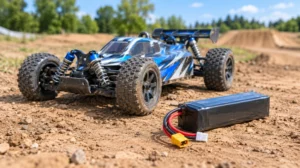
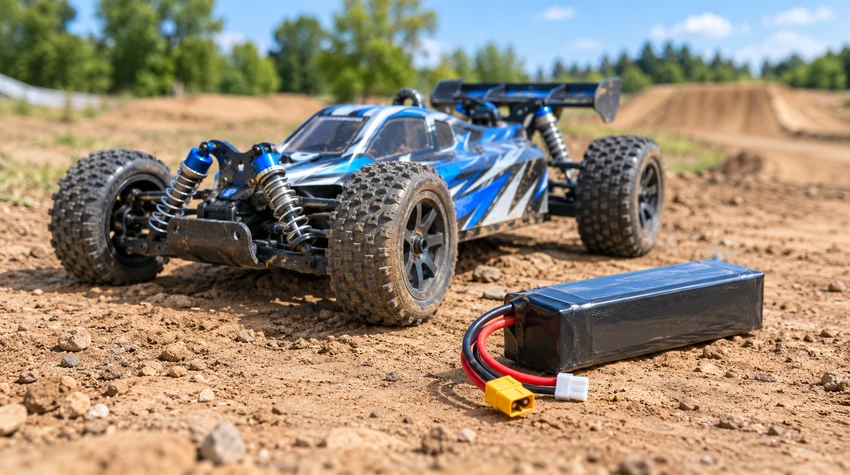
An RC car’s acceleration, power delivery, and runtime are closely tied to its battery configuration. For RC cars equipped with brushless motors, lithium polymer (LiPo) batteries have become a popular power source thanks to their high energy density, flexible configurations, and ability to deliver substantial current.
However, different RC cars have different requirements for voltage, discharge rate, and battery capacity. Choosing the right battery involves more than just maximizing performance. You also need to ensure compatibility with the electronic speed controller (ESC), motor, chassis, and charging equipment. This guide explains the key specifications of RC car LiPo batteries, how to estimate runtime, and essential safety considerations from a battery manufacturing and practical application perspective.
Why Are LiPo Batteries Suitable for RC Cars?
A LiPo battery is a type of lithium-ion battery that typically uses a polymer-based electrolyte system and flexible pouch packaging. These batteries offer relatively high energy density and flexible design options. In RC car applications, LiPo batteries can be configured with different series and parallel cell arrangements to meet various power requirements.
Compared with traditional nickel-metal hydride (NiMH) batteries, LiPo batteries generally offer several advantages:
- Lower weight: At comparable energy capacities, LiPo batteries can help reduce the vehicle’s overall weight.
- Consistent power delivery: High-discharge-rate cells can support the substantial current demands of acceleration and hill climbing.
- Flexible configurations: Different capacities, thicknesses, and enclosure designs allow users to select batteries that fit their vehicles.
However, LiPo batteries have specific requirements for charging voltage, over-discharge protection, and storage conditions. Users should always use compatible charging equipment and follow the battery manufacturer’s operating guidelines.
How to Choose LiPo Battery Voltage: 2S vs. 3S vs. 4S
A LiPo battery’s voltage depends on the number of cells connected in series. The letter “S” stands for “Series.” A conventional LiPo cell typically has a nominal voltage of 3.7V and a fully charged voltage of 4.2V.
| Battery Type | Nominal Voltage | Fully Charged Voltage | Typical Applications |
| 2S LiPo | 7.4V | 8.4V | Entry-level and certain racing RC cars |
| 3S LiPo | 11.1V | 12.6V | Power systems designed for higher-voltage operation |
| 4S LiPo | 14.8V | 16.8V | Certain high-power RC vehicles |
When motor KV rating, gear ratio, and other operating conditions remain similar, increasing the supply voltage generally increases the motor’s theoretical rotational speed. However, actual vehicle speed also depends on load, tire diameter, ESC settings, and mechanical resistance.
Upgrading voltage does not mean you can simply swap batteries. For example, before upgrading from a 2S to a 3S LiPo battery, you must confirm that the ESC supports 3S input and evaluate motor temperature, gearing, and drivetrain load capacity. Exceeding the equipment’s rated voltage may damage electronic components.
Therefore, when selecting an RC car LiPo battery, follow the voltage range specified by the vehicle manufacturer rather than simply choosing a battery with more cells.
How to Choose a LiPo Battery C-Rating: Is Higher Better?
The discharge rate of a LiPo battery is commonly expressed as a “C-rating,” which describes its current delivery capability relative to its rated capacity. For RC cars that frequently accelerate, brake, and climb hills, continuous discharge capability is an important selection factor.
The theoretical calculation is:
Continuous Discharge Current (A) = Battery Capacity (Ah) × Continuous Discharge C-Rating
For example, consider a 5000mAh LiPo battery rated at 50C:
5Ah × 50C = 250A
Based on its stated specifications, this battery has a rated continuous discharge current of 250A. However, its actual ability to sustain that output also depends on cell temperature, internal resistance, connectors, and heat dissipation.
When comparing batteries, it is important to distinguish between two ratings:
- Continuous discharge C-rating: Indicates the current the battery is rated to deliver continuously under the manufacturer’s specified conditions.
- Burst discharge C-rating: Indicates the higher current the battery may deliver for a limited period, as defined by the manufacturer.
Keep in mind that C-rating test conditions can vary between manufacturers. A higher advertised C-rating does not necessarily guarantee better real-world performance.
From a battery manufacturing perspective, cell internal resistance, electrode design, thermal management, and cell consistency also affect discharge performance. Buyers should review actual test data and allow an appropriate safety margin for the vehicle’s current requirements.
How to Choose RC Car LiPo Capacity: Is More mAh Better?
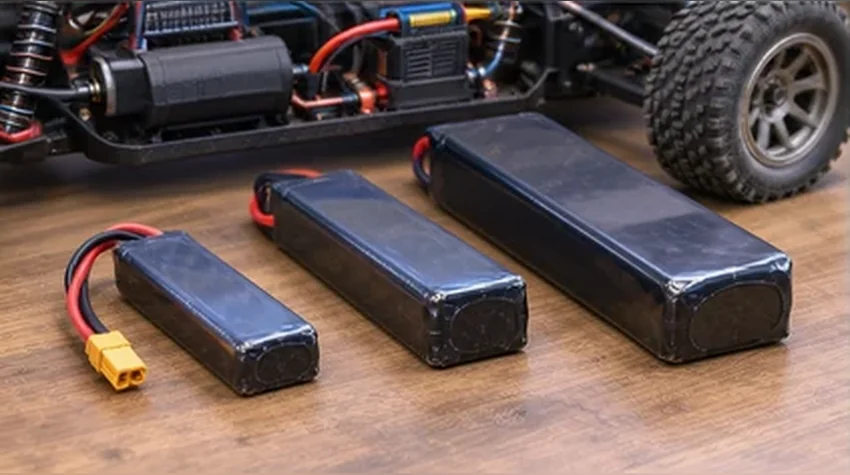
Battery capacity is typically expressed in milliamp-hours (mAh), indicating the amount of electrical charge a battery can deliver under specified discharge conditions. For example, 5000mAh is equivalent to 5Ah.
At the same voltage and under similar discharge conditions, a higher-capacity battery generally provides more available energy. However, increased capacity may also result in additional weight and larger physical dimensions.
There are three important factors to consider when choosing battery capacity.
First, check the battery compartment. A higher-capacity battery may not fit inside the existing battery tray, particularly in racing RC cars with compact chassis designs.
Second, consider vehicle weight. Additional battery weight can affect acceleration, braking distance, and steering response.
Third, evaluate discharge performance. Even when two batteries have the same capacity, they may differ in internal resistance, C-rating, and voltage stability under load.
Therefore, battery capacity should be selected by balancing runtime requirements, installation space, and vehicle handling rather than comparing mAh ratings alone.
How Do You Calculate RC Car LiPo Battery Runtime?
An RC car’s runtime primarily depends on the battery’s usable capacity and the vehicle’s average current draw. For an initial estimate, use the following formula:
Theoretical Runtime (minutes) = Battery Capacity (Ah) ÷ Average Current Draw (A) × 60
Suppose an RC car uses a 5000mAh battery and draws an average of 20A during operation:
5Ah ÷ 20A × 60 = 15 minutes
Under ideal conditions, the battery could provide approximately 15 minutes of runtime. However, in real-world use, the battery typically does not deliver its entire rated capacity, and current consumption continuously changes with driving conditions.
For example, frequent hard acceleration, driving through grass, climbing hills, and operating in colder temperatures can all reduce runtime. In addition, increased internal resistance as the battery ages may cause the vehicle’s low-voltage protection system to activate earlier.
For B2B battery procurement projects, it is advisable to conduct real-world operating tests and record average current, peak current, temperature rise, and usable capacity. These measurements can provide a more reliable assessment of battery runtime.
How to Match LiPo Batteries to Different RC Cars?
Different RC cars have different power systems, chassis designs, and operating environments. As a result, their battery requirements can vary considerably.
| RC Car Type | Primary Operating Requirements | Battery Selection Priorities |
| On-Road RC Cars | Acceleration response and handling stability | Weight, discharge performance, and chassis compatibility |
| Off-Road RC Cars | Hill climbing, high-load operation, and rough terrain | Continuous discharge capability and physical protection |
| Racing RC Cars | Power response and weight management | Cell internal resistance, weight, and racing regulations |
| RC Rock Crawlers | Low-speed control and extended operation | Capacity, weight distribution, and stable power delivery |
On-road RC cars generally need to balance power response and vehicle stability. An excessively heavy battery can change the vehicle’s center of gravity and affect high-speed cornering.
Off-road RC cars may place greater loads on their motors when driving through grass, mud, or steep terrain. Therefore, continuous discharge capability and reliable electrical connections deserve particular attention.
Racing RC cars should also comply with applicable competition rules, including restrictions on voltage, battery enclosure specifications, and weight. RC rock crawlers typically place greater emphasis on low-speed control and sustained operation, so they may not require particularly high discharge ratings.
Importantly, vehicle type alone does not determine the appropriate battery voltage. The final configuration should always follow the vehicle manual, ESC specifications, and battery compartment dimensions.
How Do You Safely Charge, Use, and Store RC Car LiPo Batteries?
Safe LiPo battery operation requires proper charging procedures, discharge protection, and storage conditions.
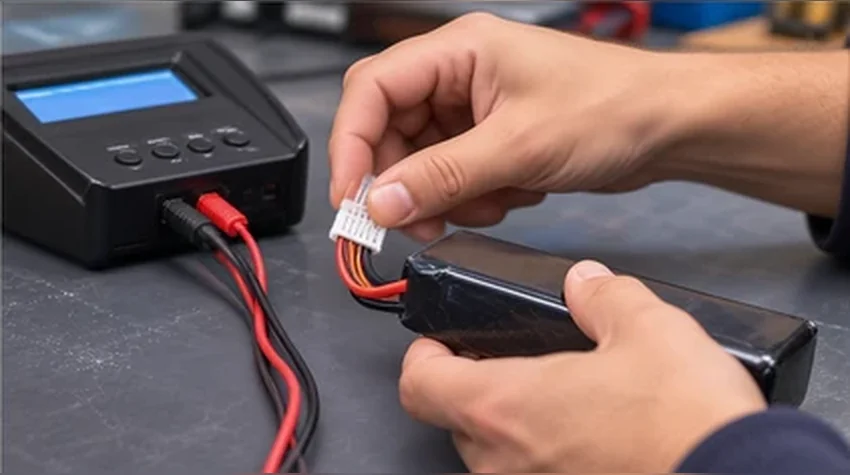
When charging, use a balance charger that supports the battery’s cell count and LiPo charging mode. A conventional LiPo cell typically has a fully charged voltage of 4.2V, although the exact specification should follow the cell manufacturer’s documentation. Charging current should also follow the manufacturer’s recommendations, as 1C is not a universal charging limit for every battery.
During operation, configure the ESC’s low-voltage cutoff correctly to prevent excessive battery discharge. After driving, allow the battery to cool to an acceptable temperature before recharging.
For long-term storage, conventional LiPo batteries are commonly maintained at approximately 3.7–3.85V per cell. Always refer to the product documentation for the recommended storage voltage.
According to Battery University’s Guide to Battery Storage and Maintenance, maintaining a moderate state of charge during extended storage can help reduce aging in certain lithium-ion batteries.
Additionally, the U.S. Occupational Safety and Health Administration (OSHA) explains in its Safety Guidance on Preventing Fire and Explosion Hazards in Small Lithium Battery-Powered Devices that mechanical damage, extreme temperatures, and improper charging can increase the risk of lithium battery failures.
Therefore, batteries should be monitored during charging and kept away from flammable materials. If a battery shows noticeable swelling, physical damage, unusual odors, or abnormal heating, stop using it immediately and follow local battery recycling and disposal requirements.
Frequently Asked Questions About RC Car LiPo Batteries
What Is the Difference Between Hard Case and Soft Pack LiPo Batteries?
Hard case LiPo batteries typically feature an external plastic enclosure that provides additional protection against everyday impacts. Soft pack batteries offer greater flexibility in physical design but require appropriate mechanical protection. The right choice depends on the vehicle’s mounting system and operating environment.
Can You Use the Same Charger for LiPo and NiMH Batteries?
You can use the same charger only if it supports both LiPo and NiMH charging modes and meets the required voltage, connector, and balance charging specifications. These battery chemistries use different charging control methods, so their charging modes must not be interchanged.
How Can You Tell if an RC Car LiPo Battery Is Aging?
Common signs include reduced usable capacity, shorter runtime, increased internal resistance, and noticeable voltage drops under load. Capacity testing, internal resistance measurements, and cell voltage consistency checks can help evaluate battery condition.
What Charge Level Should You Maintain When Storing a LiPo Battery?
Use your charger’s storage mode to bring the battery to the voltage recommended by its manufacturer. Avoid storing the battery fully charged or deeply discharged for extended periods, and periodically check its voltage and physical condition.
Can You Replace an RC Car LiPo Battery With One From Another Brand?
A compatible replacement from another brand may be used, provided its voltage, discharge capability, physical dimensions, connectors, and charging requirements match the vehicle’s specifications. However, identical advertised specifications do not necessarily mean two batteries will deliver identical real-world performance.
HiMAXBATT: Professional RC Car LiPo Battery Manufacturing and Custom Battery Solutions
HiMAXBATT is a battery manufacturer specializing in rechargeable battery research, development, manufacturing, and customized battery solutions. The company is committed to providing reliable battery products and technical support to B2B customers worldwide. Its product portfolio includes lithium-ion and lithium iron phosphate (LiFePO4) batteries for RC models, industrial equipment, communication devices, and other professional applications. For RC cars and other remote-controlled models, HiMAXBATT can provide customized battery solutions based on specific application requirements, including voltage, capacity, discharge rate, battery dimensions, connectors, and battery pack configurations.